Death marks a sharply drawn line between just another day and That Day. For those bereaved, death becomes the demarcation between many a before and after. Whether it lands like a sudden slap on the face or slowly drips into your days, leaving you in a quagmire of uncertainty – death and complex emotions are inseparable in the living. It is, therefore, difficult to imagine people gathering in large numbers to be part of a “Death Literacy Festival” called Good.To.Go.
Death marks a sharply drawn line between just another day and That Day. For those bereaved, death becomes the demarcation between many a before and after. Whether it lands like a sudden slap on the face or slowly drips into your days, leaving you in a quagmire of uncertainty – death and complex emotions are inseparable in the living. It is, therefore, difficult to imagine people gathering in large numbers to be part of a “Death Literacy Festival” called Good.To.Go.
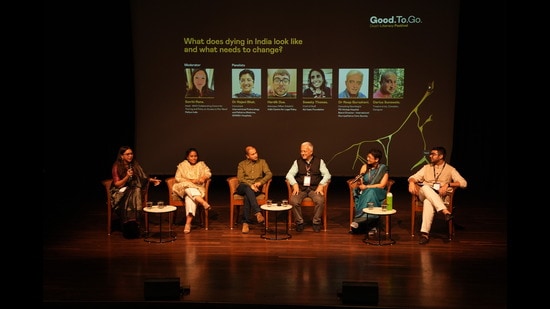
Organized by Pallium India and Vidhi Centre for Legal Policy, ‘Good.To.Go. Death Literacy Festival’ was a festival no less – complete with music, poetry, grief circles, panel discussions, workshops and installations. The festival encouraged people to express their feelings, thoughts and questions around death besides informing them of the myriad ways in which they can make death a little less difficult for their loved ones and themselves, especially in the context of advanced end-of-life care options available in today’s world. How can one prepare to die with dignity and live in full acceptance of death as the final outcome of life – the festival seemed to ask.
A first in India, the Death Literacy Festival was held at the Bangalore International Centre (BIC) over the weekend of August 23 and 24. Among its many programmes were workshops addressing organ donation, how to speak to children about death and loss, how to deal with the loss of a pet, how to write a Living Will or Advanced Medical Directive (AMD) and how to safeguard against misuse of one’s social media accounts after death with the session on “digital hygiene” being a real eye-opener. Participants left messages for deceased loved ones on specially designed installations like the Memory Tree and Letter Box and picked up messages of hope from jars. There were music playlists that attendees could access or add to, films to watch and opportunities to record memories for posterity in the form of oral histories.
An installation called the Wind Telephone saw a long line people waiting outside a subtly lit phone booth to speak on an unconnected phone to a loved one they had lost. Created in Japan by a garden designer, Itaru Sasaki, after he lost a cousin in 2010, the Wind Telephone was opened to grieving neighbours and friends after a tsunami hit their coast the following year. It now has counterparts across the world. The one installed at BIC during the festival drew people of all ages. The Grief Circle facilitated by Mumbai-based clinical psychologist, Sonali Gupta, saw a room full of strangers share long held feelings over the loss of a loved one. “Grief is a proof that we have loved so much,” Sonali reminded participants during the emotionally-charged session.
When Valli Narasimha’s husband was declared brain-dead, she and her daughter faced very difficult decisions at an emotionally fraught time. They chose to register with Jeevasarthakathe, a government organisation that facilitates organ donation for patients awaiting transplants. The transplant teams recovered three healthy organs that were either transplanted into patients or used for medical research. This is helping them cope in some measure with the absence of their loved one, Valli said.
Festival curator Madhushree Kamak says the festival’s core intent was to “normalize conversations about death and dying in India”. The Advanced Care Planning Collective aimed to help the public understand their rights, options and choices around end-of-life care. “Since this is the first ever public festival on this theme in India, we approached curation like building a bridge: start with accessible entry points (art, stories and performances) that lead into deeper discussions about advanced care planning and living wills. The process involved working extensively with experts in palliative care, law and grief therapy to ensure we created a space not just for knowledge sharing but also for care and community,” she said.
Faced with the challenge of opening conversations on such a difficult subject, they chose to highlight their belief that “…grief, and our encounters with death don’t diminish us — they become sources of wisdom, connection, and unexpected beauty.” Madhushree believes the response shows that “people are hungry for these conversations once the barriers are removed; as a society, we want spaces to process grief and loss.”
“Loss – whether through death, loss of health, financial toxicity in healthcare or any of the unique ways people experience it – is a universal human experience. Yet, these conversations are stigmatized or considered inauspicious, leaving the vast majority disenfranchised and alone at a time of intense vulnerability. The festival envisioned bridging this crucial gap,” says festival director Smriti Rana. Wanting to use messaging that conveyed the “gravitas of the subject while simultaneously being inviting” the organizers chose a name that “drew a smile or chuckle” on mention. “If you can smile at something, you can engage with it,” she says, expressing gratitude to the festival funders – Microland Foundation and the Ajit Isaac Foundation.
“I remember watching a stream of people who must have been in their twenties or even younger waiting to use the Wind Telephone and thinking that had something like this been available to me when I lost my parents, I would have certainly used it,” says Smriti, adding that they hope to travel with the festival to other cities, besides offering elements of it in smaller communities, possibly in collaboration with citizen-led initiatives.
Speaking from a medical perspective, pulmonologist and palliative medicine consultant, Rajani Surender Bhat, says she has seen “the advances of modern medicine saving many lives,” but also “seen suffering that could have been prevented through informed decisions by patients and caregivers, in honest conversations with their doctors, to avoid interventions that would not improve quality of life in a person with advanced age or multiple medical problems.” A palliative care doctor, she says, “can offer support to patients and families, not just in health and sickness, but also till the very end of life, by alleviating the unaddressed physical, psycho-social and spiritual pain of the dying process.”
Bhat adds: “An adult child asking their elderly parents about their preferences is not wishing for them to die, but only trying to ensure that their values are honoured. An elderly person broaching this conversation doesn’t have a death wish – they want to unburden their family of future decisions that could be confusing and painful.” She laments that “in a land known for its spiritual knowledge, our communities are increasingly death-denying.” She points out that “Most hospitals in India don’t have psychologists, social workers, counsellors and therefore, the responsibility of emotional support” falls upon doctors who have been trained mostly for clinical management.
The artistes who performed at the Death Literacy Festival offered soothing, even humorous, perspectives on life, death and everything between. As a soothing entry into the event, singer and musician Bindhumalini presented poetry-based songs in diverse languages. Theatre practitioners Aanand Chabukswar, Rupali Bhave and Ashwini Giri spun a whole universe of poems at the end of the festival. “So much contemplation about death made us lighter and more agile in our own lives,” says Aanand, who directed the performance. Reading poets from over the world, Aanand says they sought “not to make the piece about death too heavy or over-emotional, yet, not to give-in to levity or sound disrespectful. Anything said about death needs silence. Only poetry has silence embedded within it.”
Charumathi Supraja is a writer, poet and journalist based in Bengaluru.
One Subscription.
Get 360° coverage—from daily headlines
to 100 year archives.
Archives
HT App & Website