...
...
Next Story

Report: Madras Art Weekend

The event held in Chennai from 12 to 15 December signalled that the grand city has much to offer when it comes to contemporary art

Updated on: Jan 03, 2025 07:49 PM IST
Advertisement

At the third edition of the Madras Art Weekend held at the city’s Park Hyatt from 12 to 15 December, the question that was frequently raised was: How come Chennai, which has such a vibrant tradition of engaging with various art forms, is not at the forefront when it comes to contemporary art? I hoped to learn the answer during my brief arty sojourn in the city.
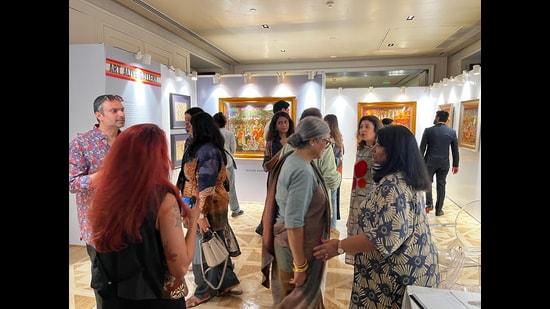
PREMIUMArt aficionados at Jayasri Burman’s exhibition walk-through during the Madras Art Weekend  (Saurabh Sharma)
Art aficionados at Jayasri Burman’s exhibition walk-through during the Madras Art Weekend  (Saurabh Sharma)

A degree of determinism is valuable in life. With this thought, I concentrated

Prakriti by Jayasri Burman (Photo courtesy Art Alive Gallery)

“The ambience helps me create art,” she said. “Everything inspires me.” During the pandemic, when the inevitable dance of death played out, she found solace in looking at clouds, birds, trees, and the moon. Prakriti (24 x 24 inches | Pen, ink, and watercolour on paper pasted) was born from these observations. Each word was thoughtfully uttered, leading to an immersive experience, which was complimented by the compelling strokes in her paintings, reminding me of the Hegelian idea that artistic beauty can be placed higher than natural beauty. She described the yellow hue that’s one of the characteristic features of her collection. But how can one miss those eyes (of the Prakriti), do they have Madhubani influence, I meekly inquired. “Bengali. These eyes are Bengali,” she replied. “I don’t sign a painting if I don’t get them right,” she said as we posed for a selfie against her Swaratmika (48 x 48 inches | Pen, ink, and watercolour on paper pasted).

Next, I was arrested by known and unknown strangers foregrounded on a canvas over an indistinguishable chessboard. The Muse of the Myth (72 x 48 inches | Acrylic on canvas) from Jayesh Sachdev’s collection entitled Oorja: A Tapestry of Ever-Evolving Energy at the Tao Art Gallery booth was truly exuberant.

I then wandered into a dungeon of a space where red sheets hung from the ceiling.

Fenced Flight by Sujata Setia (Courtesy the artist’s website)

A Thousand Cuts by UK-based artist Sujata Setia was like nothing I have seen before. It reminded me of the Canadian poet and novelist Dionne Brand, who in her book, A Map to the Door of No Return: Notes to Belonging, wrote: “One enters a room and history follows; one enters a room and history precedes. History is already seated in the chair in the empty room when one arrives.” Setia’s exhibition was one such “room”, a space in which each piece both revealed and concealed the story — its history — in equal measure. The viewer was invited into the stories of the survivors featured in the work, but it was a cautiously, meticulously designated space that had to be navigated. In proffering this incompleteness, Setia seemed to know that onlookers would fill in the stories by associating them with their own. The artist noted that while “survivors didn’t want their identities to be revealed because there’s not only external silencing but also internal, cultural, and genetical predisposed silencing,” they “wanted to be seen”, creating the ‘seen and unseen’ binary in this space. Its design was also suggestive of the revisitation of horror that a survivor must endure to tell their story. The cyclic nature of the work was overwhelming. Fittingly, Setia was aware that the “intellectual subjugation of women cannot be wiped out with one art piece”. As a result, this labour of love and pain aimed at being “conversational, not confrontational”.

The next leg in my journey included a home tour of a self-taught, Chennai-based artist and journalist Narayan Lakshman. He, along with his wife Nandini Ramamurthy, took a select few art connoisseurs and a single reporter (yours truly) through each artwork the couple has collected over the years, amusing everyone with hilarious backstories associated with each acquisition.

An engaging panel discussion titled At the Forefront of Design at the Folly, Amethyst, a multipurpose venue, followed. It featured Gowri Adappa, Farah Agarwal, Sridhar Poddar, Astha Khetan, and Shaun D’Sa, and was moderated by Samir Wadekar. From aspects of forms and functions of design to the mismanaged expectations between clients’ budget concerns, designers’ visions, and artistic fulfilment, the panel covered a lot. Money was central to the discussion besides telling stories through objects, transforming space, and the recent shift of being introduced to a variety of designs on platforms like Instagram.

The programme on the 14th of December began with the screening of three shorts — Sandeep Narayan: Tryst with Ragas, Meenakshi Srinivasan: Stage and Studio, and Benitha Perciyal: Artful Echoes — from Season 1 of Stonex’s Mastery: Journey of Excellence (Disney x Hotstar). India’s largest imported marble seller, Stonex decided to celebrate the unique ways artists engage with a variety of art forms with Mastery, featuring 11 creators. The screenings were followed by a panel discussion that touched on art, artists, and a city’s influence on their work. Perciyal spoke about what goes into producing a work and the “suspense” that this process involves. Narayan and his group gave a charismatic musical performance after the discussion.

The ground floor of the Park Hyatt was given over to another exhibition titled Threaded Visions: Contemporary Embroidery for a Sustainable Future curated by Arshiya Lokhandwala featured artworks of by Ranbir Kaleka, Gulam M. Sheikh, Nilima Sheikh, KK Hebbar, Ram Kumar, and SH Raza.

A book on the painter and artist, Jagdish Swaminathan, who helped established Bharat Bhawan in Bhopal in 1982, was launched at the event.

“Culture,” French philosopher and literary critic, René Girard noted in an essay titled Myth and Ritual in Shakespeare: A Midsummer Night’s Dream from All Desire Is a Desire for Being, “is conceived not as a mere collection of unrelated objects, but as a totality, or, if we prefer, a structure, a system of people and institutions always related to one another in such a way that a single differentiating principle is at work.” This very much seemed to be the connecting thread of the panel discussion titled A Conversation on Conservation, which was preceded by the launch of a book titled The Era of Jagdish Swaminathan (Dhoomimal Gallery), edited by Prayag Shukla and Shruti Lakhanpal Tandon, on the painter and artist, who helped established Bharat Bhawan in Bhopal in 1982. Moderated by Umah Jacob, the discussion featured Mayank Bhutra, Mrinalika Bhanj Deo, Jayesh Sachdev, Lakshmi Madhavan, and Amar Ramesh. Bhanj Deo focused on how her family opened up the doors of the heritage residence of the Bhanja dynasty of the princely state of Mayurbhanj (in Odisha) for experiential tourism, “adding value through storytelling”, for the general public. She was shocked to learn that her home state doesn’t have a heritage policy. Madhavan talked about artists’ “saviour complex” when it comes to collaborating with artisans. Sachdev made interesting remarks on how his art was influenced by mythological stories and how watching Game of Thrones made him wonder that “this was fantasy and cool, and every character here [in those stories from the epics] was a Bhagwan.” It inspired him to contextualise myths for the present generation, and to help “democratise art and reach out to a larger audience”. This lateral thinking led to a collaboration with Zara. Incidentally, he is the first Indian artist to achieve this feat.

Ramesh and Bhutra were of the view that the world was looking at India as “everyone is tired of the West”. While the former lamented the lack of documentation in the sphere of art, the latter shared how distinctive stories of a place and a time can be told by making even minute changes in fabric. One could read the atmosphere in the room: We should take pride in what we make. It seemed like the artists had forgotten — or had failed to acknowledge during the discussion — that the politics of pride is hinged on thinking about shame. Whether one’s response and drive towards making an artwork comes from a sense of pride or shame, they are the same.

All in all, I thought Madras Art Weekend provided much food for thought while also signalling that the grand city of Chennai does indeed have much to offer when it comes to contemporary art.

Saurabh Sharma is a Delhi-based writer and freelance journalist. They can be found on Instagram/X: @writerly_life.

At the third edition of the Madras Art Weekend held at the city’s Park Hyatt from 12 to 15 December, the question that was frequently raised was: How come Chennai, which has such a vibrant tradition of engaging with various art forms, is not at the forefront when it comes to contemporary art? I hoped to learn the answer during my brief arty sojourn in the city.

PREMIUMArt aficionados at Jayasri Burman’s exhibition walk-through during the Madras Art Weekend  (Saurabh Sharma)
Art aficionados at Jayasri Burman’s exhibition walk-through during the Madras Art Weekend  (Saurabh Sharma)

A degree of determinism is valuable in life. With this thought, I concentrated on the structured program at my disposal and joined the group of people that Jayasri Burman was guiding, taking them through her work displayed at the Art Alive Gallery booth. The feminine energy that her paintings exuded made me focus on her words as she described each painting with passion.

Prakriti by Jayasri Burman (Photo courtesy Art Alive Gallery)

“The ambience helps me create art,” she said. “Everything inspires me.” During the pandemic, when the inevitable dance of death played out, she found solace in looking at clouds, birds, trees, and the moon. Prakriti (24 x 24 inches | Pen, ink, and watercolour on paper pasted) was born from these observations. Each word was thoughtfully uttered, leading to an immersive experience, which was complimented by the compelling strokes in her paintings, reminding me of the Hegelian idea that artistic beauty can be placed higher than natural beauty. She described the yellow hue that’s one of the characteristic features of her collection. But how can one miss those eyes (of the Prakriti), do they have Madhubani influence, I meekly inquired. “Bengali. These eyes are Bengali,” she replied. “I don’t sign a painting if I don’t get them right,” she said as we posed for a selfie against her Swaratmika (48 x 48 inches | Pen, ink, and watercolour on paper pasted).

Next, I was arrested by known and unknown strangers foregrounded on a canvas over an indistinguishable chessboard. The Muse of the Myth (72 x 48 inches | Acrylic on canvas) from Jayesh Sachdev’s collection entitled Oorja: A Tapestry of Ever-Evolving Energy at the Tao Art Gallery booth was truly exuberant.

I then wandered into a dungeon of a space where red sheets hung from the ceiling.

Fenced Flight by Sujata Setia (Courtesy the artist’s website)

A Thousand Cuts by UK-based artist Sujata Setia was like nothing I have seen before. It reminded me of the Canadian poet and novelist Dionne Brand, who in her book, A Map to the Door of No Return: Notes to Belonging, wrote: “One enters a room and history follows; one enters a room and history precedes. History is already seated in the chair in the empty room when one arrives.” Setia’s exhibition was one such “room”, a space in which each piece both revealed and concealed the story — its history — in equal measure. The viewer was invited into the stories of the survivors featured in the work, but it was a cautiously, meticulously designated space that had to be navigated. In proffering this incompleteness, Setia seemed to know that onlookers would fill in the stories by associating them with their own. The artist noted that while “survivors didn’t want their identities to be revealed because there’s not only external silencing but also internal, cultural, and genetical predisposed silencing,” they “wanted to be seen”, creating the ‘seen and unseen’ binary in this space. Its design was also suggestive of the revisitation of horror that a survivor must endure to tell their story. The cyclic nature of the work was overwhelming. Fittingly, Setia was aware that the “intellectual subjugation of women cannot be wiped out with one art piece”. As a result, this labour of love and pain aimed at being “conversational, not confrontational”.

The next leg in my journey included a home tour of a self-taught, Chennai-based artist and journalist Narayan Lakshman. He, along with his wife Nandini Ramamurthy, took a select few art connoisseurs and a single reporter (yours truly) through each artwork the couple has collected over the years, amusing everyone with hilarious backstories associated with each acquisition.

An engaging panel discussion titled At the Forefront of Design at the Folly, Amethyst, a multipurpose venue, followed. It featured Gowri Adappa, Farah Agarwal, Sridhar Poddar, Astha Khetan, and Shaun D’Sa, and was moderated by Samir Wadekar. From aspects of forms and functions of design to the mismanaged expectations between clients’ budget concerns, designers’ visions, and artistic fulfilment, the panel covered a lot. Money was central to the discussion besides telling stories through objects, transforming space, and the recent shift of being introduced to a variety of designs on platforms like Instagram.

The programme on the 14th of December began with the screening of three shorts — Sandeep Narayan: Tryst with Ragas, Meenakshi Srinivasan: Stage and Studio, and Benitha Perciyal: Artful Echoes — from Season 1 of Stonex’s Mastery: Journey of Excellence (Disney x Hotstar). India’s largest imported marble seller, Stonex decided to celebrate the unique ways artists engage with a variety of art forms with Mastery, featuring 11 creators. The screenings were followed by a panel discussion that touched on art, artists, and a city’s influence on their work. Perciyal spoke about what goes into producing a work and the “suspense” that this process involves. Narayan and his group gave a charismatic musical performance after the discussion.

The ground floor of the Park Hyatt was given over to another exhibition titled Threaded Visions: Contemporary Embroidery for a Sustainable Future curated by Arshiya Lokhandwala featured artworks of by Ranbir Kaleka, Gulam M. Sheikh, Nilima Sheikh, KK Hebbar, Ram Kumar, and SH Raza.

A book on the painter and artist, Jagdish Swaminathan, who helped established Bharat Bhawan in Bhopal in 1982, was launched at the event.

“Culture,” French philosopher and literary critic, René Girard noted in an essay titled Myth and Ritual in Shakespeare: A Midsummer Night’s Dream from All Desire Is a Desire for Being, “is conceived not as a mere collection of unrelated objects, but as a totality, or, if we prefer, a structure, a system of people and institutions always related to one another in such a way that a single differentiating principle is at work.” This very much seemed to be the connecting thread of the panel discussion titled A Conversation on Conservation, which was preceded by the launch of a book titled The Era of Jagdish Swaminathan (Dhoomimal Gallery), edited by Prayag Shukla and Shruti Lakhanpal Tandon, on the painter and artist, who helped established Bharat Bhawan in Bhopal in 1982. Moderated by Umah Jacob, the discussion featured Mayank Bhutra, Mrinalika Bhanj Deo, Jayesh Sachdev, Lakshmi Madhavan, and Amar Ramesh. Bhanj Deo focused on how her family opened up the doors of the heritage residence of the Bhanja dynasty of the princely state of Mayurbhanj (in Odisha) for experiential tourism, “adding value through storytelling”, for the general public. She was shocked to learn that her home state doesn’t have a heritage policy. Madhavan talked about artists’ “saviour complex” when it comes to collaborating with artisans. Sachdev made interesting remarks on how his art was influenced by mythological stories and how watching Game of Thrones made him wonder that “this was fantasy and cool, and every character here [in those stories from the epics] was a Bhagwan.” It inspired him to contextualise myths for the present generation, and to help “democratise art and reach out to a larger audience”. This lateral thinking led to a collaboration with Zara. Incidentally, he is the first Indian artist to achieve this feat.

Ramesh and Bhutra were of the view that the world was looking at India as “everyone is tired of the West”. While the former lamented the lack of documentation in the sphere of art, the latter shared how distinctive stories of a place and a time can be told by making even minute changes in fabric. One could read the atmosphere in the room: We should take pride in what we make. It seemed like the artists had forgotten — or had failed to acknowledge during the discussion — that the politics of pride is hinged on thinking about shame. Whether one’s response and drive towards making an artwork comes from a sense of pride or shame, they are the same.

All in all, I thought Madras Art Weekend provided much food for thought while also signalling that the grand city of Chennai does indeed have much to offer when it comes to contemporary art.

Saurabh Sharma is a Delhi-based writer and freelance journalist. They can be found on Instagram/X: @writerly_life.

All Access.
One Subscription.

Get 360° coverage—from daily headlines
to 100 year archives.

E-Paper
Full
Archives
Full Access to
HT App & Website
Games
 
SHARE THIS ARTICLE ON
Hindustantimes wants to start sending you push notifications. Click allow to subscribe