
 E-Paper



Report: Prithvi Festival
From Kabir bhajans and plays about ageing to renditions of Begum Akhtar classics and adaptations of classic Greek plays, the festival was as stimulating as ever

 Prefer HTon Google


The annual Prithvi Festival, a fortnight-long celebration of theatre, music, dance and storytelling, was hosted by Kunal and Zahan Kapoor at Mumbai’s Prithvi Theatre from November 1 to 17, 2025. It opened on an auspicious note with folk singer Prahlad Tipanya belting out Kabir bhajans that are popular in the Malwa region of Madhya Pradesh. He could not contain his excitement about performing at the cultural hub that was built by his favourite movie star, Shashi Kapoor.
Apart from introducing the audience to gems from his musical repertoire, he also held forth on the need to speak out against religious and caste discrimination, following the legacy of Kabir who was not just a poet but also a revolutionary. With the city’s glitterati in attendance at the cultural hub in Juhu, the song Mat Kar Maya Ko Ahankar seemed like an inspired choice for the occasion. It reminded listeners that life is fleeting, and this body will soon turn to dust, so it would be a good idea to stop being obsessed with one’s status, and cultivate a rich inner life.

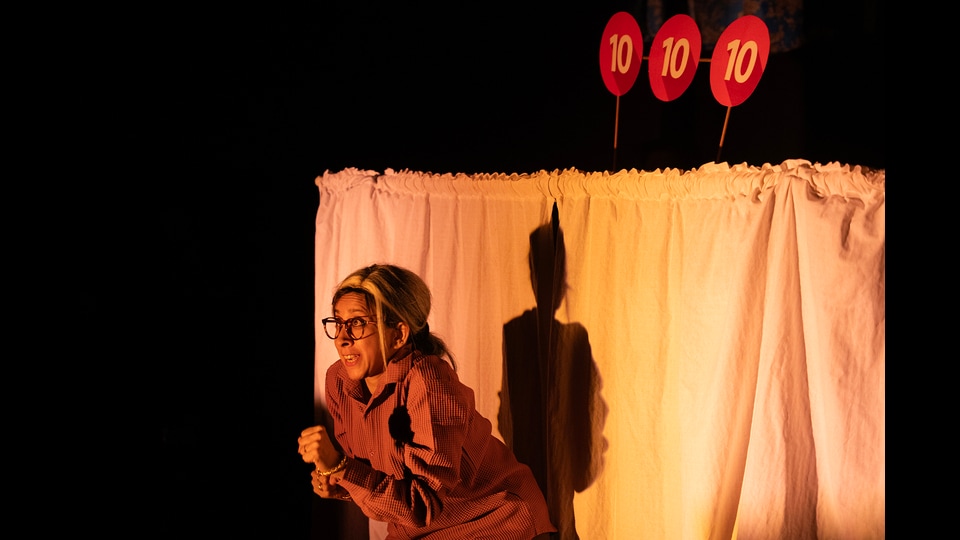
Among the plays, A Fish Ate My Cat written and directed by Yuki Ellias stood out for its gentle and light-hearted treatment of themes like aging, grief, memory loss, and the challenges of being a caregiver. Ellias said, “Masti is my starting point as a writer. I just wanted to explore the story of this woman called Sarita who is able to have fun without leaving her house. I thought of my grandma and grandpa when I was writing, and that made it really personal and special.”
Ellias, who also played Sarita, has a knack for weaving political convictions into her art without making her characters sound like spokespersons for a cause. Sarita, for instance, opts for an interfaith marriage, risking the disapproval of her parents. This plot point does not become an opportunity to insert a monologue about religious extremism and the need to combat it. Sarita loves listening to music, dressing up, and taking dance classes. Her joie de vivre is expressed through what she does, how she speaks and the way she carries herself. She is not infantilized.

Queen, written by Aditya Rawal and directed by Daniel D’souza, was memorable for its depiction of a woman who was once her husband’s favourite but is now forced to play second fiddle because a younger and supposedly more attractive woman has usurped her place. Puja Sarup brought skill and gravitas to the role of Queen Durga, a wounded tigress in a land called Banasvan, ready to destroy anything that comes in the way of reclaiming her lost power.
There is an interesting back story here. Rawal wrote the play in 2016 while studying at New York University. It won the New York Innovative Theatre Award for Best Original Script. When filmmaker Ashutosh Gowariker read it, Rawal was hired to co-write the film Panipat.
Historical fiction as a genre excites him because “it allows one to talk about the present while also presenting to the audience a distinct, colourful world of another time and place… a world that is forever beyond our reach because it is in the past.” Though Queen is set in a fictional kingdom, the time period is 1567, so Rawal read books, visited museums and looked at art to get the period, set and costumes right. “I like to learn from anything I can get my hands on. Once I sit down to write, the focus shifts to making the story and characters engaging for the audience.”
Anatomy of A Suicide, written by Alice Birch, and directed by Mohit Takalkar, looked at intergenerational trauma as an inheritance that passes from one woman to another across three generations with the same play. Posters carried a trigger warning to inform the audience that it “contains depictions of mental health struggles and suicide”. It was a thoughtful gesture because the play was dark, intense, starkly honest, and intimate in a way that can be scary.
Takalkar said, “A trigger warning isn’t about cautioning people away, it is about inviting them in responsibly… Birch doesn’t sensationalise pain, she anatomises it. That level of emotional exposure can be deeply affecting, especially for people who have walked close to the same edges.” The director has spoken openly about his own experience of living with bipolar disorder, so his treatment of mental health as a subject was deeply sensitive, layered, and not gimmicky.
The team working on the play had access to on-call psychologists for any care that they needed. The actors, director and the production crew also checked on each other regularly as being involved in telling a story like this can have a heavy emotional toll that needs to be addressed.
Neeli Deewaron Ke Beech, written and directed by Sumit Chandel, seemed more like a work in progress than a finished piece because it was trying to do too much with romance, social commentary and the supernatural all thrown in but it made an impression because it held up a mirror to the exploitation that struggling theatre actors from small towns face in Mumbai.
Chandel said, “In any theatre group, you are first relegated to backstage and there’s no guarantee you’ll get a role. When you look back, you have lost four-five years. It is frustrating.” He poured his own experiences into the script. At one point, he was absolutely fed up of doing backstage work because it was neither helping him grow as an actor nor earning him money. He recalled, “I decided not to work on plays. I even stopped watching for two whole years. But that left a void inside me. And ironically, a play came out of it. I could not stay away from the theatre.”

Atul Kumar’s Ambaa, an adaptation of Lysistrata, a play by Aristophanes, did not live up to the hype. The anti-war message that the original conveyed with wit and flair seemed too literal and unimaginative in the Indian version. The decision to switch the setting from Greece to Bundelkhand worked smoothly but the bawdy humour had some audience members walking out. That said, the competent acting and gorgeous costumes did get the appreciation they deserved.
Cultural commentator and podcaster Pragya Tiwari’s Stage Talk series was a hit, with theatre stalwarts like Arundhati Nag, Jyoti Dogra and Abhishek Majumdar talking about the ups and downs of their careers; reminiscing, lamenting and making peace with change. Tiwari’s moderation was a masterclass in listening and restraint; a welcome change from moderators who hog the microphone and forget who the real star is.
Sitar maestro Shujaat Husain Khan’s rendition of Hamari Atariya Pe Aajaao Sawariya, originally sung by Begum Akhtar, was the highlight of an early morning concert that had half-asleep listeners spring to life. Enveloped by the soothing notes of his music, every moment felt imbued with beauty and meaning. One felt grateful to be able to soak it all in, thinking of Fayyaz Hashmi’s lines “Waqt ki qaid mein zindagi hai magar, chand ghadiyan yehi hain jo aazaad hain”. The Prithvi Festival reminds one, year after year, of art’s power to set us free.
Chintan Girish Modi is a writer, journalist, educator, artist, and literary critic. His prose and poetry has appeared in various anthologies. He is currently developing a participatory performance piece about the vulnerabilities and deceptions involved in modern dating.


