The second edition of the Madras Art Weekend (MAW), held from November 29 to December 3, put the spotlight on the works of nearly 150 emerging and established artists, including two from abroad. Undeterred by the threat of Cyclone Michaung, which caused heavy flooding, claimed over a dozen lives, and brought the city to a standstill — art enthusiasts came together to celebrate the festival, which brings the entire art ecosystem (artists, galleries, collectors, et al) on a single platform.
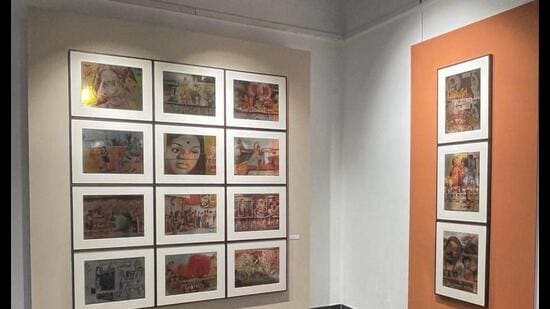
The second edition of the Madras Art Weekend (MAW), held from November 29 to December 3, put the spotlight on the works of nearly 150 emerging and established artists, including two from abroad. Undeterred by the threat of Cyclone Michaung, which caused heavy flooding, claimed over a dozen lives, and brought the city to a standstill — art enthusiasts came together to celebrate the festival, which brings the entire art ecosystem (artists, galleries, collectors, et al) on a single platform. The impending super-cyclonic storm was the first thing the taxi driver warned me about as soon I settled into the car at the airport. But I didn’t let that stop me from hopping from one venue to another; there was so much to marvel at.
The festival began with The Moving Arc, an exhibition curated by Roobina Karode for the Kiran Nadar Museum of Art (KNMA), and an auto installation by UK artist Steve Messam at the Shiv Nadar School. “All artworks, big and small, carry their own relevance, stories and the pulse of their times,” said Kiran Nadar, founder and chairperson of KNMA, as she spoke about some of the art on display and enumerated the spectrum of intergenerational works in the KNMA collection. These include MF Husain’s Two Women with Elephants, Ram Kumar’s The City, Krishen Khanna’s Ramu Kaa Dhaba, Jeram Patel’s Hospital series, the works of KCS Paniker, NN Rimzon’s sculptural installation, Tools, Arpita Singh’s Amina Kidwai with her dead husband, K Ramanujam’s untitled ink works, CK Rajan’s small-sized collages, Anupam Sud’s etching, Rear Window, Rekha Rodwittiya’s Merry Rivalry of the Anarchist, and Dilip Chobisa’s Mute Dialogues.
Elaborating on the curatorial process behind selecting specific artworks from the collection, Roobina Karode, director and chief curator at KNMA, said that Modernism and its assertions in India, which began a few years before Independence and continued for a few decades, cannot be addressed through any singular expression. “But the important junctures of artistic movements, practices, emergence of groups and camaraderie, and intergenerational dialogues were touched upon through important works of artists from different generations. The selection focused more on cross-pollination of ideas and artistic vocabularies, creating a mapping of stylistic relations, inspirations, and uniqueness demonstrated across time and regions,” she said. The idea behind including artworks from Santiniketan, Baroda and Delhi was to showcase the exchange of artistic ideas and vocabularies through certain nodal points of intersection across the nation. During this era, there was a shift in the history of Indian modern art with the emergence of women artists.
“The mainstream narrative around modernism in India parallel to the West formulated around ideas of the avant-garde and artistic genius, mainly associated with male artists. With women artists like Arpita Singh, Madhvi Parekh, or Meera Mukherjee, or many more who were their contemporaries, their vantage point and personal experiences, their day-to-day observations on life, the unique perspective of looking at society not just as a woman but as a creative entity, all flowed into their art,” said Karode. For many of these women, making art was “interwoven with their friendships, the domestic space and the outside world, and often an intimate engagement with the unremarkable that they identified as subject, and made the mundane into the artistic.”
Interestingly, MAW founder Upasana Asrani, who lives in Chennai, spent about two decades in the fashion industry. She shifted gears in 2017 to venture into the art world. Her first solo art exhibit, supported by a prominent bureaucrat, was a sellout success. However, navigating the gallery scene became quite challenging thereafter. Undeterred, Asrani identified a gap in the local art scene and took the initiative to fill it. “I realised that there were no events and not much enthusiasm for the arts in the city,” she recollects. This realisation led to the inception of a series of small-scale events, including art walks and talks, which eventually evolved into the full-fledged festival last year.
Designed to inject life into Chennai’s artistic veins, the festival’s success is palpable. “This year, it’s just grown by leaps and bounds to become something much, much larger. We have already started getting emails for partnerships for the next edition,” noted Asrani, when we met at the launch of Textiles of Tamil Nadu by Lavina Baldota, Prabhu Viswanathan, and Vipin Das at Raw Mango’s opulent art deco store. The evening featured a Bharatanatyam recital by Leela Samson, who was accompanied by Amritha M, Kamalakiran V and K Anuprakash. Attendees, adorned in a blend of traditional and contemporary attire, revelled in the vibrant gaiety, complemented by diyas, fragrant gajras, and soulful melodies.
The exhibition aimed to broaden perspectives on Tamil Nadu’s textile heritage beyond the renowned Kanjeevaram. “People mostly talk about Kanjeevaram while there’s so much more to it than that. We have some 300-year-old pieces on display here, but most of the works are new, and that is what I want to bring to the public domain,” says Baldota. The textiles highlighted Tamil Nadu’s weaving history, from fine muslin to robust calico. Also featured were South Indian Jamdani textiles (Kodalikaruppur) and Salempore, a finely striped and checked cotton fabric.
The ubiquitous Kanjeevaram silk stood out for its contemporary designs. For the show, Baldota extensively researched textiles from the state including chintz from the Coramandel Coast, the Real Madras Handkerchief and Sungudi from Madurai. The last is produced using natural dyes in the tie and dye technique. “We also have panels of embroidery which are done in Tamil Nadu including the Toda and Lambani, which are done on fine muslin much like the Mashru or ikat,” says Baldota.
Kayomi Engineer, curator of MAW, said she approached her role with the intention of doing something for Chennai. “We are premiering a lot of new ideas. At the same time, it’s also about looking at how art translates into everyday life; about seeing how companies like Lexus are using their showrooms to integrate south Asian textile into the conversation around art. An international brand, it knows that it’s in a local market, and uses its resources to make this conversation more interesting for the end user.”
In another show, Spotlight on the South, 22 artists from the city exhibited their work. Besides, Ahmedabad-based Archer Art Gallery and Delhi’s Dhoomimal Art Gallery, 108 Art Projects and Palette Art Gallery also participated. An exhibition of paintings studded with Swarovski crystals by Olaf Van Cleef, titled Glimmer, was presented by Artworld and Amethyst. The show was curated by Anahita Banerjee, the granddaughter of Soli Daruwala, who founded the city’s oldest art gallery, Sarala’s Art Centre (now known as Artworld). A close friend of MF Husain, Daruwala, who nurtured many artists, is regarded as the founder of the contemporary art movement in south India. “We must not forget that the oldest art institution in India, The Government College of Fine Arts (initially known as the Madras School of Art), is in Chennai. It was established in 1850 by surgeon Alexander Hunter as a private art school. It functioned as a crucial centre for artistic innovation and expression,” said Banerjee. She added that despite its historical importance, there has been a tendency to overlook Chennai when considering art in India.
That will now be impossible as MAW puts Chennai back at the core of conversations around art in the country.
Shireen Quadri is the editor of The Punch Magazine Anthology of New Writing: Select Short Stories by Women Writers
One Subscription.
Get 360° coverage—from daily headlines
to 100 year archives.
Archives
HT App & Website