The second edition of Unmesha, a four-day international literature festival organised by the Sahitya Akademi was held in Bhopal, Madhya Pradesh, this year. The event, that began on 3 August 2023, hosted more than 575 authors from 14 different countries representing more than 100 languages. Plans are afoot to make what is currently Asia’s largest literary event, the world’s largest one too.
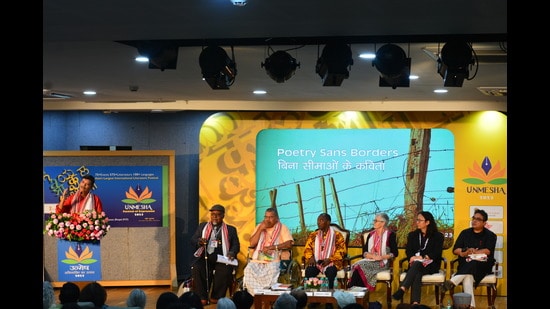
Inaugurated by President Droupadi Murmu, Gangubhai Patel, the governor of Madhya Pradesh and Shivraj Singh Chauhan, the chief minister of the state, the festival featured diverse panel discussions on different aspects of independent India and freedom, contemporary issues like the use of AI in literature, environment concerns, media and cinema, and multilingual poetry recitations too.
At the What Freedom Means to Us session chaired by Rajasthani poet Arjun Deo Charan, Hindi poet Mrityunjay Singh stated that one individual’s freedom shouldn’t become an obstacle for another. Dalit Marathi writer Sharan Kumar Limbale said certain words in his vocabulary were considered obscene by “civilized society” and hence, freedom for him meant reclaiming those words and used them in his work.
At the session entitled Role of Books in the Indian Independence Movement chaired by vice president of the Sahitya Akademi, Kumud Sharma, Hindi author Manoj Kumar Srivastava outlined the importance of religious texts in the freedom struggle and the change they brought about in the perception of freedom. Author and entrepreneur Nanditesh Nilay said that while literature might inspire leadership, the converse was also true as is the case in Mulk Raj Anand’s Untouchable where the protagonist eventually comes to believe in an idea of India where there would be no discrimination.
Among the positive initiatives at Umesha this year was the inclusion of LGBTQIA+ members on panels that went beyond queer issues. Transgender writer Kalki Subramaniam chaired a multilingual poetry reading where several poets recited in their mother tongues. While Partha Sarthi Majumdar recited his poem Vriksha, about a transwoman’s life and society’s treatment of her, in his native Bangla, Toshi Pandey shared a moving poem in Hindi about the plight of women in our society and the persecution they face. The LGBTQIA+ panel was chaired by poet Hoshang Merchant, who provided a background of the queer movement. Next, transgender writer and theatre artist A Revathi spoke about the need for social inclusion while Manabi Bandyopadhyay, the first transgender principal of an educational institution in India, said the community has never been a part of Vasudhaiva Kutumbakam and has instead been pushed into begging and sex work. Kannada writer Vasudhendra emphasized the need for queer-positive training of doctors, teachers and police professionals.
{{/usCountry}}Among the positive initiatives at Umesha this year was the inclusion of LGBTQIA+ members on panels that went beyond queer issues. Transgender writer Kalki Subramaniam chaired a multilingual poetry reading where several poets recited in their mother tongues. While Partha Sarthi Majumdar recited his poem Vriksha, about a transwoman’s life and society’s treatment of her, in his native Bangla, Toshi Pandey shared a moving poem in Hindi about the plight of women in our society and the persecution they face. The LGBTQIA+ panel was chaired by poet Hoshang Merchant, who provided a background of the queer movement. Next, transgender writer and theatre artist A Revathi spoke about the need for social inclusion while Manabi Bandyopadhyay, the first transgender principal of an educational institution in India, said the community has never been a part of Vasudhaiva Kutumbakam and has instead been pushed into begging and sex work. Kannada writer Vasudhendra emphasized the need for queer-positive training of doctors, teachers and police professionals.
{{/usCountry}}At the panel discussion on Global Literature for a Globalized World, Sri Lankan author Ashok Ferrey, who chaired the session, shared his concerns about globalization ultimately leading to the loss of localized narratives. Oscar Pujol from Spain and Maria Puri from Poland stressed on the importance of translations.
Translation quite unsurprisingly was hotly dicussed at other sessions too. Kannada writer Sahana Vijayakumar traced how the Upanishads were translated into German and read by several German philosophers and physicists while Tamil translator N Kalyan Raman called translation the foundation of civilization. He stated that lesser told stories of marginalized sections reach a wider audience through translation and hence help in the forging of solidarities. Hindi translator Vaibhav Sharma too spoke on how translation helps readers discover unheard stories from other linguistic communities.
The session on Rise of Machines discussed the threat to authentic literary works from language-based AI like ChatGPT. Author Preeti Shenoy pronounced that AI fails miserably when it comes to emotivity. To this Karthika VK of Westland Publications posed a question: “Do people actually care who has written a brilliant piece of literature?” Other panellists including the arts entrepreneur Sanjoy Roy and literary agent Kanishka Gupta said that while the technology might not yet be capable of grasping human emotions, in the future, writers might need to outsmart it in this area.
At other sessions, writers K Enoch, Kalyani Charal, Sheoraj Singh Bechain, Laxman Gaikwad and P Sivakami spoke about the work of the oppressed and about how literature has been a tool to highlight the often ignored realities of our society. This is especially true of the recurrence of caste atrocities even 75 years after independence and the plight of denotified tribes.
In her inaugural speech, President Droupadi Murmu had stressed the importance of literature as a vehicle to bring people together. The Unmesha Festival of Expressions 2023 definitely seems to have achieved that difficult task.
Chittajit Mitra (he/him) is a queer writer, translator and editor from Allahabad. He is co-founder of RAQS, an organization working on gender, sexuality and mental health