A companion novel to Gliff (2024) that also stands alone, Glyph is Ali Smith’s 2026-addition to her duology on modern-day horror. If Gliff stunned you with its structure, this scintillating observation of war, AI, story-telling and the precarity of existence. and technique, will move you with its narrative voice and emotions.
Glyph follows two sisters: Petra and Patch. While Petra Wild has a degree in archaeology and anthropology but works at an ENT centre, Patch has an adolescent daughter who has too many questions about the world. One evening, Petra spends time on the Internet trying to find the story of a young army man flattened to death during the First World War in France. A noise disturbs her all night long. When she opens her bedroom door, she discovers that an apparition of a blind horse from the war has come to haunt her. She dials her sister — who she has not met for years — to come to her rescue. As girls, Petra and Patch had spent days speaking to ghosts, invoking the flattened man, or recalling a man leading a blind horse away from death. When Patch hears of the horse, she arrives without a moment’s hesitation with her daughter Billie in tow.
There is a certain wildness to this novel; not considering the surnames of the characters, or considering it(?) It is in the way Smith writes, which is very different from her style in the earlier instalment. This one does not come alive in its disjointedness like the former did. Here, Smith provides another narrative that has a cohesive flow that tightens and makes for a thoroughly intense read. The playfulness with the structure remains. It is like the ghosts tie the two books together even though they have largely different stories. Smith’s words bounce off each other: ‘This child is very young, new in the world, only just kicking its legs, but at least it is, it’s kicking them like anything though it’s only weeks old and its leg and feet are nothing but skin on bone in a hospital bed in a hospital hall in ruins in a city also in ruins.’ Throughout, the reader nods in appreciation at the sharpness of the word play. The linguistic details work in Glyph like pentimento on a painting; they carry the ghostly imprints of Gliff, a story of the two sisters in a dystopian world marked by thick red lines and horses. In Glyph, Petra reads the book passed to her by Patch, who read it because her daughter suggested it. Petra thinks the book was a ‘bit too dark for me. A bit too clever-clever, a bit too on the nose politically, for a novel… And what’s with all that horse stuff?’
{{/usCountry}}There is a certain wildness to this novel; not considering the surnames of the characters, or considering it(?) It is in the way Smith writes, which is very different from her style in the earlier instalment. This one does not come alive in its disjointedness like the former did. Here, Smith provides another narrative that has a cohesive flow that tightens and makes for a thoroughly intense read. The playfulness with the structure remains. It is like the ghosts tie the two books together even though they have largely different stories. Smith’s words bounce off each other: ‘This child is very young, new in the world, only just kicking its legs, but at least it is, it’s kicking them like anything though it’s only weeks old and its leg and feet are nothing but skin on bone in a hospital bed in a hospital hall in ruins in a city also in ruins.’ Throughout, the reader nods in appreciation at the sharpness of the word play. The linguistic details work in Glyph like pentimento on a painting; they carry the ghostly imprints of Gliff, a story of the two sisters in a dystopian world marked by thick red lines and horses. In Glyph, Petra reads the book passed to her by Patch, who read it because her daughter suggested it. Petra thinks the book was a ‘bit too dark for me. A bit too clever-clever, a bit too on the nose politically, for a novel… And what’s with all that horse stuff?’
{{/usCountry}}The earlier novel and its plot keep reappearing throughout this one; sometimes, perhaps, a little too blatantly. At some points, Smith brings them together to make a statement about their inherent contradiction, which could have been done more subtly.
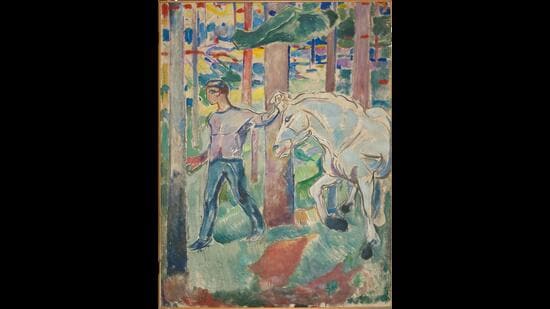
But the one image that tears through these pages is of Edvard Munch’s The Pathfinder (1912-13). When they were kids, an elderly lady at a party told Petra and Patch the story of a horse blinded by gas during World War 1. To save it from being killed, a young army man led the blind horse away by its forelock. The Munch painting that depicts this scene is rendered in a more subdued style than the artist’s earlier chaotic works like The Scream (1893). It captures the loneliness of existence in a world that has lost its way.
READ MORE: Review: Gliff by Ali Smith
Ali Smith explores contemporary loneliness in Petra and Patch’s story. Sociologists speak of the making of a ‘global village’ connecting distinct worlds. Smith offers a critique of the village imagery by showcasing the intensity of the feeling of isolation in just such a world. Petra and Patch have drifted apart as adults. Real life and concerns with finding their way as women after the passing of their parents have made them confront the fragility of what once held them together. They are moving with their heads bent low like the man in The Pathfinder but the apparition of the blind horse reminds them of the ghost that they have been holding on to.
Smith is not dispelling reality by mentioning otherworldly elements. Rather, she is making us focus on the real through a recounting of the lore, myths, and tales the Wild sisters told themselves. A world burdened by war — Smith makes startling mentions of the war in Gaza too — one that’s never ending, a world where Patch is dismissed from her job as an AI checker because the AI will itself check for AI-used documents, a world where plastics outlive its consumers. In such a world, it is these tales of ghosts that restore what’s innate to humanity. The two sisters have spent countless afternoons day-dreaming, lost in conversations with the dead, thinking of a horse, or a young man who had a rich boyfriend in the time when such things were illegal. Smith makes us wonder if humans need more immanence in a world that constantly offers technologies of transcendence. The question swirls in the mind of the reader as they make their way through the compelling prose.
Glyph can be read alongside Kiran Desai’s The Loneliness of Sonia and Sunny that captures the global nature of loneliness with the coming of the 21st century. While the latter book is an all-winding story of families and young ones, the former is about two girls forcing their way out of Munch’s painting. Petra and Patch’s journey is not that of the sisters in Gliff, who remained isolated, but of women who live with their turmoil, hearing the ‘Glyph Glyph Glyph Glyph…’ continue like a ghost.
Rahul Singh’s debut novel Unfolding has been published by Harper Collins India.