Anwar, a sheltered child, is puzzled when he sees separate vendors for “Hindu water” and “Muslim water” at the Delhi railway station. As he tries to figure out the difference between the two, he notices both filling water from the same tap.
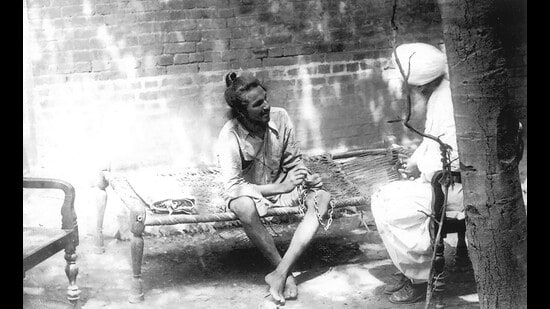
It is his first journey outside Delhi and his first time on a train. His destination is Amritsar and the year is 1919. His friend takes him to a public meeting at Jallianwala Bagh, where he gets caught in the thick of a historic event. The British opened fire on unarmed civilians for protesting against colonial laws, resulting in hundreds of deaths and many more injuries. Later, he visits Dr MA Ansari for a fever, where he sees other leaders of the Indian freedom struggle, including Gandhi and the Ali Brothers. Many of them become recurring characters in the book.
Thus, author Khwaja Ahmad Abbas’s novel, Inquilab, written in the 1940s and now reissued by Speaking Tiger, weaves Anwar’s coming-of-age story with milestones of the Indian independence movement.
Abbas is best known for writing celebrated Bollywood films like Awaara, Mera Naam Joker, and Bobby. But he also authored several books, thousands of journalistic pieces, and a weekly column that ran for 46 years, ending only with his death in 1987. It is, thus, not surprising that the imprint of early Hindi cinema’s narrative conventions are evident throughout Inquilab.
{{/usCountry}}Abbas is best known for writing celebrated Bollywood films like Awaara, Mera Naam Joker, and Bobby. But he also authored several books, thousands of journalistic pieces, and a weekly column that ran for 46 years, ending only with his death in 1987. It is, thus, not surprising that the imprint of early Hindi cinema’s narrative conventions are evident throughout Inquilab.
{{/usCountry}}The novel draws on coincidences to give shape to Anwar’s nationalist consciousness. He ends up in Jallianwala Bagh on a vacation; in a courtroom with Bhagat Singh, who is on trial; in a train with Jawaharlal Nehru, whom he idolises; and with Gandhi on several occasions. The antagonists, some of whom are Anwar’s family friends and relatives, embody beliefs that stand in the way of the nation-building to which he aspires. Not only do they have a servile attitude towards the British and contempt for freedom fighters, they also oppose amity between Hindus and Muslims.
While the plot does not rely on cataclysmic reversals or revelations for the most part, towards the end, Anwar discovers a secret his family and neighbours have kept from him all his life. The shared destiny of Hindus and Muslims in India becomes not just an ideal but a lived reality, making the political unexpectedly personal.
However, where popular Hindi cinema trades in simplistic resolutions and easy answers, Inquilab is comfortable with some ambiguity. Anwar is often unsure of what to do and the novel ends about a decade before India gains independence. The author also gives voice to the disappointment with nationalist leaders, especially from the more revolutionary groups, who are disenchanted with Gandhian non-violence. While Bollywood typically centres love stories, Anwar’s romantic relationship is a subplot rather than pivotal.
Hindi cinema, however, is just one of many influences — socialist realism also shaped the content and style of Abbas’s oeuvre. His debut directorial venture, Dharti Ke Lal (1946), was about the Bengal famine of 1943. He wrote the screenplay for Chetan Anand’s Neecha Nagar (1946), a film about a wealthy landlord who tries to displace a poor neighbourhood. It was the first Indian film to gain recognition at the Cannes Film Festival. This engagement with social and political issues is at the heart of Inquilab too.
As a child, Anwar is dismayed by how the staff of his uncle, a high-ranking government official, exploit the poorest people. On a joyride to see the Taj Mahal in Agra, he is aghast at the grinding poverty in a village en route. A pall descends over him when he discovers that this is the default state of the villagers rather than the result of an exceptional drought or epidemic.
While much of this might seem formulaic, the author departs from convention as frequently as he sticks to it. This infuses novelty into his storytelling. I haven’t come across many works in English that built a fictional cladding around the key events of the Indian independence movement or featured its leaders as characters. In this aspect, it reminded me of the Netflix show Hollywood, which depicts a romanticised version of the American film industry post-World War II and features people from the era as dramatis personae.
However, in an effort to tell the story of both a boy and a nascent nation, the novel overextends itself. It also indulges in cliches and has an overwhelmingly north Indian male perspective. In that aspect, Abbas, who was from Panipat — and his protagonist Anwar — do not transcend or deeply interrogate their own backgrounds. Everything at the margins of or outside their world is either exoticised (for example, sex workers), mocked (“jaw-breaking” names), or glossed over.
And yet, in many respects, the novel is as pertinent today as when it was written. Anwar’s story unfolded a century ago, but we are no closer to his dream of building amity across religions and an India without dire poverty and exploitation. Just as the colonial forces beat up Anwar and jailed his compatriots, many young Anwars today face violence and imprisonment for speaking up against injustices.
This, however, might not have fazed the author. Despite the many problems Abbas dwells upon, he champions a mode of writing at odds with the current zeitgeist — hope for a better future. Today, our imagination might gravitate more readily to visions of the world’s end than to utopian scenarios. But the novel harks back to an era when the vigour of the independence movement made possibilities seem boundless.
Decades after Abbas’s death, some of his works are still available in three languages: English, Hindi, and Urdu. Much of his prolific literary output, though, is out-of-print, like Inquilab was. I hope this edition of the novel opens the door to bringing more of his writings to a new generation of readers.
Syed Saad Ahmed is a Boston Congress of Public Health Thought Leadership Fellow 2024. He speaks five languages and has taught English in France.