
 E-Paper



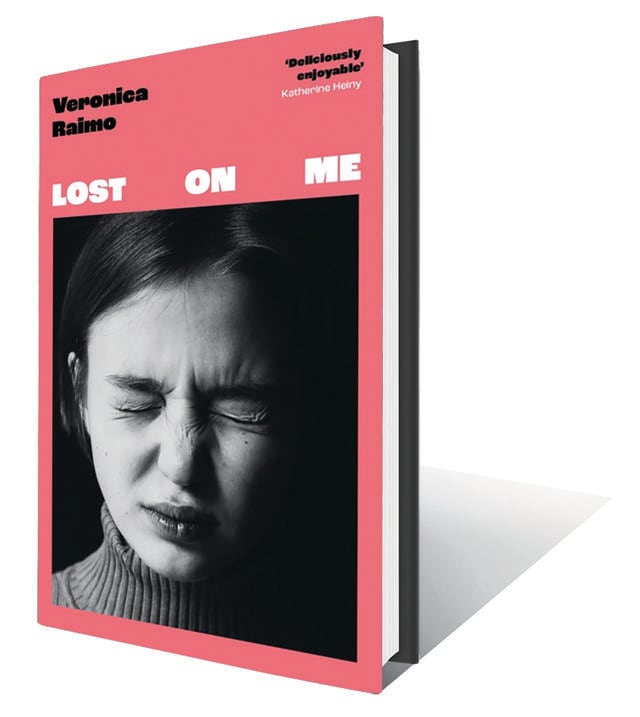
Review: Lost on Me by Veronica Raimo
An exploration of girlhood and womanhood, Lost on Me, which has been longlisted for the International Booker Prize 2024, stands out for its humour and solid punch lines

 Prefer HTon Google


The novel about the self-hating white woman writer continues to be popular. The presence of Veronica Raimo’s Lost on Me on the International Booker longlist for 2024 proves that. Originally written in Italian and translated by Leah Janeczko, this book stands out for its phenomenal humour and solid punch lines.

Veronica, called Verika by her mother, is a writer who recollects her life as a girl growing up in Rome in the 1980s and 1990s. She creates a labyrinth of her life and in flowing vignettes, guides her reader from one corner of it to another. Early on, she situates her readers in the novel’s time frame by alluding to how the 1986-Chernobyl nuclear disaster in Pripyat affected her family’s life. Concerns over the contamination of food have travelled to Rome and her neurotic father subjects the unit to a diet of canned food for three years. This was the beginning of all her present struggles as a writer and as a woman who is alone and cannot bear her family anymore. At eight, she learned that, “there was something my family feared even more than the tacit cloud from Chernobyl: hedonism.” Veronica cannot come to terms with this defining realisation on which the novel rests.
Veronica is as unreliable and as miserable too as Marguerite Duras’s protagonist from The Lover. The nameless 15-year old girl in colonial Vietnam from Duras’s 1984-autobiographical novel has a similarly strained relationship with her family. In both instances, the mothers openly prefer their sons to their daughters. Veronica’s mother praises her brother to guests while dismissing her. Naturally, the siblings do not have a pleasant bond. While Duras’s novel is told through a deep-seated melancholia and features disturbing violence, Raimo’s work plays with razor-sharp humour and is narrated with nonchalance.
The problem with this book, however, is the absolute absence of a plot. 60 pages in, the reader realises it is solely character-driven. This could still have been interesting if the characters weren’t so unoriginal. As it stands, this reads in parts like yet another book about a self-abnegating white woman in the literary world. Take the entire episode of her time with Za that began when she was 19: leaving him, meeting him again years later, being with a German man and leaving him on an impulse to return to Rome, locking herself in the apartment without eating, calling Za to congratulate him on his wedding news. The series of episodes about Veronica’s family members, lovers and friends that is supposed to give the reader a sense of her life is just plain annoying. It makes the you wonder if the writer is unconsciously reproducing other similar characters who use people only to show why she is miserable. While she gives Veronica’s life a three-dimensional character, Raimo simply refuses to allow other characters the space to be themselves.
There are moments, however, where the author’s scathing exploration of girlhood and womanhood peaks, paralleling the observations of Elena Ferrante, Rachel Cusk and Otessa Moshfegh. Veronica’s admission, “I never received a sexual education” comes at a brilliant point, bang in the middle of the book. She is beginning to menstruate when men in public spaces start making lecherous advances. Ferrante’s portrayal of such instances with her young girls in Naples is taken forward by Raimo. She provides a picture of the incident through the eyes of a very young Veronica as a man flashes a “spongy, lumpy nose” from his underwear.

Later, as an adult, Veronica undergoes an apparently significant event in her life. Seeing her mother yearn for more children but unable to conceive any after the two she has, she decides she never wants a family of her own. When she gets pregnant, she decides to have an abortion. The incident dismantles and reshapes her and she grows aloof from the friends who choose motherhood. While she is repelled by protesting Catholic fundamentalists burying aborted foetuses, she is also troubled about the possibility of never feeling maternal again. At this point, the character’s view on abortion becomes unclear. Veronica’s change after the abortion, can make it seem like she is against it. The change could, however, also be the consequence of what her body has been subjected to throughout her life under the control of various men, and now, a foetus. Which one it is, the reader will never know.
Still, despite its flaws, the novel with lines like “Sometimes we write not to process grief but to make it up” is a beautiful read. Eventually, the reader does feel for Veronica, even if it comes too slowly and too late.
Rahul Singh is a PhD candidate in Sociology at Presidency University, Kolkata. He writes about books on Instagram (@fook_bood) and X (@rahulzsing).


