
 E-Paper



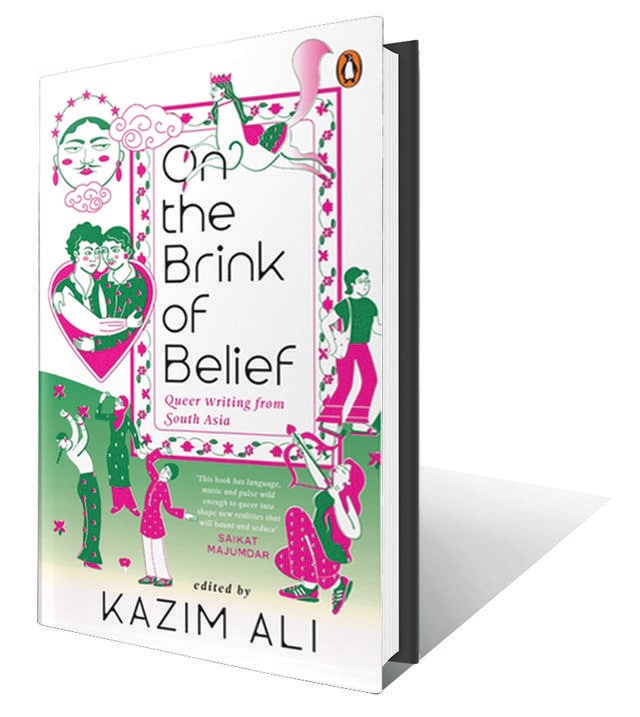
Review: On the Brink of Belief edited by Kazim Ali
Of djinns, shakchunnis, and shaitans of guilt... A collection of short stories and poems from the Indian subcontinent offers a living, breathing portrait of queer life across the region

 Prefer HTon Google


In the opening pages of On the Brink of Belief: Queer Writing from South Asia, a collection of short stories and poems by 24 underrepresented voices from Sri Lanka, Bangladesh, Nepal, Pakistan and India, I caught a flash of recognition. In this anthology, born in The Queer Writers’ Room set up by The Queer Muslim Project (TQMP), editor Kasim Ali writes: “Perhaps it is only the queer person — perennially and by definition outside the mainstream of culture, politics and organised religion — who can know God.” This observation echoes what I wrote in my own exploration of the Hindu faith: ‘I was undoubtedly an insider, but I was also an outsider in that I found myself outside the bounds of established convention’.

That we both hold a specific gaze, of the outsider looking in or struggling to break free, is no coincidence. It is often the different ones, the weird ones — an euphemism frequently used for queer people — who grow into adulthood with an acutely developed sense for teasing out the codes designed to stifle our spirit. This is so even if we might, shaped by our parenting, retain aspects of tradition. “Our queerness and Muslimness are not in conflict,” Kasim Ali rightly says, and as the prose in this book shows us — casting a slanted light on personal journeys traversing inherited mythologies and lineage — “they are the frameworks through which we tell our stories, challenge assumptions and reimagine the world.”
In the book’s first part, we encounter poems that reflect the queerness of the body and mind, mirroring, too, the loneliness of marginalised communities, as well as short stories that draw on hyper-local yet recognisable South Asian traditions, all yearning for visibility, agency, and love.
In Nangsal, Nepali writer Dia Yonzon, reflects on childhood trauma, reminding us that no matter how far we travel, we never leave our roots. In Darling by Kiran Kumar, a boy at the cusp of manhood tells us how he feels when he’s disparagingly called ‘darling’ by his coach. Later, though, while watching women’s cricket, ‘seeing athleticism and queerness so visibly on screen’ stirs in them ‘powerful emotions of gender yearning’ they’re nearly ready to explore, even if such feelings can’t always be voiced.
In their memoir, The Beauty and Complexity of Being Queer and Muslim, Adnan Sheikh recounts how ‘this inner conflict can become all-consuming.’ And yet, they continue on their unique journey with the ‘unwavering belief in the knowledge that Allah loves them just as they are’.
Sara Haque in A Fever, A Djinn And The Collectibles of Grief, recalls her grandmother’s relationship with an apparition, a djinn, and in so doing she shows us how South Asian culture has a rich history not only of subversive folklore, but of queer (in the broadest sense) personalities as well: an acknowledgement of the existence and accommodation of quirky spirits within our expansive ethos, even if they make no declarations as to their self-identity.
The second part of the anthology marks a subtle shift, where alongside perceptual depth there comes at times an uneven tone. A story set in a dystopian, waterlogged Dhaka doesn’t appear to precisely fit in. But perhaps this is the point. Another interesting vignette about Shakchunnis, spirits of unhappily married women who haunt married women in the afternoon, while reminiscent of the Djinn story, could have, I felt, been more fully realised.
Themes of honour preservation emerge in Hassan Bhai by Amama Bashir, as we read of a hidden gay love affair within a Muslim community, as well as again in Dreading by the Lohtak by Mesak, set in Manipur, where they blend with notions of land ownership and desire, as an army youth frisks a student.
By the middle, the writing grows bolder — shifting from concealment and negotiation to asserting moral clarity. Obituary by Dia Yonzon imagines a transgender woman asking her lover from the afterlife: ‘Will you tell your family about me and take days off to mourn me?’ And in Even Shaitan Showers, Begum Taara Shakar provocatively writes: “I always thought God was in love with Shaitan? Did no one notice that a whole world was created to prove Shaitan wrong? That God who knows everything that is to happen still lets it happen?”
In Slippage, Kaleemullah Bashir explores the loss of childhood friendship due to parental pressure to avoid the ‘wrong’ crowd. Though not explicitly queer in tenor, the story examines themes of shame and childhood vulnerability. The hints and suggestions built up over the many previous pieces then culminate in sexual intimacy in In Darjeeling and Desires by Birat Bijay Ojha.
In the fourth and final section, we’re reminded that despite the tremendous progress LGBTQ+ people continue to make in the subcontinent, our struggles are as enduring as our desires. If Birat Bijay Ojha opens his poem A Raging Pyre with the visceral words: “Intergenerational trauma sneaks in like a raging alcoholic father,” then Darius Stewart matches them in Love, Like in the Movies with: “What if, before he leaped, he assured himself the world would be just fine without him, and he without it, and that things would get back to their normal course in due time, the way, once he crashed through the water, the surface of the river would appear as if it had never been anything but this peaceful wrinkling?”
There are quibbles: an over-explanation by way of footnotes of local words and phrases breaks the flow of prose in places when context alone could have sufficed. Yet the collection succeeds in painting queerness in its broadest, richest sense: feelings and desires that haunt, shimmer and linger. Even if some pieces feel like fragments, they do connect, like small moving parts of a greater whole, offering a living, breathing portrait of queer life across South Asia — scattered and ethereal, full of djinns, shakchunnis, and shaitans of guilt, stitched together by desire, longing, and a cry for affirmation. These once-silenced voices are now finding light. That alone is worth celebrating.
Siddharth Kapila is a lawyer turned writer. He is the author of Tripping Down the Ganga.


