The witch, historically, is a figure burdened with accusations and moral judgment. She has been scapegoated for calamities and reduced to a trope, the trope of a spectral effigy of patriarchal anxiety. Megha Rao’s Our Bones in Your Throat conjures this spectrality and gives it form and fury within the confines of St Margaret’s College. This campus, with its cryptic woods and architecture is where Esai and Scheherazade, friends-turned-rivals, recast the witch as metaphor.
Esai, the novel’s protagonist, is the girl-next-door grappling with the extraordinary. When she finds out the haunting tale of Minaxi, a water spirit tethered to the college’s forbidden lake, she stumbles into a historical continuum of betrayal and resistance. The figure of Minaxi, half folkloric, half allegorical is Rao’s reclamation of witches as archivists of oppression whose stories are sedimented in time only waiting for someone to unearth them.
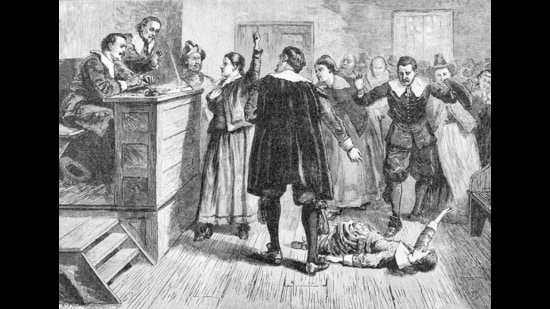
But Our Bones in Your Throat is not simply a story about witches, it is a story about the enduring architectures of power. Rao takes the reader to the Salem witch trials by way of St Margaret’s campus politics. Both milieus share an eerie synchronicity: the same paranoia, the same weaponized whispers. Rao evokes the socio-cultural crucible of the Early Modern Age where women’s defiance was transmuted into deviance and lets it ricochet into the contemporary. Through Esai’s unease and Scheherazade’s incandescent rage, Rao makes clear that witch hunts never ended; they merely modernized, and that is clear in the language used in the novel.
At the novel’s core is the relationship between Esai and Scheherazade. Scheher is an artist whose dissent crackles like electricity and who uses her words as both sword and salve. Esai, in contrast, is tentative, caught between loyalty to her friend and allegiance to a college committee steeped in secrecy. Rao orchestrates their dynamic with an operatic intensity. Their relationship is similar to fraught alliances of witches past, women bound by shared persecution yet undone by divisive power structures.
{{/usCountry}}At the novel’s core is the relationship between Esai and Scheherazade. Scheher is an artist whose dissent crackles like electricity and who uses her words as both sword and salve. Esai, in contrast, is tentative, caught between loyalty to her friend and allegiance to a college committee steeped in secrecy. Rao orchestrates their dynamic with an operatic intensity. Their relationship is similar to fraught alliances of witches past, women bound by shared persecution yet undone by divisive power structures.
{{/usCountry}}The prose is a nice blend between the lyricism of folklore and the clipped urgency of a campus drama. She wields metaphors that cut through the banalities of collegiate life to reveal the skeletons underneath. A blackboard is not just a blackboard; it’s “a slate of unspoken histories, stained by the dust of forgotten revolts.” The library isn’t merely a repository of books; it’s “where the ghosts of old ideas spar with the insurgencies of the young.” Yet Rao’s language occasionally buckles under its own weight. A simile like “I hauled myself down onto the ground like a feather” falters, straining for an elegance it cannot sustain. These lapses, however, are rare cracks in an otherwise polished veneer.
There seems to be a deliberate echo in Rao’s work of Silvia Federici’s Caliban and the Witch, which situates the witch not just as a victim of patriarchal violence but as a figure of economic and political resistance. Rao extends this argument to her fictional campus, where the myths of witches, real and imagined, mix with contemporary student politics. In this sense, Our Bones in Your Throat compels the readers to interrogate the stories we tell about power, femininity, and dissent. But one shouldn’t mistake the folklore for the real world as it is as much a part of the novel.
And yet, Our Bones in Your Throat does not always land its punches. Secondary characters, while thematically potent, often feel like sketches rather than fully realized figures. The story’s reliance on exposition where characters are introduced with their ideologies worn too plainly, sometimes undermines its themes.
The novel’s intertextuality is striking too. Rao peppers the narrative with snippets of global history and regional folklore, from the Malleus Maleficarum to Tamil and Malayalam myths. The lore of Minaxi, for instance, dovetails seamlessly with Scheher’s insurgent poetry and reminds readers of the revolutionary potential of storytelling.
If there is a flaw in Our Bones in Your Throat, it lies in its characterization. Rao’s minor characters often serve as vessels for ideas rather than fully realized individuals. Joshua, for instance, is introduced with an almost caricatural bluntness: “He was a brat. A man-child. He stood for fascism, hate speech, and blaspheming minority religions.” Such broad strokes deny him the grey shades of human complexity. Similarly, Esai’s health struggles briefly mentioned as a side effect of campus politics feel tokenistic, a subplot abandoned before it can take root.
Despite these shortcomings, Rao excels in constructing an atmosphere thick with tension. The woods surrounding St. Margaret’s are a liminal space, both sanctuary and snare. The lake, with its “breath of brine and blood,” becomes a character in its own right, its depths a repository of forgotten narratives. Rao’s Bombay, too, is a city of contradictions romanticized yet real, its allure as vivid as its undercurrents of decay.
The novel’s open ending is likely to sit well with the reader. Like the best campus novels, Our Bones in Your Throat refuses closure and leaves its characters suspended in the liminal space between rebellion and resolution. Rao’s decision to eschew a tidy denouement feels apt for a story about unfinished revolutions and the ghosts of untold stories.
Our Bones in Your Throat is a genre-bending interrogation of power, gender, and the stories we inherit. Rao’s witches are survivors, archivists, and insurgents. They are the Esais and Schehers who dare to question, to remember, to resist. In reimagining the witch, Rao might just have written a spell of a novel.
Pranavi Sharma writes on books and culture. She lives in New Delhi.