
 E-Paper



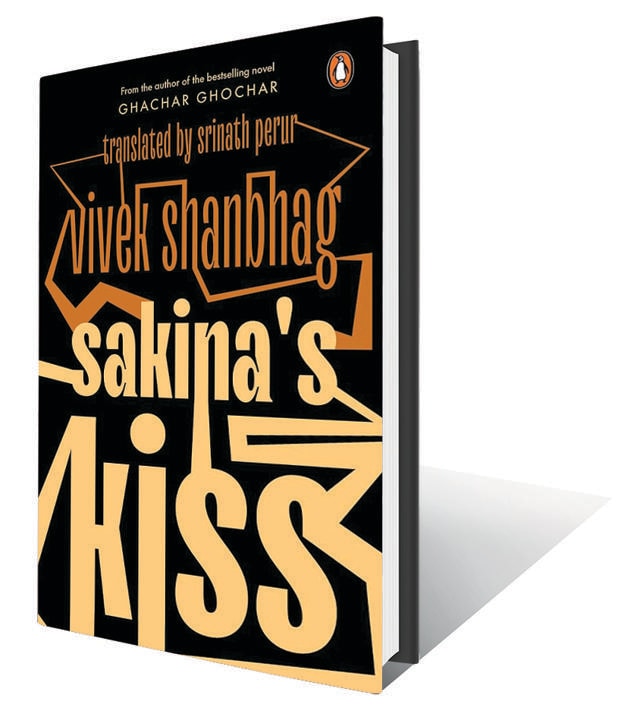
Review: Sakina’s Kiss by Vivek Shanbhag
Tackling issues of masculinity, polarization of politics, and the consequences of Indian liberalization, Sakina’s Kiss is very relevant to our times

 Prefer HTon Google


Vivek Shanbagh’s terrific new novel Sakina’s Kiss (translated into English from Kannada by Srinath Perur) is an intimate portrait of a middle-class, middle-aged man bewildered and isolated by the changes of modern life, which he painstakingly built for himself and his family over the years.

Slowly, over four days, Venkat reveals — more like confesses to — his life’s story: his aspirations, accomplishments, self-consciousness, and shame.
Venkat and Viji are an ordinary couple, he points out. Their neighbours in the apartment building where they live use no adjectives to describe them, as if nothing about them stands out, referring to them simply as “the C-3 people,” he explains. He’s a very unreliable narrator, his views of his life are so coloured with embarrassment, he cannot see the family’s achievements. Their friends see them as successful, but he thinks they’re pretty average, maybe a few steps ahead because of their double income. After passing many of life’s milestones, he says, they’re at the point where they’re going to be evaluated by the conduct of their children.
And so the novel begins, in the hands of this iffy protagonist, with two young men looking for his daughter Rekha. She isn’t at home but at his ancestral village, Venkat tells them, where there’s no phone reception. But they return, accompanied by two shady men. And so the novel is set up like a thriller — where is Rekha? What do these men want? Is Venkat hiding something? Will something bad happen?
This unease is familiar. The mood of Sakina’s Kiss is like Ghachar Ghochar, the first of Shanbhag’s novels to be translated into English in 2015. That slim novel came into international limelight — heralding attention to Indian writing in languages other than English. There is the title of course, “ghachar ghochar” was a nonsense word, made up by the wife of the protagonist, meaning something that is tangled beyond repair, a knot that cannot be untied. “Sakina’s kiss” is also a nonsense phrase, in the sense, without giving much away, it is a kind of misunderstanding, underneath which lies terror. The narrators of both novels are similar in that they’re both awkward and unreliable, both baffled by the changes in their circumstances — in Ghachar Ghochar by the family’s rags-to-riches fortune; here, their urbane modernity.
Ghachar Ghochar is a novel hard to match. But Sakina’s Kiss comes close and it is very, very relevant to our times, tackling issues of masculinity, polarization of politics, and the cracks in, and perhaps consequences of, Indian liberalization.
And then there are crisp sentences, translated smoothly, almost discreetly, in Perur’s translation. Entire trajectories are summed up in single sentences:
Venkat is short for Venkataramana, the name “richly intoned by the teachers at my village school, lost the flick of the tongue at its end in the mouths of my north Indian friends in college and became Venkatraman. It dwindled to Venkat among colleagues.”
To translate into English the effect of the Kannada pronunciation of Venkataramana in the original text, Perur added an extra sentence describing the loss of the “flick of the tongue” at the end of the name, he told the Indian Express.
Three quarters of the novel go into locating Rekha over four odd days. Venkat and Viji travel to the village and the mystery thickens. And slowly, unexpectedly, Venkat reveals — to the reader — the memories “trapped in the crevices of my childhood. Revisiting them feels like taking a stroll near a dormant volcano.” He hasn’t divulged his family secrets to his wife, “revealing too much would only be giving her a stick to beat me with.”
Secrets, like shame, only grows heavier with time. Venkat carries the double barrel — shame, and guilt from a particular family secret — the fountain from which all of his discomfort springs, and one he keeps trying to plug away. It is also what he tosses and turns throughout the narrative to show glimpses, only flashes, of his past and of his feelings — but in full display is the tragedy of loneliness.
Shanbhag uncovers the political implications of that feeling of alienation and isolation — as Venkat watches vicious TV news channels much to the chagrin of the women in his family, almost as a response to being excluded from, what he thinks of as the mother-daughter club. As the “TV’s clamour filled out hall. Words that had never been heard in our house now ran through it in a torrent. Mother and daughter were both appalled...” and Venkat, “I was elated by the disgust in her tone. This was the perverse pleasure of having gained the upper hand. I had been adamant about watching that channel, and it felt like the victory of someone who may be caught for corruption but manages to hang on to the ill-gotten gains anyway.”
The beauty of Sakina’s Kiss is that its mammoth subjects and themes never weigh it down — there’s a soft lightness to the novel. One can read it in a couple of sittings, and wonder for some time after, if really they read it right. What I saw as Venkat’s tragedy could very well be a tantrum. Just like the novel’s title — in the book, it’s a joke because it is indecipherable — Sakina’s Kiss doesn’t hit you, until after it’s done.
Saudamini Jain is an independent journalist. She lives in New Delhi.


