
 E-Paper



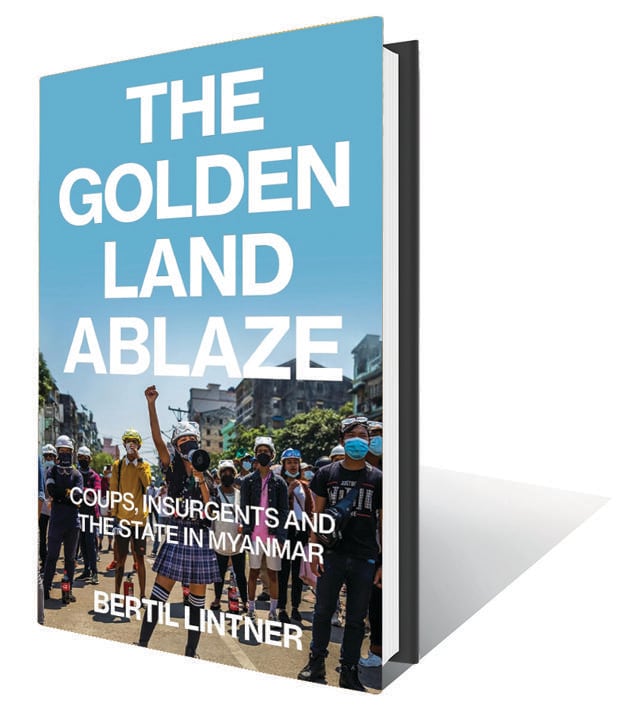
Review: The Golden Land Ablaze by Bertil Lintner
A fascinating, if depressing read that covers incidents until at least April, 2024, this is a thorough analysis of the troubles in contemporary Myanmar

 Prefer HTon Google


My home in the bustling town of Lamka, officially called Churachandpur, in Manipur, is around 60 kms from the Myanmar border. Yet, Myanmar, which was officially called Burma until 1989, always feels distant and dreamy. In the 1980s and ’90s, we grew up listening to melodious Zo songs originating from the Tedim area of the Chin Hills. Enraptured by movies like Tui Bawsa Kiluak Kik Theilou, we paid a hard-earned ₹5 to watch them in video halls. As for actual people, the ones I remember the best are the Tahan traders who came selling fancy tape recorders and other trinkets in our village. They spoke our language but had a different accent. We always knew we were the same people though we lived on this side of the border and they on the other side.
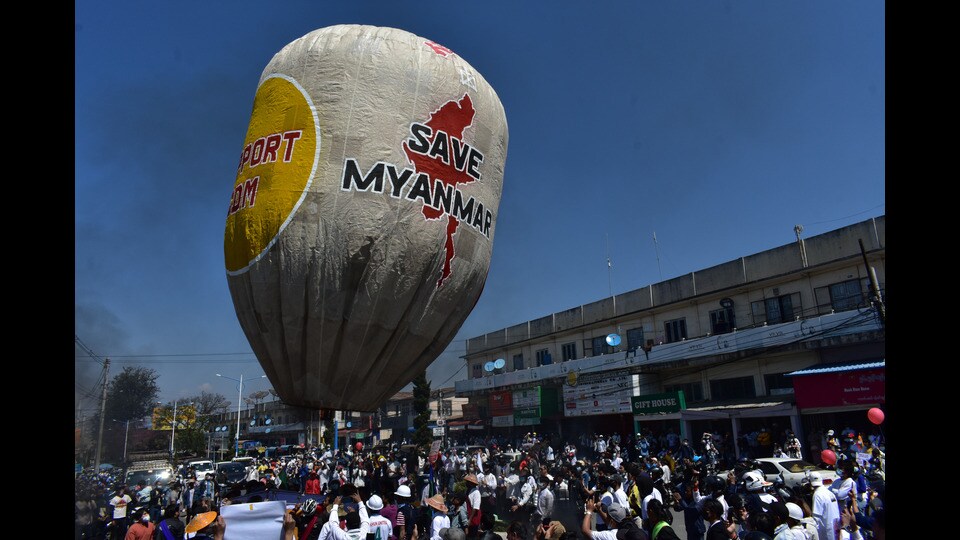
The 2021 military coup in Myanmar and the state of anarchy unleashed in its wake, followed by the 2023 Manipur communal flare up that is also unresolved, made me realise how little I know about the sleepy country next door. I can’t make out who is fighting whom, and for what; I can’t keep up with the names of new factions and groups. Some blame “Burmese refugees” for instigating the Manipur crisis, making it sound like the streets of Churachandpur are overflowing with lungi-clad Burmese immigrants. Those of us who live here are left looking helplessly at each other and wondering where all those refugees are hiding.
Bertil Lintner’s The Golden Land Ablaze mostly does not address these immediate questions though it covers incidents until at least April, 2024. This is disappointing though perhaps not surprising. What he does provide, though, is a thoroughgoing analysis of the background and context – local and regional, institutional and ideological – which conspired to make the messy Myanmar of today. The book makes for a fascinating, if depressing read. Lintner writes as if from memory, in a measured and assured tone, and in lucid, accessible prose. He cites not an inconsiderable number of other works to illuminate his own, but unlike some ponderous academic tomes, the flow of his narration remains undisturbed.
Myanmar comes across as a place marked by paradoxes. A land of jade and natural wealth yet endemically poor and impoverished; a land of Buddhism, the most non-violent of religions yet perpetually racked by killings; a country with relatively high literate population and vibrant press (the first offset newspaper in Asia was in Myanmar, started in 1956) yet steeped in superstition, and saddled, for the most part, with military rule. That the name of the Burmese capital, Rangoon (now Yangon) translates as “end of strife”, sounds like a cruel joke.
The hold that superstitions and numerology have on the Myanmarese psyche, not least the military elite, is astounding. The military rulers justified their changing of the country’s name from Burma to Myanmar in 1989 with the claim that Myanmar better represented all the “135 national races” in the country. However, Myanmar does not have 135 national races. The figure was chosen rather because the digits add up to nine, the military’s lucky number. Also, it was no accident that the Myanmarese army was founded on 27 March 1945. The army stepped in to crush the 1988 uprising on 18 September. The country’s name was changed on 18 June, 1989 and the first election after that was called on 27 May, 1990. Ceasefire talks between the military and rebel armies in 2015 were scheduled at 9 am on 9 September. Myanmar had actually issued banknotes in the denomination of 45 and 90 between 1987 and 1989! Later, after the military took over again in 1988, they chose their supposedly lucky date of 18 September (1+8 = 9 and the 9th month) to seize state-run radio.
In the introduction, Lintner says that his aim is “to explain the enigma of military power in Myanmar…” The British colonial annexation of Burma happened in the 1880s and 1890s, around the same time as much of what is present-day Northeast India. In fact, Myanmar was a part of British India until 1937. Lintner explains that the disrespect shown to certain Buddhist practices (like the refusal to take off shoes while entering pagodas) by the colonial officials, the influence of left-wing nationalism and old kingdom nostalgia gradually coalesced into an armed Myanmarese struggle against the British. The country briefly came under Japanese occupation during the Second World War. Then, on 19 July, 1947, a group of uniformed armed men opened on the country’s pre-independence cabinet. Nine people were killed. The dead included Aung San, who had signed an agreement with Britain in January 1947 for Myanmar’s independence. Given the disparate nationalities composing it, Myanmar was an unlikely country to begin with, and the killing of the entire national leadership at this stage didn’t augur well. Since it gained independence from the British in 1948, violence has been a constant presence in Myanmarese national life. The first military coup happened in 1962. The 1970s were bloody, and the 1988 massacre is well-known. The decade from 2011 until the coup of 2021 was relatively peaceful. As Lintner showed, the people of Myanmar are brave. Fierce resistance followed each military act of repression. Yet, popular movements have consistently failed to dislodge the military. But unlike in the past, the 2021 coup provoked a robust armed resistance, and rebel groups are now in control of more than 50 percent of the country’s land area. However, Lintner is skeptical that the military will ever be defeated; the most important factor for this is China.
Linter devotes an entire chapter to China, which has its “foot in every camp” in Myanmar. Unlike democracies like India or the US, China’s policy on Myanmar is based on hard-nosed realism. For China, Myanmar is a pivotal gateway to the Indian Ocean and also a source of cheap natural resources. As Lintner argues, China does not want a democratic and prosperous Myanmar, which will tempt the country to break free of its powerful northern neighbour and chart an independent foreign policy. But it does not want a broken and anarchic country either as this would interrupt its geostrategic designs and inundate it with refugees. Therefore, it caters to all sides and plays one against the other to ensure that delicate balance which makes China itself indispensable to all sides. Other powers, including India, Japan and the US are reduced to playing second fiddle. If they harp too strongly on democracy or human rights, they only risk driving the country deeper into China’s embrace.

The Golden Land Ablaze also has chapters on the ethnic make-up of Myanmar and the political leadership. It traces the sobering history of Aung San Suu Kyi’s family, one that is indispensable to Myanmar yet afflicted by all sorts of tragedies. There is also a helpful analysis of the Rohingya crisis. Today, the junta remains in control of the heartland, the military remains united and the opposition fractious. The big powers are circling overhead. The future remains uncertain and bleak.
This is a valuable book. However, it would be wonderful if Lintner came up with a sequel that turns westward and focuses on the dynamics and linkages of the Myanmar and Manipur crises, cross-border armed groups, the changing contours of the drug trade and transit routes, the politics of border fencing and the phantom of illegal immigration to India. I can think of no one else who can do it better.
Thangkhanlal Ngaihte is assistant professor of Political Science at Churachandpur College, Manipur and PhD candidate at Mizoram University, Aizawl.


