
 E-Paper



Review: The Madhouse by Gyan Chaturvedi
An incisive portrayal of Post-Liberalisation India, this satirical novel raises incisive questions about the control exerted by market forces

 Prefer HTon Google


Dystopic fiction transports readers into an uncomfortable space that eerily helps us make better sense of our own time, its politics, and of human nature. This has been the case with Aldous Huxley’s Brave New World and George Orwell’s 1984. It is the case too with Gyan Chaturvedi’s Pagalkhana (2018). Now translated into English as The Madhouse by Punarvasu Joshi, this poignant tale by one of Hindi literature’s most prominent names oscillates between humour and a philosophical examination of reality, the thin lines between the sane and the insane.

The author’s fifth novel and among his most critically acclaimed works, The Madhouse, an incisive portrayal of Post-Liberalisation India, does not revolve around a single central character. Rather, the market itself emerges as a character, alongside several others who might be labelled as “mad”. A medical doctor himself, Chaturvedi beautifully captures the power that physicians have over the human body; how they decide who is sick, and who is not. The novel then raises incisive questions about market forces slowly beginning to control everything, and about those who try to escape this grip: “The world was ensnared by the Bazaar and its thinking. The world was learning with and within the Bazaar. But even then, there were some crazies who considered life to be something more than mere consumption, and greater than the market. They believed that the market is for life but life isn’t only for the market… that it has deeper meanings.”
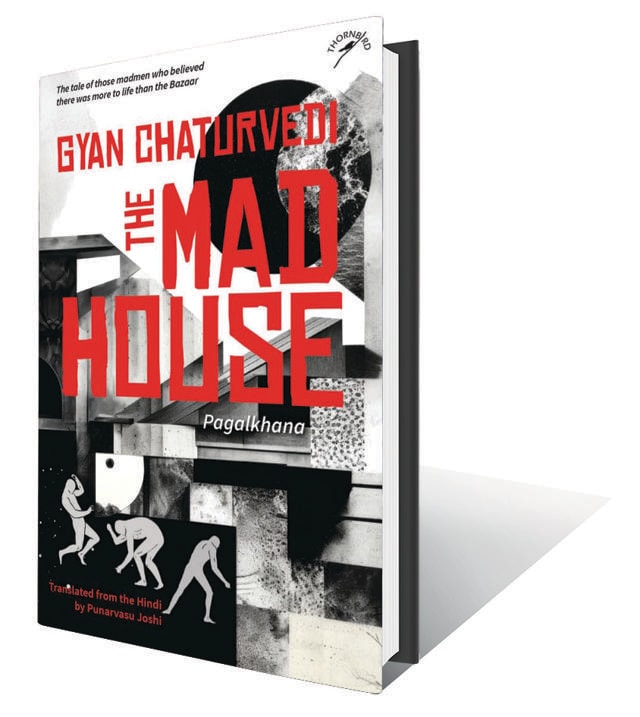
The Madhouse presents many fascinating scenarios: a man secretly building a tunnel; another who believes he has lost his dreams; a father convinced that his son will one day sell him online like old goods on a website. The book comprises a collection of such stories, each with its own independent trajectory. Together, they make the reader reflect on the market, how it shapes our behaviour, and how we, in turn, internalise and redefine market-based “rationality”.
The story about the man who worries that he has lost his dreams is a sharp send-up of those who live mechanically. The character’s wife and children are unconcerned about his predicament until they begin to perceive his behaviour as worthy of psychiatric attention. It’s clear that to them, anyone who cares about their dreams is “irrational”.
The Madhouse calls to mind Madness and Civilization where French philosopher Michel Foucault pointed out that being “unproductive” is the greatest sin in the Age of Reason. The market considers Chaturvedi’s “crazies” useless because they are unproductive. Instead of being busy, they are concerned about nightmare scenarios where the market pursues them, sells them like goods, and worry about the loss of their dreams.
Chaturvedi’s remarkable wit makes this a novel that’s simultaneously hilarious and unsettling. It makes readers shiver, and then question everything that the market has normalised. The ever-expanding definition of what’s “normal” seems directly proportional to what is labelled as “abnormal.” Today, doom scrolling and even spending long hours glued to a screen is considered normal. Someone who avoids social media, however, is immediately suspect unless, of course, he has something more pressing to do. If he doesn’t, he may be judged as “abnormal”.

Unlike many dystopian novels, The Madhouse does not sink into despair. The market, despite being all-powerful, can do nothing if “time decides to revolt.” The novel’s strength is that it offers hope; it’s a hope that emerges from the perspectives of the “crazies” who choose to live differently. The world of the market might consider them mad but that doesn’t matter because they have something far more meaningful to pursue.
Vyangya or satire is one of the most compelling genres in Hindi literature. It asks questions subtly, and engages with readers. Writers like Harishankar Parsai and Shrilal Shukla, both masters of satire, have amassed a cult following with the latter’s Raag Darbari now a confirmed classic. Chaturvedi too has carved out a space for himself. Punarvasu Joshi’s translation of Pagalkhana is as entertaining and scathingly ironic as Joseph Heller’s Catch -22. It wouldn’t surprise this reviewer if The Madhouse too becomes an enduring classic.
Mayank Jain Parichha is an independent bilingual journalist. He writes about the environment, wildlife, culture, literature, and politics.


