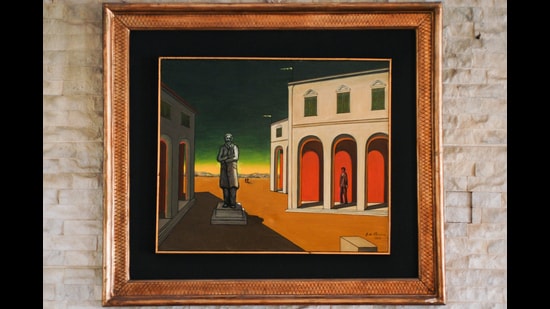
A figure in Giorgio de Chirico’s 1914 painting The Enigma of Departure stands as if caught between two worlds. The viewer, who sees only his shadow, cannot guess if he is leaving or arriving. The stillness of that moment holds both possibility and fear. This image feels like the right place to enter A Stone Thrown in a Pond, a collection of essays, stories, and poems about departures and leaving edited by Ritu Menon, writer, founder-director of the publishing house, Women Unlimited, and co-founder of Kali for Women, India’s first feminist press.
Leaving is something everyone does, but we don’t often stop to consider how differently it unfolds for each of us. Sometimes you walk out the door and never look back. Sometimes you are pushed out. Sometimes you stay in place while the world leaves you behind. This book shows you all those possibilities. There are different kinds of leaving – of partners, of parents, of cities, of ideas, of ways of life. Then, there is also the eternal leaving – death.
The idea sounds simple enough. The book’s subheading, ‘Essays & poems on the enigma of leaving’ plays on Naipaul’s The Enigma of Arrival. Each story in the collection complicates the idea of leaving which happens sometimes with longing, sometimes with anger, sometimes even with humour. There is also a sharp contrast between leaving by choice and leaving under duress. We are used to thinking of departure as a matter of freedom. But what happens when leaving is not what you want?
{{/usCountry}}The idea sounds simple enough. The book’s subheading, ‘Essays & poems on the enigma of leaving’ plays on Naipaul’s The Enigma of Arrival. Each story in the collection complicates the idea of leaving which happens sometimes with longing, sometimes with anger, sometimes even with humour. There is also a sharp contrast between leaving by choice and leaving under duress. We are used to thinking of departure as a matter of freedom. But what happens when leaving is not what you want?
{{/usCountry}}Adania Shibli writes from Palestine, where occupation makes leaving inevitable, even when you resist it. She prepares for a visit to Jenin with polished black shoes, imagining the possibility of being shot along the way. She even assigns the bullet a place: “either in my leg or in my chest.” How do you describe that kind of anticipation? For her, departure is a risk. For her, words are the only things light enough to carry without permission.
Other essays in the collection extend this political line. Gagan Gill writes of Partition, Ranjit Hoskote of 19th-century histories of forced movement, Kshama Kaul of being ‘thrown out’ of her homeland. These are essentially records of rupture. They make clear the difference between the person who leaves by will and the person who is expelled. Not all departures can be reframed as opportunities, some remain wounds.
The collection also benefits from the variety of forms. There are essays, but also poems and fragments. Arundhathi Subramaniam’s short pieces about her parents’ deaths are hard hitting. She names objects like sorbitrate strips, bottles of cologne, neat handwriting and suggests how, after someone dies, we try to string those things into a coherent story. But the dots never join, she admits. Parents were always partial, unknowable, piecemeal. Her language is pared down, unsentimental, which is refreshing.
But there are other writers in the book who have left again and again and lived to tell the story differently. Anita Anand has lived in 26 homes. She describes leaving as practice. “Leaving has been good for me,” she writes, before asking the question that unsettles everything: “But what happens when we are left?” For leaving can also be a way to stay alive.
It’s easier to narrate one’s own departure than to narrate absence. When someone leaves you, what do you do with the fragments they leave behind? Letters, photographs, garden trees, habits, smells, these things hold the weight of what’s gone. Ritu Menon’s own essay leans into this and suggests that being left is a cluttered space. Departure is often the residue that sticks.
A Stone Thrown in a Pond also briefly circles around the mythic glamour of leaving as opposed to its ordinariness. Cinema and literature have often dressed departure up in heroic clothes. We have the images of the wanderer on the open road, the exile transformed by suffering, the artist who moves on to greater things. But in these essays, leaving is rarely so cinematic. It’s rather messy, practical, sometimes even boring.
And yet the myths are there. Jerry Pinto alludes to Indian films and situates the idea of leaving within the country’s context. Often, men in Hindi films get to sing about leaving: Chala jaata hoon kisi ki dhun mein, Main ek baadal aawara. These songs have the potential to turn departure into an anthem, a kind of freedom coded as masculine. “Women don’t leave, men do,” says Pinto, a man himself. We don’t hear a story of his own leaving; he simply meditates on the idea.
The gendered lines of leaving are everywhere in the book. Sabyn Javeri, writing about discarding the “good girl” mask, bluntly says: “The hardest story to leave behind is not the one society hands us, but the one we tell ourselves.” At 50, she chooses to begin again, and in doing so, shows what it looks like to leave a stale script behind.
Sometimes, leaving takes the shape of memory, even fantasy. Bulbul Sharma writes about her lost garden as if it were Eden. She knows the garden wasn’t as beautiful as she remembers: “It was never like that,” she says, but memory insists otherwise. Departure, in her case, creates myth, because myth is easier to hold than bare absence. Reading her, you wonder: when we remember our own departures, do we also invent gardens, smooth out their rough edges, just to make the leaving tolerable?
The book makes you think about how leaving shapes identity. The self begins to look like a trail of departures and our story becomes the one we tell to stitch those gaps together. Some of the writers here treat leaving as a wound. Others, as a method. Some dwell in the sadness of being left. Others insist on new beginnings.
I am not sure if A Stone Thrown in a Pond says that leaving makes us stronger, or that every loss comes with a hidden gain. It admits that sometimes leaving saves you, and sometimes it ruins you. It admits that leaving can be a cliché, and that even clichés might be worth holding on to if they help you step out the door.
The enigma of leaving is that it never really ends. We keep leaving people, places, selves, and one day life itself. To write about it is to admit that we are always in motion even when we stay put, even when we look still, like the figure in de Chirico’s painting, who hovers between departure and arrival.
Pranavi Sharma writes on books and culture. She lives in New Delhi.