Santanu Bhattacharya’s novel Deviants is worth reading for many reasons; the first of these is the announcement of its queerness without excess or apology. It lures the reader with an enticing photograph of a shirtless man with shapely eyebrows and a stylish moustache, who looks secure in his sexuality, and holds a defiant gaze that is in keeping with the novel’s title.
It is hard to create a book cover that is true to the spirit of the story, and does not engage in queerbaiting only to sell more copies. Model Llavi Tyagi, photographer Harsh Jani, and designer Amit Malhotra, and the publisher Westland Books must be applauded for a book cover that does not attempt to make the queerness of its protagonists palatable to conservative audiences.
Deviants tells an unusual story of three generations of gay men from the same family — Vivaan, his maternal uncle who is introduced to the reader as Mambro, and Mambro’s maternal uncle, Sukumar. Their journeys are remarkably different, partly because of the circumstances that they are born into, and partly as a result of the choices that they make. The connecting thread is a shared quest for love.
Bhattacharya’s attempt at “tracing a delicate bloodline of forbidden love across three generations, three renegade young men fifty years apart” is praiseworthy for its conceptual clarity and fine execution. These words are uttered by Mambro, who is a bridge between the past and future. He articulates an affirming vision of what kinship can look like when it is not framed through a patriarchal lens that assesses a man’s worth by his ability to produce heirs.
{{/usCountry}}Bhattacharya’s attempt at “tracing a delicate bloodline of forbidden love across three generations, three renegade young men fifty years apart” is praiseworthy for its conceptual clarity and fine execution. These words are uttered by Mambro, who is a bridge between the past and future. He articulates an affirming vision of what kinship can look like when it is not framed through a patriarchal lens that assesses a man’s worth by his ability to produce heirs.
{{/usCountry}}The author has developed a distinct personality and voice for each of his characters. Vivaan is a teenager, about to enter adulthood. He uses apps to meet prospective sexual partners. His mother knows that he is sexually active, and she advises him to use protection. Sukumar is in a long-term relationship with a man but they keep it under wraps because society would never accept it. He gets married to a woman and makes her life miserable. When he loses the man that he is involved with, he starts cruising for sex in public places. He is ashamed of who he is and has no role models or mentors.
Given how the novel unfolds, it is tempting to conclude that things have transformed drastically for gay men in India over the last few generations. Vivaan does not have to pretend to be heterosexual to find acceptance. In contrast, Sukumar had to suppress his desires, live in the closet, and protect his family’s honour. While the reading down of Section 377 of the Indian Penal Code in 2018 has reduced the stigma around homosexuality, it is also true that many gay men in India marry women due to pressure from their families or to hold on to the privileges that patriarchy offers heterosexual men. Given this, it is advisable to enjoy this book as a work of fiction and not as a sociological study of changing attitudes towards gay men in India.
Mambro is presented as a character who lies between the extremes that Vivaan and Sukumar denote. Unlike Sukumar, Mambro has access to queer representation in literature and cinema. He refers, for instance, to Ismat Chughtai’s short story Lihaaf and Deepa Mehta’s film Fire. Both feature queer relationships in an Indian context. Mambro is not as helpless as Sukumar but not as liberated as Vivaan either. His enjoyment of sexual intimacy is tainted by guilt and fear and he bullies other gay men to pass off as heterosexual and feel safe.
Bhattacharya is realistic in his portrayal of how things play out when people experiencing persecution devise survival strategies. Their primal instinct is to look out for themselves. In an ideal world, everyone being oppressed by patriarchy would band together and defeat their common enemy. What happens instead is that people negotiate the best deal they can get. They do not realise that, sooner or later, they will lose the little power they enjoy. This is exactly what happens to Mambro. When his sexual orientation becomes public knowledge, he faces the worst kind of humiliation and violence from his peers and is sexually abused.
Vivaan’s world is depicted as light years ahead of what Mambro’s milieu was like. What Mambro has with his partner is a clandestine affair. Vivaan, on the other hand, brings his boyfriend home. He wants to take his boyfriend to the school dance. When the principal objects, his father says, “What is the problem, ma’am? Are you saying you are against homosexuality? You know, love is love.” His mother says, “Homosexuality is legal in India. How much time would you need before your school can catch up? Last time I checked, court judgements were effective immediately.” This book compels the reader to imagine how much more joyful Sukumar’s and Mambro’s lives would have been if they had such parents.
Bhattacharya’s novel is emotionally engaging not only because the characters have depth and complexity built into them but also because the prose is culturally rooted in a setting with which the Bengali Brahmin author is well acquainted.
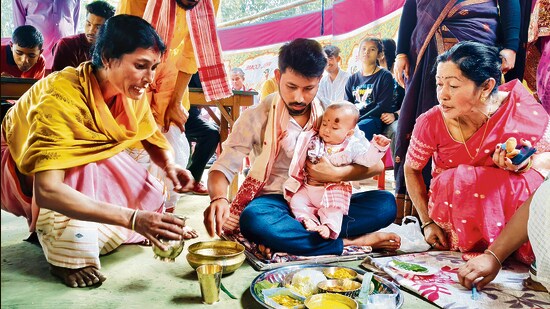
One of the book’s most beautifully written parts is the description of the time 30-year-old Sukumar sees his six-month-old nephew for the first time in the spring of 1982. The baby is brought by Sukumar’s sister for the annaprasan ritual. The author writes, “It was the maternal uncle’s right to feed a child their first grain of rice, granting him the place of custodian. This was the first time Sukumar had been given so much respect, offered a role in the life of the next generation.” This child grows up to be Vivaan’s uncle aka Mambro.
Later in the novel, it is quite apparent that Sukumar is aware of what he has in common with his nephew. His impulse is to protect the child but he has neither the guts nor the vocabulary to have an open conversation. What he has is a heart full of blessings and small gestures of affection that speak volumes. On the other hand, Mambro’s relationship with Vivaan is fairly informal. The latter can ask his uncle any question without the slightest hesitation. They talk about sex, relationships, testing for HIV, queer history, and everything under the sun.
Through this novel, Bhattacharya emphasizes the value of acknowledging queer ancestors whose lives have been erased from family histories because they were seen as deviants rather than as individuals looking for love. In the absence of the rights and freedoms guaranteed by law, they tried to hold on to what fleeting joys and pleasures they could find. Some of them made choices that seem unforgivable by today’s standards but they are not around to defend themselves. Bhattacharya shows that any sense of legacy comes with its own baggage, and that histories of trauma and resilience are deeply intertwined. Deviants deserves to be read widely for the author’s attempt to tell a story that is both depressing and heartwarming.
Chintan Girish Modi is a Mumbai-based journalist, educator and literary critic. He can be reached @chintanwriting on Instagram and X.