Poet laureate of Toronto from 2015 to 2019, Anne Michaels won the Orange Prize for Fiction (now Women’s Prize) in 1996 for her debut novel, Fugitive Pieces. Her third novel, Held, a poetic saga about the burden of memory and love across generations, has been longlisted for the 2024 Booker Prize.
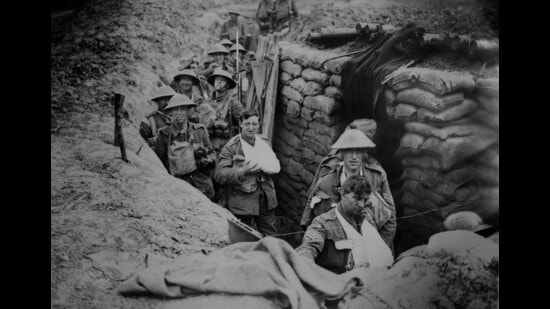
The story begins in France in 1917 when John is cold in the battlefield and recalls falling in love with a girl he’d met at the railway station. In 1920, he is back home in North Yorkshire where he runs a photography studio by day and finds peace with Helena at night. But the wind changes its direction and suddenly John begins to see things he shouldn’t. Though Helena feels deprived of the love she had once received without asking, a daughter is born and lives through the 1960s and beyond. The story presents the attempts of four generations to find love and deal with mortality.
It is difficult to define this 220-page book’s genre. A historical fiction that begins during the First World War and definitely a literary novel, it also takes on a speculative tone. Unlike a conventional historical work, it does not dwell on painting a world in vivid detail, but there is a richness in its examination of John’s photography, of Marcus’s meeting with Marie Curie, and of the walls between science and women. The writing also encourages the reader to speculate about the contemporary world and it is this constant speculation that makes this an engrossing read.
Intense and unsettling, Held is breathtaking even at the level of the sentence. Each word gives birth to sounds, images and sensations that lead into the larger story. When one of the characters enters a house, he finds this: “There was a good fire, stoked high — as Mara would have said, ‘blaze-worthy’… Two men were sitting in the dark; in their shapeless coats, their hats on their laps, they looked like a symbol of disaster, the bearers of terrible news.” The character’s mood and sense of impending turmoil is palpable.
{{/usCountry}}Intense and unsettling, Held is breathtaking even at the level of the sentence. Each word gives birth to sounds, images and sensations that lead into the larger story. When one of the characters enters a house, he finds this: “There was a good fire, stoked high — as Mara would have said, ‘blaze-worthy’… Two men were sitting in the dark; in their shapeless coats, their hats on their laps, they looked like a symbol of disaster, the bearers of terrible news.” The character’s mood and sense of impending turmoil is palpable.
{{/usCountry}}The author’s mastery over the language is evident when she writes scenes of characters meeting for the first time. The vulnerability of the love between John and Helena, or Alan and Mara recalls the fragility of the bond between Jack and Della in Marilynne Robinson’s Jack (2020). The lovers in Michaels’s story move from hoping to longing to feeling anxious to staying.
But this isn’t a conventional novel that follows a set of characters and their progeny over a century. It jumps back and forth with new characters appearing here and there. Sometimes, it is difficult to figure out the connections. The story is clear until chapter six, and the reader is gently let into the world that sprang from John and Helena. The following chapters, however, lose the smoothness of the beginning. This is not to say that the latter part is a different story, or that it is divorced from what went before. Rather, like Elizabeth Strout’s Olive Kitteridge or Olive, Again, the reader follows characters related to the core story of John and Helena. You learn of their inherited traumas, their transient memories, and the longing for a member who appears to them more as embodied being than a figment of the imagination.
Where Strout’s characters are steeped in domestic mishaps, Michaels’s protagonists are more affected by wars and big events. His limp and his loneliness at returning to find that his parents are no longer living are what make John a victim of war. The war, imagined later by his granddaughter and her husband, is eventually written “in this child’s body, will be read as war has always been read: stranger to stranger, parent to child, lover to lover.”
Michaels deftly captures the ruin that war brings both physically and emotionally to its victims. In the end, despite the plot that sometimes lacks steam, the language and style of this novel makes it a remarkable read.
Rahul Singh is a PhD candidate in Sociology at Presidency University, Kolkata. He is @fook_bood on Instagram and @rahulzsing on X.