In 2014, Prime Minister Modi invited leaders of the South Asian Association for Regional Cooperation (SAARC) to his swearing in ceremony, a symbolic reflection of his attempt to infuse new energies into India’s foreign policy and diplomacy. An invitation went out also to Mauritius, an observer member of SAARC, just like Myanmar, which was left out. In 2019, as the Prime Minister was sworn in for his second term, the leaders of the BIMSTEC (Bay of Bengal Initiative for Multi-sectoral Technical and Economic Cooperation) forum were the main invitees. By then, as the Look East Policy (LEP) was revamped into the Act East Policy (AEP), Indians became a little more aware about international affairs towards the East in particular. Yet, except in the context of sporadic references to the AEP or some security concerns pertaining to India’s Northeast Region, very few in the country know enough about Myanmar. This is Jaideep Chanda’s rationale for writing an almost encyclopaedic account on the country that shares a 1643 km long border with India.
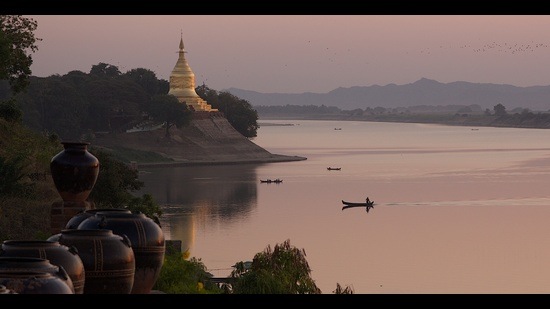
In Irrawady Imperative, the author, an army officer, attempts to address the existing “blind spots” over Myanmar evident in policy, research and academic institutions across India, and to induce what he terms as “Myanmar consciousness” in the Indian psyche. Chanda completed this book project with the nationalist think tank, the Vivekanada International Foundation, in 2020, before the coup in Myanmar this February.
With 14 chapters and an exhaustive index, the book, which draws its name from the river Irrawady that flows through the length of Myanmar, covers Burmese history and culture, projects and economics, international politics and diplomacy, and security and geography. It begins by providing two theoretical groundings – borderland studies and geographic realism. From describing the demographic and political details of the India-Myanmar Border (IBM), its importance and its unsolved issues, to talking about the Free Movement Regime (FMR) that was updated in May 2018, the early chapters of the book lay down the physical context of the area of study. Within this scope, there are many interesting stories. The reader gets a peek into how the IMB passes right through the house of the chief of Longwa village in Nagaland and how the Chief Minister of Mizoram, Zoramthanga, is connected to the Arakan Army in Myanmar. These depict the socio-political connections between the two countries and add subjective weight to the book.
Other parts of the volume are more empirical in content: Chapter 5 painstakingly provides an updated report on the Kaladan Multimodal Transit and Transport Project (KMTTP) that stands as India’s biggest infrastructure investment in Myanmar, and Chapter 12 delves into China’s investments in Myanmar on the China Myanmar Economic Corridor (CMEC), a part of its ambitious Belt and Road Initiative (BRI). In this context, the author makes an analysis: Chinese investments have usually been ‘dollar to dollar’ unlike Indian investments that engage with Myanmar’s ‘heart and mind’. However, there has been a change in Beijing’s attitude. Today, China has a more multi-layer policy that increasingly makes use of soft power. Colonel Chanda proposes that India too must engage in multi-lateral joint venture deals like the Myanmar-China Gas Pipeline project, which, in his opinion, will enhance cooperation between countries in the region.
{{/usCountry}}Other parts of the volume are more empirical in content: Chapter 5 painstakingly provides an updated report on the Kaladan Multimodal Transit and Transport Project (KMTTP) that stands as India’s biggest infrastructure investment in Myanmar, and Chapter 12 delves into China’s investments in Myanmar on the China Myanmar Economic Corridor (CMEC), a part of its ambitious Belt and Road Initiative (BRI). In this context, the author makes an analysis: Chinese investments have usually been ‘dollar to dollar’ unlike Indian investments that engage with Myanmar’s ‘heart and mind’. However, there has been a change in Beijing’s attitude. Today, China has a more multi-layer policy that increasingly makes use of soft power. Colonel Chanda proposes that India too must engage in multi-lateral joint venture deals like the Myanmar-China Gas Pipeline project, which, in his opinion, will enhance cooperation between countries in the region.
{{/usCountry}}While the theories fit well for many of the chapters, Irrawady Imperative’s contents spill beyond these. They include discussions on Myanmar’s international trials (whether it is a case with the Federal Court at Buenos Aires or the Internal Criminal Court) and Aung San Suu Kyii’s defence at the International Court of Justice against a case filed by Gambia in November 2019. Troubles pertaining to the Rohingya issue and its ensuing complications are discussed and nuances about the Rakhine conflict are also presented.
The author’s approach is analytical and factually careful while examining two things in particular. One, while assessing the Tatmadaw as feudal in its approach, he concludes that the Arakan Army, in comparison, is a rather efficient body. Two, he places an emphasis on India’s enhanced relationship with Myanmar as a result of Defence Diplomacy, especially during the 2000s and 2014 onwards.
The book uses a mixed approach in its methodology. Chanda’s primary sources include various interviews and field work that has been used throughout the text. Archival material from the personal papers of four Indian diplomats to Myanmar - YD Gundevia, SAS Tyabji, MA Ruaf and Baleshwar Prasad provide deep insights into Indian diplomatic functioning. Maps, tables and figures, used generously, give context to the various arguments. The many pictorial references remind the reader of works like Nitin Gokhale’s Beyond NJ9842 (2014).
Any reviewer complaints with the book have to do with the excessive in-text indents, an attempt to provide heavy scholarly citations, that seem unnecessary and take away from the smoothness of the narration. Some editing errors could have also been avoided. Still, the book is an excellent research compilation on Myanmar and early career researchers, especially, will find Irrawady Imperative very useful.
Shrabana Barua is Assistant Professor at the Department of Political Science, Hindu College, New Delhi