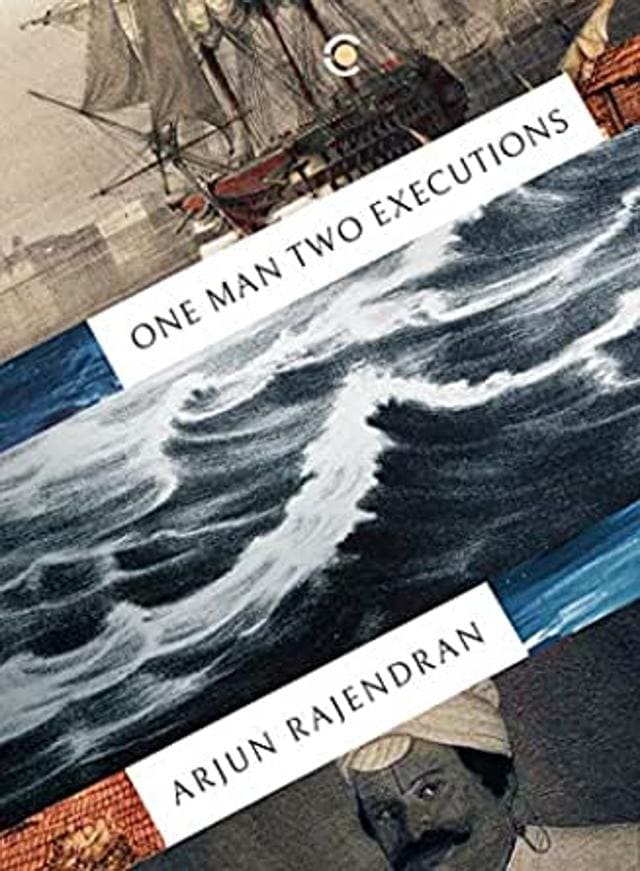
In a poem called Chéseaux’s Comet, Arjun Rajendran describes the great comet of 1744 as ‘this celestial messenger/ seen across continents, in the spyglasses of pirates/ & admirals’. In his description, the comet – a sensational astronomical event recorded in the mid-Eighteenth century – leans its nucleus ‘against the cold ribs/ of a lascar’s widow’. The poem ends with a startling image. The highly unusual ‘sextuple tail’ of the comet that rose above the horizon had been particularly noted in contemporary astronomical records. It had overawed its observers who saw it with their naked eyes. In Rajendran’s imaginative retelling of that moment, this awe is not lost, it is seamlessly evoked. The poem ends with this dramatic tail of the comet ‘aiming auguries at/ the governess, yet to outlive her daughter and grandchild’.
That’s the challenge of the genre of the ‘historical poem’, to restore affect to the archive, to recover the once-lived nature of things which end up in the records, to revivify this record. The spectacularity of the 18th century comet is not just told to us, it is realized. We are not just informed. Instead something is deftly evoked for us. The awe of the contemporaries leaks into the words. The comet aims auguries at people. Its radiance is more than any potentate’s, ‘nawab, Mahratta, or Queen’. We have both the historian’s material and the poet’s persuasion, together. One would have been amiss without the other. That’s the strength of Rajendran’s verse. In his new poetry book One Man Two Executions, he begins with a large section of ‘historical poems’, ‘spanning the years between 1739 and 1749… set in French colonial Pondicherry/Pondichéry, during the Carnatic wars’. The scale of his ambition is astounding, the archives in front of him are multitudinous, and the period of his choice is tumultuous. A poet would have needed both academic rigour and writerly restraint, and an unmistakable lyric capacity to enliven this subject material. Rajendran has each of these things.
Across its various histories, poetry has often been held hostage to the idea of the dramatic moment of inspiration. The poets are supposed to sit starry eyed and wait for the oracles to speak to them. And when it happens, the poem materialises as if out of nothing, and speaks powerfully of love, loss, abjection or ambition. Its power is supposed to come from some mysterious source and almost blindsides the poet. In practice, all this is one-third true and two-third bunkum even on a good day. In Rajendran’s verse, whose project in this book is not just ‘lyric’ but also ‘historical’, such an idea is left far behind. What takes over instead is deliberation, diligence and craft, and what is almost never associated with poetry in the popular imagination, research.
{{/usCountry}}Across its various histories, poetry has often been held hostage to the idea of the dramatic moment of inspiration. The poets are supposed to sit starry eyed and wait for the oracles to speak to them. And when it happens, the poem materialises as if out of nothing, and speaks powerfully of love, loss, abjection or ambition. Its power is supposed to come from some mysterious source and almost blindsides the poet. In practice, all this is one-third true and two-third bunkum even on a good day. In Rajendran’s verse, whose project in this book is not just ‘lyric’ but also ‘historical’, such an idea is left far behind. What takes over instead is deliberation, diligence and craft, and what is almost never associated with poetry in the popular imagination, research.
{{/usCountry}}Rajendran has scoured the ‘diaries of Ananda Ranga Pillai (1709-61), a meticulous diarist, and a dubash (interpreter) to the French governor’. He mines Pillai’s work for ‘the anecdotes, footnotes and chronicles of caste, astrology and maritime records drawn from Volumes One to Six of Pillai’s twelve diaries’. His research had taken him to the National Maritime Museum in Greenwich and to the descendants of the diarist. In his engagement with these archives, there surely must have been moments of unexpected discovery and sudden insight for him, which might look like the proverbial flashes of poetic inspiration, but here they are studiously cultivated rather than received like manna from heaven. He puts in the labour, reads the records, pauses at the details, and then uses his poetry toolbox relying more on craft than on serendipity to arrive at his poems. I am thinking multiple drafts till the archival material has been thoroughly absorbed into the poem and been refreshed by his counter-intuitive, imagistic repertoire.
This is easily evidenced in his poems. For instance, consider the one on Pillai’s own portrait, which Rajendran saw on a three-day trip to Puducherry. The density of place references, the trade inventories, the arrivals and departures of ships, the particularity of traded objects, all these ‘fade the moment he realises/ why his reflection doesn’t know him anymore,/ and immortality brings him to laughter – a portrait commissioned by a trader he saved from ruin/ now stands in place of the mirror, catching his/ heartbeat, mustachio, earrings and ego, by surprise.’ Rajendran doesn’t just describe the portrait. He imagines a moment when the diarist is observing it on his own, chuckling at what the artwork implies for his longevity long after death, reposing more trust in it than in a mirror which can betray age and illness, and finding himself surprised by his own parts and accoutrements. Heartbeat, invisible but felt, mustachio hyper-visible, earrings, customary fanfare, and finally, ego, ambient, ever-present, and even weaponised. This is an example of the layeredness of Rajendran’s historical verse. Where the historical object has gone through the gauntlet of the poetic process, where it has been absorbed, re-imagined, selected from, and even betrayed (why not), till it becomes a poem. This is the necessary condition of it becoming a poem.
This is Rajendran’s writing process for historical verse. In an interview, Rajendran said that he “read the diaries several times, and made notes whenever [he] came across descriptions of events that struck [him]. Pillai writes with a sense of self-importance. He isn’t witty or entertaining, so reading was certainly a challenge. Each poem took almost a month to write.” He confesses that “[p]eople who read [his] initial poems found them dense, so [he] realised that [he] needed to go easy on the history. I introduced more imaginary elements.” What he means by ‘going easy on the history’ is precisely the measure of its absorption. If the history juts out from the poem, if it seems like a backdrop or a mere scaffolding, or only derivative detailing, then it wouldn’t work. History, in Rajendran’s own words, is “only a launchpad for me to create ambience and images.” This book is his flight.
Akhil Katyal’s last book of poems was Like Blood on the Bitten Tongue: Delhi Poems