Recent works on the politics of the Northeast typically focus on longstanding issues like the Naga talks, the citizenship question in Assam, or AFSPA and related themes. As for Manipur, it seems as if there’s no issue worth pursuing beyond the signature themes of Irom Sharmila and the campaign against AFSPA. This is one reason I really looked forward to reading Sudeep Chakravarti’s most recent work, The Eastern Gate: War and Peace in Nagaland, Manipur and India’s Far East.
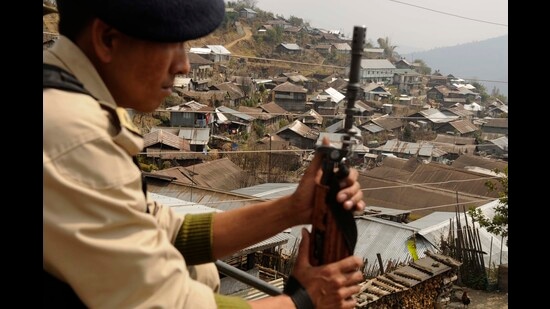
However, after reading the book – which, at 400 pages or so, is a big one by today’s standards – I came away mildly disappointed.
Chakravarti has cast his net wide. There are 42 chapters divided into three sections titled Smoke, Mirrors, and Smoke and Mirrors. Rebels, gun runners, dealers of narcotics, bureaucrats, activists and politicians are all afforded space on these pages. Interspersed with the narration are subsections called Notes which, presumably, are copied from the author’s records of meetings and observations between 2008 and 2020. An acute observer and a master narrator, Chakravarti tells his stories in breezy style, as if recalled from memory. There are puns and wordplay aplenty. Appropriately inserted, these can add verve and lend immediacy to the narrative. An excess can and does trivialise it.
Unlike academic research, works of this nature do not come with a preset thesis. The agenda is open ended and issues are picked up along the way and analysed through interviews with interested parties or by re-reading news reports concerning them. Inevitably, there is a lack of depth. Chakravarti is clearly fascinated with the region and sounds well grounded in its political play. He tries to project hope, but cynicism is writ large. In some measure, he succeeds in capturing the suffocating wave of resentments that smoulder through the land. The blame is primarily with the State and its machinery, which are content to “manage” the crises in the region instead of seriously seeking a resolution. As he emphasises, it is official indifference and unresponsiveness that often catapulted local level demands for autonomy or complaints about lack of development to the status of a war with the State. If there is political will, many of the region’s crises are solvable.
{{/usCountry}}Unlike academic research, works of this nature do not come with a preset thesis. The agenda is open ended and issues are picked up along the way and analysed through interviews with interested parties or by re-reading news reports concerning them. Inevitably, there is a lack of depth. Chakravarti is clearly fascinated with the region and sounds well grounded in its political play. He tries to project hope, but cynicism is writ large. In some measure, he succeeds in capturing the suffocating wave of resentments that smoulder through the land. The blame is primarily with the State and its machinery, which are content to “manage” the crises in the region instead of seriously seeking a resolution. As he emphasises, it is official indifference and unresponsiveness that often catapulted local level demands for autonomy or complaints about lack of development to the status of a war with the State. If there is political will, many of the region’s crises are solvable.
{{/usCountry}}The book chronicles attempts at peacemaking at the community level between the Kukis and Nagas in Manipur. The bloodshed during the 1990s has remained a bitter memory and a sticking point between the two communities. The author records the peace overtures made by the Kuki Inpi Manipur (KIM) to their Naga counterpart, United Naga Council (UNC). “What do you want? Since you people started it, you have to say sorry. Then we will do the same, also say sorry… Solution is not in Geneva or Delhi. Solution is with us only” he recorded Thangkhosei Haokip, the president of the Kuki Inpi as saying, sometime in 2010. Response: “Armed group not agree.”
“Armed group” here refers to the National Socialist Council of Nagaland (IM). The shenanigans of the NSCN (IM) take up a major chunk of the book and not in a flattering way. The group continues to occupy a predominant position in Naga political talks. Yet, it still struggles to find popular acceptance in Nagaland. While the Meiteis see them as a major threat to Manipur’s integrity, the Kukis accuse them of genocide, no less. Even among the Zo groups in Manipur, realisation is dawning that it is actually this group that has always stood in the way of pan-tribal autonomy movements in the state.
Yet another body with which the group was at loggerheads was the “oddly-named but resolute” Against Corruption and Unabated Taxation (ACAUT). ACAUT was a Nagaland civil body set up in 2013. It carried out campaigns against excessive “taxation”, or extortion by underground groups in Nagaland and also exposed scams relating to recruitment to government services, the misuse of funds and bogus electoral rolls. The campaign generated widespread support and put the armed groups on the back foot. The relative success of groups like ACAUT is a rare bright spot in the region’s politics and a source of hope. Chakravarti asks why such campaigns were not replicated in places like Manipur. Why, indeed?
The book also discusses in some detail the UNC’s demand for what they called “alternative arrangements” for the Naga areas in Manipur. Another important issue that the book broaches relates to the unaccounted wealth of politicians and bureaucrats and UG leaders visible in the form of expensive farm houses, resorts and hotels, bungalow-and-Airbnbs and apartments in major cities in India and abroad. Sadly, the author did not go beyond quoting a few CAG reports of malfeasance and dropping some locations without details.
I am also surprised that the poppy menace figures so little in the book. Poppy is a huge issue and the viral videos of children harvesting it and the Manipur government’s very loud attempts to physically destroy poppy fields testify to the scale of the malaise. College classes run half empty during harvesting season. And how could one, writing on political intrigues, miss the drama and controversy that attended the election of the titular king Sanajaoba to the Rajya Sabha in 2020?
All said and done, there are just too many stories still waiting to be told; stories that will likely remain untold, unless someone like Chakravarti records and tells them. The Naga talks remain in limbo. The poorly-written framework agreement of 2015 ended up pulling the two sides further apart. The last dispatch received on the matter, dated 5.10.2020, read: “Muivah has decided he cannot die leaving a legacy of surrender.” Where do we go from here? Chakravarti should sharpen his pencil and come back with a new notebook.
Thangkhanlal Ngaihte teaches political science at Churachandpur College, Lamka, Manipur