
 E-Paper



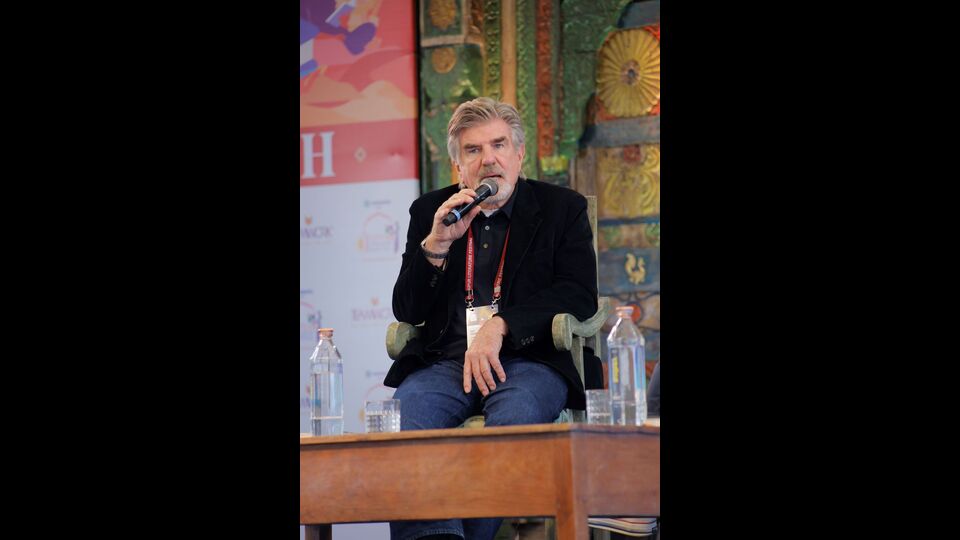
Tom Freston: “I like being on the edge”
At the Jaipur Literature Festival, the co-founder of MTV and the author of Unplugged: Adventures from MTV to Timbuktu spoke about surviving 1960s counter culture in the US, India as a leader in advertising, and the fallout of Trump’s tariffs

 Prefer HTon Google


Your parents’ generation valued stability while you were a product of 1960s hippiedom. What was your relationship like?
Well, my parents were really supportive. But they were questioning what I was doing. My father had really imbued in me a sense of making my own money, so I did every menial job imaginable. I worked my way through college. Then, when I got out of school, I took a year off, but I would always bartend or work; I was always making money.
My parents wanted me to get a ‘real’ job. What we used to call, a grown-up job. Like a reporter for the Hindustan Times. But I resisted. I worked in an advertising agency. They were really proud of me then, because I was in a legitimate company. Then, I told them I was going to quit and go around the world. I had saved enough money to do it. I lived on a shoestring, though. When I came back and told them I wanted to start my own company in India and Afghanistan, they shook their heads, but they were supportive.
In the end, when I was successful, they were really proud of me. You know, other parents would have said, ‘You shouldn’t do this and that; you’re wasting your life.’ My parents were willing to take a chance on me, but would often shake their heads.
How did you manage to avoid being swayed by the Haight-Ashbury hippie counterculture era in the US and later in Afghanistan too? How did you keep your entrepreneurial clarity intact?
I saw a lot of people fall off the trail. There used to be a whole graveyard in Kabul of kids who had overdosed. I was never a big drug user. I’d smoke hashish occasionally or have a few beers. I had more self-control because I could sense it wasn’t a good long-term strategy. I enjoyed the music world, but I wasn’t necessarily a drug user. I enjoyed the music that was being made by some of the wilder brands. I wanted to live along on the edge. That was exciting to me. But I just felt I don’t want to become a drug addict.
I was always a sort of businessman, I guess. I wasn’t a musician. Or an artist. But I enjoyed being around them. I enjoyed creative work, and being associated with creative people; I could think creatively. I was more of a business person, which is why I took the path I took, and I took it very seriously without going overboard with the party scene.

You write, “To me, over in marketing, MTV was a lot like Kabul.” Please explain.
Yeah, so, people would always say, ‘Oh, boy, Kabul is like a crazy place.’ But I was thinking of the Westerners who lived in Kabul at the time as well as some of the Afghans that I used to do business with. However, this statement was mostly about the Westerners there, who chose to live there in the 1970s. Those people were a little on the wild side. They were a little bunch, had outside personalities. They were risk-takers. Wild.
When I went to work at MTV, not just the marketing department, which, at the time, only had three people, but also the entire place, it was insane. Nobody there had an MBA or had gone to college; they were all music fanatics. They were wild. It was a wild time.
Was the wildness that you talk about somehow related to the notion of being an ‘outsider’?
Yeah, we were all outsiders, basically. We were working on rock and roll, an outside art form, because even people in the entertainment business never took it seriously, but they made a lot of money. These people always thought that the rock-and-roll artists were a little bit sleazy. It wasn’t great, but it [the music] appealed to me.
I like being on the edge, and people who were attracted to come to the company [MTV] were also on the edge. Not your normal, job-seeking, traditional corporate people. The things that I learned from my eight years in Asia were the perfect training ground for all that I did in the company, leading non-conformist people. I understood where these people were coming from, and that’s why I had a more lenient hand because I wanted the place to be both fun and purposeful. I wanted us to take risks.
The things that I learned [in Asia], like humility, empathy, being tolerant of outsized, unusual characters, risk-taking, and working on a shoestring, were all things I valued.
In the book, you note how MTV’s biggest concern was the remote control. With music aggregators like Spotify and the AI, ChatGPT-led disruption in the music industry, what’s your take on where things are headed?
People always said, MTV, you help shorten people’s attention spans. I really believe that if we had all of that stuff 50 years ago, as people did with remote control because there was a demand [for a variety of things], people would be doing [all sorts of things]. I think it’s just human nature.
Now, we live in a world where everybody can watch anything they want on any device at any time they want. How do you even function in this world and get people’s attention? It’s a huge challenge. Part of me says, ‘Wow, I’m glad I’m out of it. I don’t have to deal with that.’ The other part says you have to be a master of social media. You need younger people to help show you the way. I don’t think it’s impossible if you’ve a good product. Good things still somehow get found, but you’re never going to have a sort of what I would call the monoculture that we had. Like you had in India in the 1990s, with a limited number of TV networks. Today, we’ve a culture where everybody is just moving from place to place, which is very challenging. We require really smart people to navigate this change, and I’m not the man for that job right now.
Unlike the 1990s, why aren’t any really memorable ads being made anymore?
Because most people screen ads out now. The predisposition against advertising is greater than ever. People look at an ad as an interference. They find that this isn’t something that tells someone how to make their life better. People find ads a pain in the a**. Though people still make great ads. But that’s the thing, some of the ads work, and some don’t. That’s always been the case in advertising.
Advertising is the bedrock of the consumer economy. It helps create an augmented demand that’s required for the juices to flow, so to speak. I’m a believer in advertising, but running an advertising or media company today is more challenging than ever. India is really a leader in this area. There have been so many great minds coming out of India in terms of advertising and marketing communication that I see everywhere.
You write about Jimmy Carter’s protectionism. Please reflect on economies being disrupted with Trump’s tariffs, and the younger generation of entrepreneurs being affected because of government policies.
I feel so sorry for young companies in the States. Companies that aren’t big, who can maybe take a hit like Apple, but someone who’s importing furniture from Indonesia, or someone who’s importing clothing, they don’t have a lot of money to play around with. They’re getting wiped out. Their dreams are being dashed. They had really wisely created a supply chain, and then all of a sudden, a guy comes in, and one day, he changes the rules. I think this is worse than Carter’s [time].
Trump is doing this unilaterally. He doesn’t need any Congress or anyone to support him. It’s really disgraceful, this idea that we’re going to bring manufacturing back to the States. It’s just a dream. It’s not going to happen. Who’s going to invest money in a factory in the States when they see that it’s so mercurial, the leadership? Nobody. Prices are going to be higher. Unemployment is going to be higher. A lot of young and middle-aged people who have small or medium-sized companies are going to go out of business. I remember, in my day, all Indian exporters were really hurt when the US market closed down. What’s happening is going to be a lot worse. The Indo-US relationship was getting strong, and I think that progress now has stalled. But I’m an optimist at heart, too, and I think this era will pass and will be seen as a hiccup, and we’ll get back to dealing with common sense.
Saurabh Sharma is a Delhi-based writer and freelance journalist. They can be found on Instagram/X: @writerly_life.


