American writer Ursula K Le Guin, who died on Tuesday, would hate most of her obituaries.
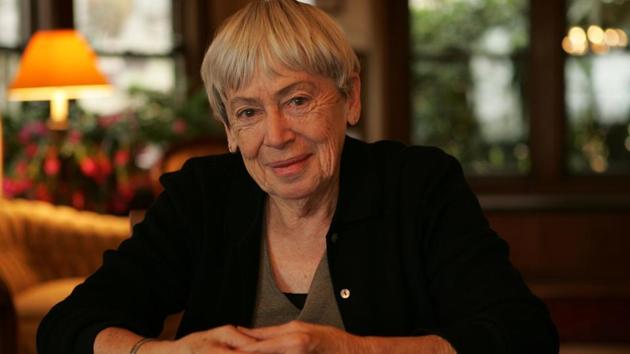
Newspapers and magazines have called her a ‘feminist science fiction author’, ‘a novelist of speculative fiction’, ‘a wordsmith of startling originality’, ‘a fierce social critic’, ‘literary icon’ and ‘a poet of uncommon talent’. These are exactly the compartments and clichés she spent a lifetime – 88 years – dismantling.
Many used the word ‘prolific’. She’d have hated that too. Her vast output encompasses novels, essays, poems, short stories, podcasts, translations and children’s books. But she’s torn apart interviewers, fans, and the SciFi channel, for reducing her ideas to summer-blockbuster stereotypes. (To be fair, The Legend of EarthSea miniseries was indisputably cheesy.)
What Le Guin would hate most was if her legacy were reduced to quotable quotes, no matter how well they’d fit a tattoo or T-shirt. She gave words more power than most writers do. In EarthSea, an early fantasy quartet, power grows from knowing the ‘true names’ of things and people. In The Dispossessed (1974), the people of Anarres have the same word for work and play. Many aliens she invented had no word for war or love. In her fantasy worlds, morality is inseparable from grammar; stones have longer thoughts than people; eloquence can be weaponised.
Le Guin’s work has won Hugo, Nebula, Locus and World Fantasy awards. She’s a Grandmaster of Science Fiction – the genre’s top honour and one rarely awarded to women. Her good guys weren’t always white. Her characters’ genders are not always male-female. Many of her warriors did no battle – they grappled with philosophical dilemmas and the social order as much as malicious shadows and dragons. And her fantasy worlds aren’t magical; they’re there to test the limits of language, cultural differences, power and humanity. Even her poems – short, withering, often offering no redemption – are about anarchy and a crippling normalcy that must be overthrown.
{{/usCountry}}Le Guin’s work has won Hugo, Nebula, Locus and World Fantasy awards. She’s a Grandmaster of Science Fiction – the genre’s top honour and one rarely awarded to women. Her good guys weren’t always white. Her characters’ genders are not always male-female. Many of her warriors did no battle – they grappled with philosophical dilemmas and the social order as much as malicious shadows and dragons. And her fantasy worlds aren’t magical; they’re there to test the limits of language, cultural differences, power and humanity. Even her poems – short, withering, often offering no redemption – are about anarchy and a crippling normalcy that must be overthrown.
{{/usCountry}}One line from The Left Hand of Darkness (1969), “It is good to have an end to journey towards; but it is the journey that matters in the end,” is often attributed to Ernest Hemmingway. The error is ironic. Le Guin’s books resisted male-female power dynamics. One race of aliens lived as hermaphrodites, switching to male or female at mating. She scathingly refused to blurb a book of short stories that had no female writers. And she pushed science-fiction itself into a genre for more than young boys.
One of her quotes, “You cannot buy the revolution. You cannot make the revolution. You can only be the revolution. It is in your spirit, or it is nowhere,” may just echo through 2018. The line from The Dispossessed (1974) has a catch-all quality that works for with #MeToo, Trump’s last tweets, a mass-shooting, caste politics and jauhar threats. A more empowering line, perhaps, is one Le Guin used in an interview, describing herself as more than a sci-fi author: “I don’t fit because I’m all over. My tentacles are coming out of the pigeonhole in all directions”.
Don’t put it on a banner. She’d probably hate that.