I am mostly an urban and popular sights explorer, but last year my sister’s trip to Kenya spiked my interest in safaris. It was easy for me to decide on Tanzania, home of the biggest wildlife savannah in the world. And even easier to get there: I booked the trip based on my vacation days instead of thinking about weather, migration etc., and it worked out just fine. Most people visit Tanzania during the great migration period – that means higher prices and an obstructed view of the land and life (during peak season, there are about 100 safari vehicles in the grasslands, rather than the usual five to seven).
The elephant’s suspicions
I started from Arusha, the gateway to the safari circuit in Tanzania. My first night was at a lodge in the foothills of Mount Meru, where I’d been welcomed with the traditional Hakuna Matata song. The safari began the next morning after a drive to Tarangire National Park, where I spotted a herd of zebras, hundreds of them, moving freely in the open. The zebras’ best friends, the wildebeests, were also in the herd; this was my first ever view of these animals. Though they look intimidating and their name is frightening, they are actually very shy animals.
The next stop was a traffic jam. But not because of cars – an elephant family was crossing the track! Adult elephants always walk at the front and end of their convoy, keeping younger elephants between them for safety. Then came my first lion, lying down, and relaxed. Naturally, I took a selfie. After all, lions know this is the iPhone era, and they are cool with it. In fact, they are totally comfortable with the humans around them, never react angrily, or in fact, react at all. On one occasion, when the driver of my vehicle slammed a car door to wake up a sleeping lion, it just gave us an annoyed look and went back to sleep.
{{/usCountry}}The next stop was a traffic jam. But not because of cars – an elephant family was crossing the track! Adult elephants always walk at the front and end of their convoy, keeping younger elephants between them for safety. Then came my first lion, lying down, and relaxed. Naturally, I took a selfie. After all, lions know this is the iPhone era, and they are cool with it. In fact, they are totally comfortable with the humans around them, never react angrily, or in fact, react at all. On one occasion, when the driver of my vehicle slammed a car door to wake up a sleeping lion, it just gave us an annoyed look and went back to sleep.
{{/usCountry}}Safari parks have a rest area for picnic lunches and bathroom breaks. My lunch was consumed amidst scenic savannah views and a river. While I protected my food from the hungry monkeys hanging around, I spotted giraffes that were even taller than the treetops they were eating, and ostriches that refused to hide their heads in the sand. By the end of the day, it felt as though I was on the set of an animal-themed movie.
Gentlemen, mark your territories
On the road to Serengeti the next day, I found myself chatting with local kids who wanted not only to sell souvenirs, but also exchange Bollywood gossip. I also toured a Masai village, where I learned that tourists must never wear red or brightly-coloured clothes – the Masai wear those colours which stand out against the drabness of the savannah, and warn animals of human presence. Khaki and earth tones are best for visitors.
After a drive through a rainforest, we arrived in the savannah. And thus began my game drive, with hundreds of zebras and wildebeests on both sides of the track. By now I had seen them so often that it felt as though they were humans around me in a city. There were also scary-looking hyenas, as well as gazelles and antelopes with beautiful skin and curvy horns. These animals frequent the open savannahs because predators can be easily spotted.
Safari drivers keep in touch with each other via radios, sharing information on interesting animal sightings. So when my driver began moving with focus, I figured we were about to see something specific, Sure enough, we got to a stream where a lion and his family were spending a relaxed afternoon. Cubs were walking over the lower branches of a tree, the lion was watching over his family, and also keeping an eye out for other animals, and a lioness appeared from a bush with a small cub that had strayed to an unsafe zone.
By nightfall, I was in a tent right in the middle of the Serengeti. One main tent had a dining area, and visitors have six tents on either side of it. We were briefed upon arrival not to walk without a staff escort in the dark, to blow the whistle they’d given us in case of any danger, and to zip our tents at night for safety.
Considering it was in the middle of a wildlife park, the tent had a comfortable bed, dim battery-operated lights, a torch and a whistle. The small overhead tanks were manually filled with water for the toilet and shower. After dinner and a bonfire, we were escorted back to our tents, where I waited excitedly for visiting lions. No lions appeared, but hyenas and other animals did wander through the camp, nosing around the tents. I even saw a tail in the shadow, phew! Though it was scary, this was my favourite night of the safari.
Where art thou, rhino?
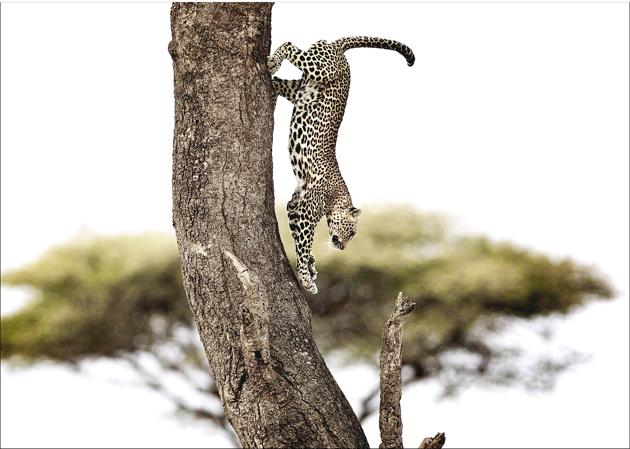
The next day’s game drive started from a tree with birds sitting on every branch, as if they were posing for a photoshoot. We saw a few cars near a rock and figured something was going on so we drove there. A leopard was fast asleep on the rock, but since it refused to wake up, we moved on. The next scene was a blockbuster: two cheetahs chewing on a gazelle. But the third scene was a bore: a pond full of hippos.
But I did have an adventure soon enough. Spotting an Instagram-worthy group of giraffes against the backdrop of the mountains, I asked my driver to slow down so I could take a few pictures, and he stopped the car. But then the engine would not start again, giving us all the shivers, till another safari car behind us pushed our car to restart.
After driving through narrow, curvy, rollercoaster roads in heavy rain, we arrived at the lodge where I was going to spend my last safari night, atop a hill overlooking the Ngorongoro crater, and surrounded by zebras and buffalos. The Ngorongoro crater is a safari park in itself, it had a high concentration of diverse animals. Zebras and wildebeests were in abundance, so were lions, flamingoes, and other unique birds. I finally managed to spot a hippo family outside their pond, including a baby hippo, and promptly took a bunch of selfies. By now I had seen four (lion, elephant, leopard, buffalo) of the savannah’s ‘Big 5’ animals. The fifth of The Big Five, rhinos, were hard to spot.
Thus ended my safari, which gave me a year’s worth of education about wildlife and nature in just four days. Reading or watching documentaries is not the same thing as experiencing the wild. And this experience will stay in your memory forever.
(Author bio: The author is a finance professional based in New York. He is enthusiastic about travel and has set sights on travelling to 50 countries in the near future. Follow him on Instagram at @travel.arvin)
From HT Brunch, March 18, 2018
Follow us on twitter.com/HTBrunch
Connect with us on facebook.com/hindustantimesbrunch