Have you ever wondered what Ram, Lakshman and especially Sita wore when they were exiled from Ayodhya, for 14 long years? They surely could not have been wearing the costly raiment they would normally wear at court, so I like to think that they wore the simplest of hand-spun and hand-woven khadi; the men in classically-draped dhotis or lungis, and the lady in sturdy cotton, softened by many washes and faded to a whisper of its original, vegetable-dyed colour. A small bag of saris and few gamchhas to cover the upper body with would have completed Sita’s wardrobe.
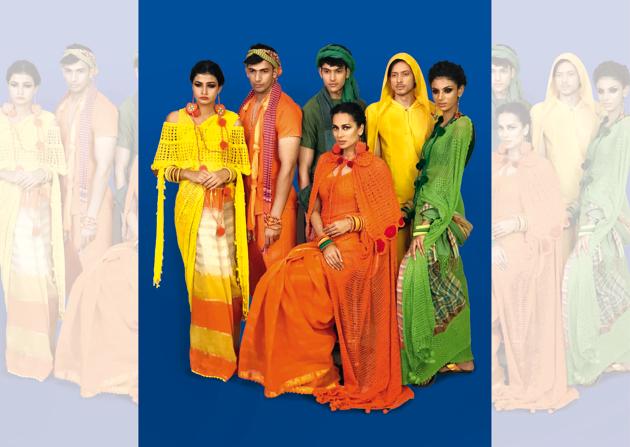
Colonial prudes
Cholis and petticoats came much later. These were actually designed to conform to prudish Victorian wardrobe diktats, issued to prevent Indian women from exposing their bodies to the male gaze. The women of Kerala dressed only in the mundu, or lungi, leaving their upper bodies bare, much to the colonists’ consternation.
It is said that Rabindranath Tagore’s sisters were once banned from attending the British governor’s ball in their delicate, transparent, muslin saris which left little or nothing to the imagination. For good measure, they had painted their lower halves with alta, a deep red vegetable dye, to further enhance their contours. We can only imagine the scandal this caused amongst the prim expatriates.
The concept of patterned garments comes to us from the Mughals. Until then, we draped ourselves in fabrics like cotton, wool and silk, in myriad styles. Even now there are almost 18 different styles of sari-draping still in use all over India. The most common style of wearing a sari is the Mysore style: the ulta-palla where the usually embellished palla is thrown over the left shoulder, with the pleats in front. Other variations include the seedha-palla, where the palla is taken behind and pulled forward over the right shoulder, as seen in the Gujarati sari with the pleats in front, or the Coorg sari where the pleats are at the back. Both styles wear the palla draped forward over the right shoulder. The dhoti styles for men also vary, and you mostly find these still worn in Andhra Pradesh, Telangana, Rajasthan, Bengal and Odisha.
{{/usCountry}}The concept of patterned garments comes to us from the Mughals. Until then, we draped ourselves in fabrics like cotton, wool and silk, in myriad styles. Even now there are almost 18 different styles of sari-draping still in use all over India. The most common style of wearing a sari is the Mysore style: the ulta-palla where the usually embellished palla is thrown over the left shoulder, with the pleats in front. Other variations include the seedha-palla, where the palla is taken behind and pulled forward over the right shoulder, as seen in the Gujarati sari with the pleats in front, or the Coorg sari where the pleats are at the back. Both styles wear the palla draped forward over the right shoulder. The dhoti styles for men also vary, and you mostly find these still worn in Andhra Pradesh, Telangana, Rajasthan, Bengal and Odisha.
{{/usCountry}}Winning the wardrobe
Indian women in the South managed to retain wearing the sari through several invasions, including the Mughals and the British. They preferred the hand-woven sari, possibly the most unstructured garment in the world. When worn, it has the ability to change character and affords a high degree of flexibility in the wearer’s choices. Most photographs of the colonial years show our grandmothers and mothers always in a sari, while our male ancestors looked like brown sahibs in their highly unsuitable suits.
In fact, when Gandhiji called for the burning of imported textiles as a mark of protest against the British rule, the women hardly had anything to burn.
In recent years, there has been a move to bring draping styles for men back to the fashion forefront. It has limited popularity in the wedding market, because for men, the idea of having to drape five meters of fabric for a dhoti is daunting. This led to that abomination – the tailored dhoti, which you pulled on like a pair of pants, with the pleats artfully arranged and pre-stitched for convenience. The lungi is an easier option and you find it all through India, Sri Lanka and South East Asia.
The ancient Greeks and Indians had much in common. Both favoured draped garments, though the Greeks introduced elements of tailoring into their togas and wraps. The evolution of weaving across more than 30 centuries ran undisturbed till the advent of the power loom by Edmund Cartwright in 1785. Till then, the human race only wore khadi in wool, silk and cotton. Dating back to the Indus Valley Civilisation, the art of fabric draping evolved slowly across the centuries and textile weaving became a refined and valuable craft.
Designers are now scrambling to reinvent the sari to make it more appealing to the younger generation. The tailored sari is worn like a gown and the designer fits it to your body with a lot of extra embellishments like ruffles, pleats and pin-tucking. But the woman who knows how to drape the perfect sari with little individual touches will be the woman who always has something to wear!
Prasad Bidapa is a Bengaluru-based style and fashion curator, with over four decades of experience in the fashion industry
From HT Brunch, August 2, 2020
Follow us on twitter.com/HTBrunch
Connect with us on facebook.com/hindustantimesbrunch