In the winter of 2013, I went to Northern Belgium following the boot marks left by Indian soldiers who had fought, bled and died there a hundred years
before I set foot on the land. Driving past the verdant countryside dotted with dreamy villages and quaint towns, it was hard to believe during World War I, Indians were fighting their way through the fields of Flanders in a war that they had nothing to do with.
The northern region of Belgium that borders the Netherlands is called Flanders and the language they speak is Flemish, though I have it on authority that it really is Dutch with a bit of accent. The Flanders region of Belgium is a modern day Don Quixotic land, where huge wind turbines dot the countryside… And then you chance upon the occasional old windmill that tells you to stop and hear its story.
My Flanders story begins in Brussels, the bustling (unofficial) capital of the European Union. Tram lines, office hour traffic and comics capital of the world, I found Brussels neither nothing more nor less than my expectations. Historic buildings beside modern avant-garde architecture, this was one busy city trying to keep pace with the demand for space. Apart from the well known Hergé Museum that is a bit on the outskirts, Brussels hosts some 80 other museums and has countless restaurants for those who like to be serious about food. But be warned that at the upmarket ones, the menu and choice of wine in French, Flemish and even English can be intimidating. (I didn’t really always know what I was eating but it all tasted very good.)
Please mind your heart
{{/usCountry}}Please mind your heart
{{/usCountry}}From Brussels I went to Ypres or ‘Ieper’ as it is locally called in Flemish. Ypres is about an hour and a half by car from Brussels and this small town dates back to the Middle Ages when there was a canal that ran right through the city centre. It was here that in October 1914, the Indian troops were fed piecemeal into some of the fiercest fighting that took place during WW I.
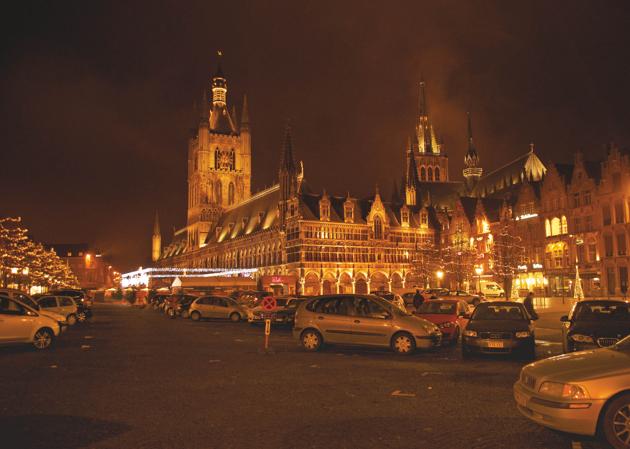
An imposing Gothic style building that I took to be a cathedral turned out to be what the locals still call the Cloth Factory. This was the heart of Ypres back in the days when trading in cloth was what ran the economy of the place. Today it houses the In Flanders Fields Museum that showcases the brutality of the First World War. I found some Indian Army artefacts on display, including a khukri from a Gurkha soldier of 1915.
Ypres remained in the thick of battle for all fours years of WW I and was completely demolished. All around Ypres stretched the trenches...miles upon miles of dugouts and shallow canals where men lived, fought and died. The hundreds and thousands of deaths are now marked by the cemeteries that dot the region.
Of late, on TV or in person, the reader may have seen Europeans wearing red poppies on their coat lapels. Those are in commemoration of the poppies that grew on Flanders Fields, immortalised in the most quoted poem from WW I.
In Flanders Fields by John McCrae
In Flanders fields the poppies blow
Between the crosses, row on row,
That mark our place; and in the sky
The larks, still bravely singing, fly
Scarce heard amid the guns below.
We are the Dead. Short days ago
We lived, felt dawn, saw sunset glow,
Loved and were loved, and now we lie
In Flanders fields.
Take up our quarrel with the foe:
To you from failing hands we throw
The torch; be yours to hold it high.
If ye break faith with us who die
We shall not sleep, though poppies grow
In Flanders fields.
Every nationality and region that sent soldiers to fight in Flanders finds mention on the grave stones that stand reminder to the horror that visited this land. Tucked in corners of such cemeteries I saw the memorials of those Indians who never came back. Many of those tombs did not have names; they just said ‘An Indian Soldier of the Great War’. On a tombstone of a young English soldier, I read what his father had engraved in remembrance, ‘Sacrificed to the fallacy that war can end war’.
To one side of Ypres is the Menin Gate through which the soldiers marched to battle to defend the town. The Menin Gate is like the India Gate in New Delhi: it is a memorial to the war dead and, like the India Gate, has etched on its walls the names of those who fell in battle during WW I. I saw the Indian names etched on those walls among those who never came home.
Every evening at 8pm, in a tradition that began in 1929, the traffic stops as a small band assembles to play the Last Post. This ceremony has continued ever since then except for a period of four years during World War II, when the town was under German occupation. On the very evening that Polish forces liberated Ypres, the ceremony was resumed at the Menin Gate, in spite of the heavy fighting still going on in other parts of the town.
The Flanders winter is damp and cold, but at night Ypres is a sight out of a fairy tale. Standing there on the cobbled streets, looking at the buildings all around, it is very easy to be transported 100 years back in time. Quaint family run hotels overlook the Cloth Hall façade and it is an experience lying in bed and staring at the belfry of the building. Here is a tip for the tippler while in Flanders: do taste the Trappist Beer, the darker the colour, the better and stronger it is.
Please mind your mind
Next stop Ghent: Under the watchful eye of Gravensteen Castle or Castle of the Counts, the city boasts an Opera House, 18 museums and 100 churches. At Ghent I decided to get myself a glimpse of a mystic lamb. The Adoration of the Mystic Lamb is possibly the most famous painting in Flanders. Painted by the brothers Jan van Eyck and Hubert van Eyck in 1432, it once again hangs in its original location at St Bavo’s Cathedral.
The Ghent Altarpiece is said to be the most stolen artefact in history and it came back to St Bavo’s after 600 years of nearly constant movement. At one time or the other it had been in the possession of some of history’s most famous figures, including Napoleon, Goering and Hitler. After WW II, it was rescued by The Monuments Men... that story is known to anyone who has seen the George Clooney movie by the same name.
Ghent is also Flanders’ biggest university town, which means linger-as-long-as-you-like cafés and a laid-back atmosphere. In the evening I took a barge ride on the canal, sipping champagne as the boatmen skilfully guided their vessel under bridges that date back to the middle ages. I am almost sure that the maximum gap between my barge roof and the bridge could not have been more than four inches...so mind your head when in Ghent!
A trip to Flanders wouldn’t be complete if you missed Antwerp of diamond and fashion fame. But it wasn’t diamonds or fashion that I looked at in Antwerp, I went for history, and art and culture. There are some really interesting museums here, the newest attraction being the Red Star Line Museum that opened in September 2013.
The Museum is housed in the original warehouses of the Red Star shipping line that operated between 1873 and 1935. The core theme of the museum is immigration and it revolves around the individual stories, artistically symbolised by packed suitcases, representative of the millions who sailed from Europe to America in search of a new life.
When in Antwerp, don’t miss a visit to the Central station even if you are not taking the train anywhere. It is called the Railway Cathedral and for good reason too. Built in 1905, it does look like a massive house of worship instead of a train station, with three semi-subterranean levels that link Antwerp to the rest of Europe.
Europe has been commemorating the centenary of the Great War since 2014 and in Flanders too, towns and villages have organised many exhibitions and history tours that relive the events of those terrible days. For Indians interested in remembering the exploits of the
Indian Army, a trip to Flanders would be an eye opener, about a near forgotten contribution that India made to the outcome of history.
The author Sujay Bhattacharyya, who now goes by the name Shoejoy, is an award-winning TV producer and documentary director based in New Delhi.
From HT Brunch, February 18, 2018
Follow us on twitter.com/HTBrunch
Connect with us on facebook.com/hindustantimesbrunch