Global runways and fashion campaigns have always set very high standards in the perception of beauty– and they have always been inaccurate and unrealistic. People come in all shapes and sizes; fashion’s ‘model standard’ is meaningless in the real world. And now, finally, there has literally been a curve in the acceptance of diversity: the recent digital shows by Versace and Ferragamo that included body positive models seem to be pioneering a global shift in the thought that fashion only caters to the thin.
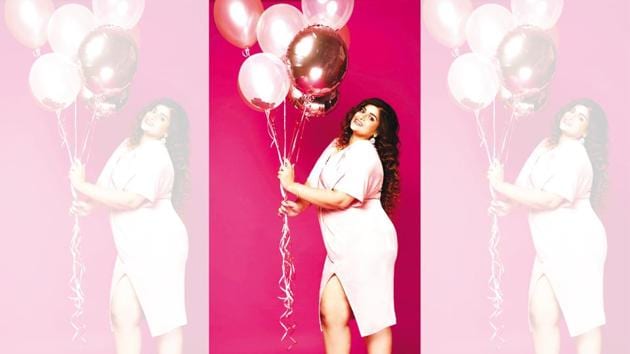
Diversity is the new normal
“Fashion will pass by people who don’t accept this change and leave them behind,” says designer Narendra Kumar Ahmed, one of the first few Indian designers to create a collaborative collection especially for plus sizes that was showcased at a fashion week with only curve models. “This is an important aspect of how the millennial views the world. It’s about being happy in your skin. You can be any size and be healthy.”
The fact that the label has changed from ‘fat’ to ‘curvy’ shows how deeply the change is setting in, says model Apoorva Rampal. “Just a few years ago, having plus-size models in a fashion show would have been unheard of, yet ,here we are now walking at top fashion weeks. We are on the right path now, but there is still some ground to cover till we reach the point where the fashion industry is closer to representing all types of people in society,” she says.
Genetically, Indians aren’t tall and statuesque. So, are the lines between real, aspirational and surreal all too blurry? “India has always had the boutique culture so people have had access to clothes that are made to measure. While we have catered to clients of all body types, the only difference is that we are communicating that as well now,” says designer Gaurav Gupta whose recent showcase at India Couture Week had diverse representation, including, a curve model. “All over the world, the definition of standard model sizes is changing. India, in a way, has always celebrated diversity, now we are celebrating it in the communication as well.”
{{/usCountry}}Genetically, Indians aren’t tall and statuesque. So, are the lines between real, aspirational and surreal all too blurry? “India has always had the boutique culture so people have had access to clothes that are made to measure. While we have catered to clients of all body types, the only difference is that we are communicating that as well now,” says designer Gaurav Gupta whose recent showcase at India Couture Week had diverse representation, including, a curve model. “All over the world, the definition of standard model sizes is changing. India, in a way, has always celebrated diversity, now we are celebrating it in the communication as well.”
{{/usCountry}}Payal Soni, social media influencer and body positivity champion in the iconic Olay campaign, feels that Indian brands need to understand that we have different body types. “They should stop obsessing over conventional model size and start concentrating on people who have different sizes as the world is moving forward in terms of body image,” she says.
Models find their footing
Designer Sabyasachi has created several benchmarks, one of them being the presence of a curve model in his campaign. Varshita Thatavarthi is the perfect example of being in the right place at the right time. A chance meeting with the designer led her to a place in his prestigious campaign. “After my first campaign with Sabyasachi that released last year, I was fortunate to garner the support of many women who were battling the weight prejudice inflicted on them by society. I was overwhelmed with the response I received on social media. Sabyasachi has helped me become the instrument of change,” she says.
Apoorva landed a place in Katrina Kaif’s Kay Beauty campaign. “Having someone like Katrina Kaif stand for body positivity really helps spread the message to a much wider audience,” she says.
“When I held the castings for my show, over five hundred people came to audition. This was the beginning of a mission; some of the first timers at the show have gone on to become popular models in the curve section,” says designer Narendra Kumar Ahmed.
“Fashion evolves with culture and culture with fashion. They’re in a continuous dialogue with each other,” says Gaurav Gupta. “Change happens when the world is ready to see fashion in a different way and, in effect, fashion begins to see the world differently.”
Narendra Kumar Ahmed adds, “If I design differently, then it would mean that I’m going with preconceived notion of what a person of a particular size should wear. That really defeats the idea of diversity.”
Baby steps or a giant leap
“In India, I find it annoying when models are expected to be size 2 when an average Indian woman is size 16. So, who exactly is the fashion industry representing?” questions Varshita. “I think we still have a long way to go since I don’t see much representation of curvy models in Indian designer campaigns or even in magazines.”
Apoorva agrees, “It’s about breaking the mould of unrealistic feminine beauty standards. I am optimistic about the future of the Indian fashion industry. We need to build on the momentum; we have to drive change.”
But what will steer this closer to its goal? Payal puts it in the hands of big brands: “Things are changing slowly and one day, I hope we will see that everyone is treated equally without discrimination.”
And how does one urge the industry at large to make this change? “Copy me, just the way they always do!” laughs Gaurav Gupta. Ah, plagiarism. A topic we’ll leave for another Brunch conversation.
Bharat Gupta is a fashion commentator, consultant and stylist
From HT Brunch, November 15, 2020
Follow us on twitter.com/HTBrunch
Connect with us on facebook.com/hindustantimesbrunch