You have been diagnosed with diabetes. "Par mein to meetha khaata hi nahi hoon," you argue like the typical Indian you are. Never mind what you say. Your family and friends instantaneously order a sugar divorce.
Your morning cup of tea is no longer sweet. Your spouse has found new, innovative places to hide the chocolate and mithai boxes. Dessert has deserted you. And your kitchen cabinets now hold packets of ingredients labelled 'healthy' and 'nutritious'. It's enough to make you sick.And now - our deepest apologies for this - we're about to make you sicker. You may think you've eliminated all the sugar from your life. But you haven't. Not by a long shot.
"Sugar in any simple form is forbidden to diabetic patients," says Dr Saptrishi Bhattacharya, endocrinologist, Max Super Specialty Hospital. "Whether it's in juices, sweets or chocolates, any form of sugar which is easily digestible should be avoided."
Body basics
However, we forget that sugar is a form of carbohydrate and most carbohydrates ultimately break down into sugar. Even the not-at-all-sweet vegetables and food grains. That is why it is important to keep tabs on your carbohydrate count to manage your blood glucose levels, not simply count spoons of sugar.
Also read: Are you a label junkie?
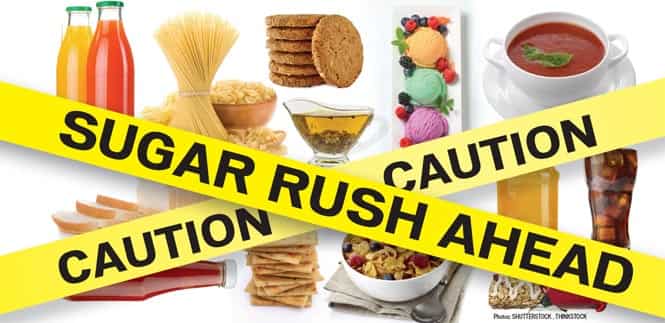
How do you tell the good carbs from the evil? Simple and refined sugar and starches (bread and pasta made with white flour, white sugar, sodas, cakes and candies) get absorbed by the body rapidly and have a high glycemic index, meaning they cause blood sugar levels to rise rapidly after eating.
So, look out for words like glucose, fructose, sucrose, lactose, maltose, and galactose in the ingredients list of the processed foods you buy. They are all simple sugars. Also read: Truth about natural sugars unveiled
Other carbohydrates, such as the fibre found in whole grains, fruits and vegetables (spinach, cabbage, brown rice, cauliflower, broccoli) move slowly through the digestive system, and much of it isn’t digested at all because it’s insoluble fibre.
Also read: Are you a label junkie?
How do you tell the good carbs from the evil? Simple and refined sugar and starches (bread and pasta made with white flour, white sugar, sodas, cakes and candies) get absorbed by the body rapidly and have a high glycemic index, meaning they cause blood sugar levels to rise rapidly after eating.
So, look out for words like glucose, fructose, sucrose, lactose, maltose, and galactose in the ingredients list of the processed foods you buy. They are all simple sugars. Also read: Truth about natural sugars unveiled
Other carbohydrates, such as the fibre found in whole grains, fruits and vegetables (spinach, cabbage, brown rice, cauliflower, broccoli) move slowly through the digestive system, and much of it isn’t digested at all because it’s insoluble fibre.
That’s simple so far, but now it gets a little complicated.
We just told you to avoid food products that list fructose or lactose on their ingredients list. But fructose is found in fruits, and lactose in dairy products. Does that mean you should avoid fruit and dairy?
The answer is a firm NO. Because the source of the carbohydrates matters just as much as its type and quantity.
Agreed, fructose is present in candies, sodas and other known dietary villains - and also in fruit. But a fruit is healthier than a food product with fructose simply because it the fructose is just one element of the fruit. It also has fibre, vitamins and antioxidants that help you feel satisfied longer after a meal. The same goes for vegetables and grains which contain simple carbohydrates mostly in the form of sucrose.
On the other hand, processed foods such as cookies, candies, and cakes are high in added sugars and calories but devoid of nutrients, leading to cravings and compulsive eating and wide fluctuations in blood-sugar levels.
Slow is beautiful
Don’t let all that information you’ve just read convince you to go on a carb-free diet. That’s not the point at all. "Carbohydrates are an important constituent of any diet and the source of energy for our body," says Dr Bhattacharya.
However, you do have to look at carbs in a somewhat different way than you may at present be used to. Think of them as slow burning wood in a bonfire rather than dry hay, writes fitness expert Deanne Panday, in her book Shut Up And Train! "You don't want a raging inferno; you want the fire to burn slowly and for a longer period of time," she says. And this applies especially to diabetics whose bodies cannot cope with blood sugar spikes.
Also read: Are you on a sugar high?
That is why it is better to have a whole fruit than a glass of tetra-packed fruit juice, or candies, cookies or anything with added sugar. The fibre in the fruit allows the body to break down the sugar (a carbohydrate) in a slow and steady manner, which means the glucose will take a longer time to be released into the blood stream, which means your blood sugar levels will rise much slower.
The evil within
You may be tracking your carb intake. But you still have to watch out for simple sugars hiding in the most complicated places. Sugar lurks in the shadows under many aliases, sabotaging your intentions of healthy eating without your even knowing it.
“Sugar hides under several names, including high fructose corn syrup, dried cane syrup, invert sugar, brown rice syrup, dextrose anhydrous, dextrose monohydrate, dried glucose syrup, demerara sugar, treacle, high fructose insulin syrup, corn sugar, xylose and caramel syrup,” says Lovneet Batra, clinical nutritionist, Fortis La Femme.
Besides, a product heavy with sugar needn’t be sweet. “Some not-so-sweet sugar-laden foods are ketchup, salad dressing (even the low-fat variety) and cereal (including ‘natural varieties’),” she adds.
So what do you do? You turn to the ‘healthy’ and ‘nutritious’ products. But guess what! Just because a product claims to be healthy (read, zero trans-fat, fat-free, high-fibre, or made with whole grains) it need not necessarily be low on sugar, and thus advisable for a diabetic patient. Also read:How sweet is too sweet?
A packet of oats ‘high in fibre’ and ‘made with whole grain’ has 14 gms of sugar per 100 gms. Pre-mixed soups like Chinese Manchow soup have around 13 gms of added sugar per 100 gms. "Even ‘organic food’ means that the food is grown without using pesticides. It doesn’t imply it is without sugars," clarifies Batra.
In fact, if you’re serious about your health, says Dr Aseem Malhotra, cardiologist and science director, Action on Sugar (a group of specialists working to bring about a reduction in the amount of sugar in processed foods), you must avoid all food packages marked with a ‘healthy’ label. "Labelling itself is synonymous with ‘processed’ and it is processed food that’s driving the epidemics of obesity and type-2 diabetes."
Besides, nutritional labels are not exactly user-friendly. "In many cases, you need to be a math whiz to figure out what you are eating, and how many grams of sugar, calories or fibre it contains," says Dr Nicole Avena, research neuroscientist and author of the book, Why Diets Fail: Because You're Addicted to Sugar.
"It is up to the consumer to interpret the label and understand that there is more than one form of sugar. The list of possible names for added sugars is lengthy, and many are not even obviously added sugars. For instance, rice syrup almost sounds healthy, but it is really another type of added sugar."
So how does a diabetic decipher nutritional labels? Look at the 'total carbohydrates' content of the product, not just the 'added sugars' content, says Dr Anoop Mishra, chairman, Fortis C-DOC Centre of Excellence for Diabetes, Metabolic Diseases & Endocrinology.
That is because, in calculating 'added sugars', most manufacturers do not include a category of largely indigestible carbohydrates called sugar alcohols, such as mannitol, sorbitol, xylitol, and other polyols, which are modified alcohol molecules that resemble sugar.
These substances are commonly used as artificial sweeteners and are thought to have minimal impact on blood sugar levels, but they still exist in the food product. 'Total carbohydrates' is a better way to gauge the sugar content of the food.
Though Dr Mishra says you don't need to ban sugar altogether even if you're diabetic, Dr Avena recommends a sugar separation even for non-diabetics. "Try to go two weeks without added sugar," she says. "This way, you can see how it affects you, how much you were really eating, and if you were dependent on it. After that, you can decide if you need a divorce."
Also read: Get rid of your sugar craving
But that is not as easy as it sounds. Our daily consumption of sugar is seriously high, even when we avoid sweets. Even as I write this piece, I realise I am over the maximum daily recommendation of 20 gms. By 12 noon, I had had a bowl of cereal with milk (10 gms) and later, a banana (12 gms).
Sugar is only an indulgence, and can be done away with, says Dr Malhotra. "It's important for people to understand that there is no biological requirement for added sugar for our bodies," he says. "A sugar divorce is long overdue. This is a failing marriage that's causing a lot of misery!"
Follow @JainAtisha on Twitter
From HT Brunch, November 9
Follow us on twitter.com/HTBrunch
Connect with us on facebook.com/hindustantimesbrunch