In 2020, ₹50 lakh felt like a distant number to Ankit. He was 31, taking home around ₹1 lakh a month and saving without a clearly defined investment plan. Then came the pandemic. Working from home reduced spending on commuting, eating out, and travel, giving him more room to think seriously about where his money was going.
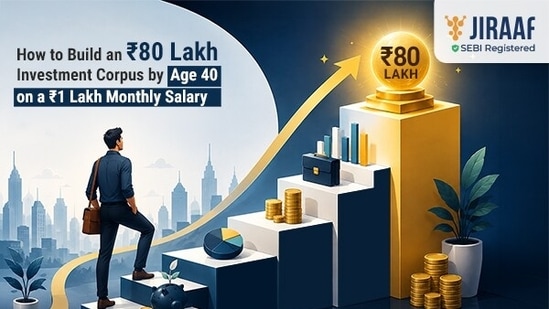
That year, he began investing ₹30,000 a month, or 30% of his take-home salary.
Six years later, that decision has started to show results. By September 2026, ₹47 lakh">his portfolio is worth ₹47 lakh and has given a return of 12% pa, and could cross ₹50 lakh by the end of the year.
The ₹80 lakh milestone that once seemed ambitious now looks achievable.
2020: The Journey Starts With ₹30,000
Ankit began with a simple rule: as his salary rises, his investments should rise too.
He starts with ₹30,000 a month and increases the contribution by 10% every year. By 2023, the monthly investment is nearly ₹40,000, and the portfolio has ₹20 lakh">crossed ₹20 lakh.
{{^htLoading}} {{^usCountry}} Year | {{/usCountry}} |
|---|
Year
Age
Monthly Investment
Corpus at Year-End
31
₹30,000
₹3.8 lakh
32
₹33,000
₹8.5 lakh
33
₹36,300
₹14.2 lakh
34
₹39,900
₹21.0 lakh
35
₹43,900
₹29.2 lakh
36
₹48,300
₹39.1 lakh
37
₹53,100
₹50.8 lakh*
38
₹58,500
₹64.6 lakh
39
₹64,300
₹81.0 lakh
*The 2026 figure is the projected year-end corpus. The portfolio is around ₹47 lakh by September 2026 under the same assumptions. Returns are illustrative and actual market performance will vary.
2023: The First ₹20 Lakh Is Mostly About Saving
In the early years, Ankit's own contributions do most of the work.
Compounding helps, but the portfolio is still too small for returns alone to make a large difference. The real advantage comes from continuing to step up investments rather than allowing every salary increase to disappear into higher spending.
By 2023, Ankit has crossed ₹20 lakh. From here, the nature of the journey slowly begins to change.
A larger corpus means returns are now being earned on a bigger base, even as fresh money continues to come in every month.
2026: At ₹50 Lakh, Allocation Starts to Matter
Fast forward to 2026. Ankit is 37 and ₹53,000 a month">investing over ₹53,000 a month.
His portfolio is around ₹47 lakh by September and could be close to ₹51 lakh by year-end. The ₹50 lakh number that felt distant in 2020 is now effectively within reach.
But ₹50 lakh also raises a new question: should every rupee in the portfolio continue to do the same job?
When the corpus is ₹5 lakh or ₹10 lakh, the priority is usually accumulation. As it grows, asset allocation takes on greater meaning. The investor can start separating money intended for long-term growth from money intended to provide fixed returns, regular payouts, or greater diversification.
Ankit could, for instance, begin gradually moving a portion of his portfolio into investment-grade bonds to help anchor it against equity volatility. Additionally, bonds can help create an income buffer as he prepares to enter his 40s.
A starting allocation of around 10–20% to bonds would mean roughly ₹5 lakh- ₹10 lakh in a ₹50 lakh portfolio, depending on his risk appetite and financial goals.
This does not mean replacing equities. Equities can continue to be the primary growth engine, while bonds begin to play a complementary role.
Platforms such as Jiraaf have also made it easier for individual investors to discover and evaluate listed corporate bonds across credit ratings, tenures, and payout structures. For investors like Ankit, this makes it possible to think of fixed income as a portfolio allocation rather than something considered only near retirement.
The Portfolio Changes as the Corpus Changes
This shift is important because portfolio construction is not static.
The allocation that works for someone with ₹10 lakh may not be the allocation they want at ₹50 lakh or ₹80 lakh.
At ₹50 lakh, Ankit may still want most of his money in growth assets because retirement is decades away. But he may also want a portion generating fixed returns or regular coupon payouts.
For example, a ₹7.5 lakh bond allocation"> ₹7.5 lakh bond allocation earning an illustrative 9–11% pa. could generate roughly ₹67,500- ₹82,500 per year before tax. He may choose to reinvest those payouts, allowing the fixed-income allocation to build alongside his equity portfolio.
The objective at this stage is not income replacement. It is to begin giving different parts of the portfolio different roles.
2028: ₹80 Lakh Becomes a Realistic Milestone
If Ankit continues to increase his investments by 10% each year, his monthly contribution will rise to around ₹58,500 in 2027 and ₹64,300 in 2028.
At the same illustrative 12% return, his portfolio could reach roughly ₹81 lakh by the end of 2028.
By then, his allocation may have evolved further.
An illustrative ₹80 lakh portfolio could have around ₹60 lakh in equities and ₹20 lakh in bonds. The equity allocation remains focused on long-term wealth creation, while the bond allocation adds fixed returns and periodic cash flows.
At an illustrative average yield of 9–11% pa., ₹20 lakh in ₹1.8 lakh to ₹2.2 lakh">bonds could generate ₹1.8 lakh to ₹2.2 lakh in annual pre-tax interest.
Ankit can reinvest that money while he is still working or use part of it for medium-term financial goals.
Keep the Emergency Fund Outside the ₹80 Lakh
Over the same period, Ankit can build a separate emergency fund of around ₹6 lakh to ₹8 lakh. By his late 30s, his financial responsibilities are very different from 2020. Household expenses are higher, while a home loan, children, or dependent parents could make it harder to absorb income disruptions.
The emergency fund therefore serves a different purpose. It stays liquid and accessible, while the ₹80 lakh portfolio remains focused on longer-term goals.
What Really Changed Since 2020?
In 2020, Ankit's financial progress depended almost entirely on how much he could save from his salary.
By 2026, he is approaching ₹50 lakh and can start thinking not only about how much he owns, but also about how that money is allocated.
By 2028, he could be around ₹80 lakh, with equities supporting long-term growth, investment-grade bonds adding fixed returns and regular payouts, and an emergency fund providing liquidity.
That is perhaps the bigger financial transition of the 30s. The journey begins with saving more. As the corpus grows, it gradually becomes about making the money already accumulated work in more than one way.
Note to the Reader: This article is part of Hindustan Times' promotional consumer connect initiative and is independently created by the brand. Hindustan Times assumes no editorial responsibility for the content.