
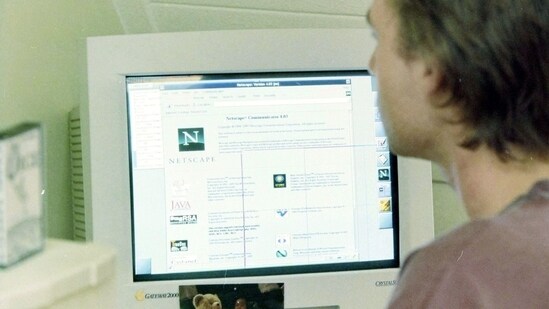
The initial public offering was filed at $14. Everyone wanted shares, so Morgan Stanley set the deal price at $28. As trading started, the stock popped to $74, ending the day at $58. Tech star Figma? The latest SPAC? No, it was 30 years ago this week, Aug. 9, 1995. The Journal’s Molly Baker nailed it: “It took General Dynamics Corp. 43 years to become a corporation worth today’s $2.7 billion in the stock market. It took Netscape Communications Corp.
The initial public offering was filed at $14. Everyone wanted shares, so Morgan Stanley set the deal price at $28. As trading started, the stock popped to $74, ending the day at $58. Tech star Figma? The latest SPAC? No, it was 30 years ago this week, Aug. 9, 1995. The Journal’s Molly Baker nailed it: “It took General Dynamics Corp. 43 years to become a corporation worth today’s $2.7 billion in the stock market. It took Netscape Communications Corp. about a minute.”
Remember, Netscape was a money-losing company with only $16.6 million in sales in its previous six months. Worth $2.7 billion! That’s the equivalent of Nvidia shares going up 11 cents today. We’ve come a long way, baby.
There are lessons galore. First, a new computing era was born. Netscape founder Marc Andreessen’s browser broke the 80-20 data rule—computer users went from manipulating 80% of data on their local networks and 20% elsewhere, to accessing 80% of information from the emerging World Wide Web. This unleashed huge demand for bandwidth to upgrade data speeds. The browser was simple to use, and putting up websites required little programming.
Startups previously had to show at least two quarters of profitability before going public. No more. For investors, it was a new sky-is-the-limit internet era, and long-duration investing became standard. Growth was more important than profit. Funky ideas got funded. Money accelerated innovation as investors were willing to fund losses. Speculation roared and momentum lured in new and late investors. No one wanted to miss out on the next big thing.
Sound familiar? No worries, the thinking went, companies would grow into their inflated value (most didn’t). In 1999 dot-com mania saw 480 companies go public, raising $62 billion—most, like Pets.com, with flimsy prospects.
Meanwhile, new business models emerged—speculation enables experimentation. Netscape was free for individual users, but corporations paid a license fee. This freemium model scaled from thousands to millions of people, as it was so easy to download the product, a precursor of today’s smartphone apps, including artificial intelligence.
Previously unthinkable, Netscape reduced Microsoft’s power. It helped that Netscape drove an antitrust case to stop Microsoft from bundling its own browser. It took years for Microsoft to embrace the internet and eventually reinvent itself as a data-center company to deliver . . . web pages.
Corporate America scrambled to “webify”—a huge power shift toward Silicon Valley. Many were trampled in the process. Every company put up a website, but this enabled search engines like Google to crawl distant computers and run ads against search results, hurting magazines and broadcasters. Craigslist ran classified ads online, killing many local newspapers. E-commerce sites like Amazon devastated much of retail.
Open beats closed. The Web’s protocols were available to anyone. Other online services, like America Online, were closed to outside innovation. AOL was nicknamed the Love Boat, versus the shark-infested open internet waters. We know who won.
Success attracts scrutiny. As computers relied more on phone and cable companies for bandwidth, regulators stepped in. Silicon Valley spent more on lobbyists, culminating in $1 million inauguration donations and prime seating. Ugh.
The Netscape earthquake was only the beginning. There were so many more great investments and IPOs to come—first the web, then software as a service, then the entire smartphone ecosystem. I was running a small venture fund in the ’90s, and we were set to invest in Mosaic, later renamed Netscape. It wasn’t to be, as the lead venture investor insisted on doing the entire funding round. Afterward, whenever I got tossed out of other deals, and there were many, I could whisper loud enough to be heard, “Yeah, I’ve been thrown out of a lot better deals than this one.”
With today’s flurry to invest in any company that can spell AI, Netscape’s biggest lesson is that nothing lasts forever. AOL bought Netscape in 1998 for $4.2 billion in stock. AOL’s peak value reached $222 billion in December 1999, and in January 2000 it bought Time Warner for $182 billion. The dot-com boom peaked a month later, and the merger was a massive failure. AOL stopped supporting Netscape browsers in 2008. In 2015 AOL was sold to Verizon for peanuts, and in 2021, along with the remains of Yahoo, it was sold to private-equity firm Apollo.
In the current bull run, the “Magnificent Seven” stocks, growing on the backs of Netscape’s innovation, are worth $19 trillion. Netscape is a footnote in history but proof that the spark of a new idea and the freedom to pursue it, coupled with robust capital markets and even a dose of runaway speculation, can change everything. Even if the first movers, the original innovators, don’t make it.
Write to kessler@wsj.com.
One Subscription.
Get 360° coverage—from daily headlines
to 100 year archives.
Archives
HT App & Website