US stocks started September on a weak note on Tuesday. All three major stock indexes fell as investors worried about higher oil prices, rising bond yields and possible interest rate changes by the Federal Reserve later this month.
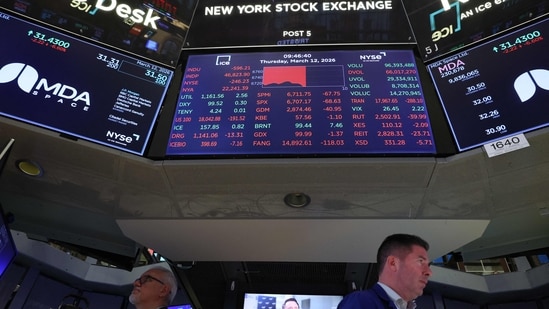
The Dow Jones Industrial Average fell 301 points, or 0.6%. The S&P 500 dropped 0.7%, while the Nasdaq Composite fell 1.1%, according to CNBC.
Nasdaq falls as tech stocks drop
The Nasdaq saw the biggest fall among the three major indexes as technology stocks came under pressure.
Investors were worried that higher borrowing costs could hurt technology and other high-growth companies. These companies often depend on borrowing money to grow, so higher interest rates can make things more difficult.
Several major tech stocks also fell. Nvidia, Advanced Micro Devices and Micron Technology each dropped about 2%. Microsoft and Google-parent Alphabet both fell more than 1%, according to CNBC.
Treasury yields hit new highs
The sell-off came as US and global bond yields moved higher. Higher yields can make stocks less attractive because investors can earn more from government bonds while companies also face higher borrowing costs. The 10-year US Treasury yield climbed to 4.788%, its highest level since January 2025. The yield rose about 3 basis points during Tuesday's trading.
{{/usCountry}}The sell-off came as US and global bond yields moved higher. Higher yields can make stocks less attractive because investors can earn more from government bonds while companies also face higher borrowing costs. The 10-year US Treasury yield climbed to 4.788%, its highest level since January 2025. The yield rose about 3 basis points during Tuesday's trading.
{{/usCountry}}Bond yields also jumped in other major economies. Japan's 10-year government bond yield reached 3% for the first time since August 1996, while Germany's benchmark yield reached its highest level since 2011.
Japan's shorter-term bond yields also hit multi-year highs. The country's 2-year government bond yield reached 1.81%, its highest level in 31 years, according to CNBC. UK government bond yields also surged. The 10-year UK Gilt yield rose 10 basis points to 5.2501%, its highest level since June 2008. The 30-year Gilt yield climbed 10 basis points to 5.8909%, its highest since March 1998.
Also read: 10-year Treasury yield hits 2025 high as Iran tensions fuel oil, inflation fears
Oil prices rise on Iran tensions
The rise in bond yields is closely linked to renewed inflation fears. Traders are worried that higher oil prices could push inflation higher, making it harder for central banks, including the Federal Reserve, to cut interest rates.
Oil prices climbed again on Tuesday. US crude prices gained about 3% to trade above $88 a barrel, while Brent crude rose more than 2% to around $92 a barrel. Middle East tensions are adding to the oil-market pressure.
The latest moves came after military action between the US and Iran resumed, raising fears about possible disruptions to oil supplies and shipping. The Strait of Hormuz is a major concern for investors. A tanker traveling through the strait was hit by three unknown projectiles on Monday.
Trump warns Iran after attacks
President Donald Trump also threatened a strong response to Iran. Trump told Fox News on Monday, “we are going to hit them hard,” after Iran's latest attacks on US military bases in the region, according to CNBC.
Fed rate decision in focus
Investors are now watching the Federal Reserve closely. The Fed is scheduled to meet in about two weeks, and traders are assessing whether higher oil prices and inflation could affect the central bank's interest-rate decisions. September is also historically a difficult month for US stocks. This added another reason for investors to remain cautious as the new month began, according to CNBC.
Goldman Sachs traders said the market is showing signs of nervousness. They pointed to new data from the American Association of Individual Investors' Sentiment Survey and said investors are also reducing risk in their portfolios, according to CNBC.
Stocks were already lower at the opening bell. The Dow initially dropped 363 points, or 0.7%, while the S&P 500 fell 0.7% and the Nasdaq declined 1.3%. There could still be a better outlook later in the year. Capital Markets analysts said they expect higher volatility during the third quarter but see the possibility of a stronger fourth quarter if inflation starts to cool.
AI stocks remain under pressure
Capital Markets said weaker inflation could improve investor confidence in the Fed. The firm also expects investors could become more comfortable with the central bank around the time a new Fed chair becomes more important to markets, according to the analysts.
AI remains a major driver of the stock market. Capital Markets said artificial intelligence continues to dominate the market narrative and presented a seven-part framework for understanding the AI investment story.
China's AI progress could create more pressure on Western companies. Capital Markets said China's development of “low-end but highly efficient models” could increase concerns about whether huge AI investments in the West will generate enough returns. Capital Markets expects AI to remain important for stocks. The analysts concluded that AI's dominance of the stock market is likely to continue for some time.
Also read: Over 175,000 tech jobs cut in 2026: Apple, Microsoft, Amazon, Oracle and more join layoff wave
Akamai gets bullish analyst upgrade
Akamai Technologies was one of the stocks moving against the broader market trend. Piper Sandler upgraded Akamai to overweight from neutral because it expects demand for computing capacity to accelerate. Piper Sandler still lowered its price target for Akamai to $125. Even after the cut, the target suggested about 15% upside from Monday's closing price, according to the firm.
Akamai may need to increase capital spending to meet rising demand. Piper Sandler analyst James Fish said the additional spending could be worthwhile because of the company's long-term growth opportunity. Piper Sandler expects Akamai's computing business to accelerate. Fish said the company's estimates have been reset enough and pointed to $2.8 billion in commitments as providing some visibility into future demand.
Akamai could potentially add around 100 megawatts of capacity, according to Fish. The analyst also said application-security demand and higher contract renewal prices could provide additional support for the stock. Akamai shares were nearly 1% higher in premarket trading Tuesday, even as the broader stock market prepared for a weaker open, according to CNBC.
Hut 8 shares rise in premarket
Hut 8 was another stock in focus before the opening bell. Its shares were around 4% higher in premarket trading after Reuters reported that the company is developing a major new Texas data center with Anthropic and Lambda.
What investors are watching now
Overall, Wall Street's main concern is the combination of higher oil prices, rising bond yields and inflation. If these pressures continue, investors may worry that the Federal Reserve will have less room to ease monetary policy.
For the stock market, technology shares remain particularly sensitive to higher yields. That helps explain why the Nasdaq, which has a heavy concentration of technology and growth stocks, fell more than the Dow and S&P 500 on Tuesday.
The key market signals to watch now are oil prices, Treasury yields and Fed expectations. A further rise in any of these could keep pressure on stocks, while easing inflation and lower yields could give markets some relief.