Many years ago, Samsung showed the way with foldable smartphones, and every rival then exhausted many more years trying to catch up. Some have, many haven’t, and perception battles aren’t easy to win. For everyone critical of Samsung’s incremental foldable experience improvements at different points over the past few years, this is the Korean giant’s resounding response; they haven’t dozed off at the wheel. The Samsung Galaxy Z Fold8 will be, mark my words, a milestone that defines foldables for the next few years. History has set about repeating itself. Rival phone makers will again spend years trying to match Samsung’s benchmark with a different form factor foldable. And I’ll say this with unwavering conviction — the passport-size and stylish foldable smartphones are surprisingly handy, remarkably fun and the sort of form factor you didn’t know you needed.
We live in times dictated by geopolitical uncertainties that affect supply chains and component costs, and there is no reason to hope that the very likeable Galaxy Z Fold8 will be any less premium priced than expected. Prices start at ₹1,79,999 for the 12GB memory and 256GB storage specification. The 512GB storage spec costs another ₹20,000 while the highest tier 16GB + 1TB combination will demand you part with ₹2,39,999 of your money. The foldable portfolio is now a troika, with the Galaxy Z Fold8 Ultra and the Galaxy Z Flip8 for company. Mind you, this chapter has been written exactly a year after the radical design overhaul of the Z Fold7 last year. Clearly, Samsung isn’t resting on its achievements.
Also Read:Samsung Galaxy S26 Ultra review: Screen and real innovation, for your eyes only
{{/usCountry}}Also Read:Samsung Galaxy S26 Ultra review: Screen and real innovation, for your eyes only
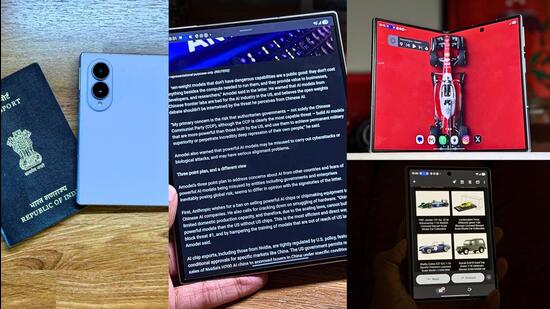
{{/usCountry}}The Galaxy Z Fold8 is three form factors in one. And all three are incredibly usable. Including the cover screen (that’s Samsung learning from the early days of the book style foldable). While Samsung isn’t the first to make the passport style foldable (that’s the Huawei Pura X Max launched earlier this year), it certainly leads the way in terms of global relevance. There is the very usable cover screen, 5.5-inch with 1972x1248 pixels and a 10:16 aspect ratio that makes it more of a square, than a tall screen real estate. Surprisingly usable, even for message conversations and the reduced height means you’ll find it incredibly ergonomic for single hand use. Most apps already respond well to this aspect ratio, and expect that to come across all apps in the coming updates.
Then there’s the larger 7.6-inch foldable screen that’s wider in aspect ratio than most foldable phones, including its sibling the Galaxy Z Fold8 Ultra. There are advantages to that extra horizontal real estate in this viewing scenario — two apps side by side get more space to use, and the scaling is closer to traditional phones. Or for watching Live sports, movies and YouTube videos. And that’s before you factor in the possibility of flipping the phone over and positioning it in tent mode.
Then, gently move the phone as you are holding it in landscape mode, in a clockwise direction. This is where you get the first glimpse of a screen that’s almost as tall as an iPhone 17 Pro Max, but significantly wider. A small tablet, if you may (except that the volume and power keys are now on the top spine). Great for reading, for checking cricket scoreboards, equally good for a more comprehensive view of your X and Instagram feeds. A win-win.
Also Read:Samsung Galaxy Z Fold7 review: By far, the most mature and refined foldable
There is something to be said about the display collective, because both are sharp, have just the right saturation levels, can get really bright (peak brightness is generationally higher) and the anti-glare coating does its bit to significantly eliminate reflections whilst not impacting visual quality. Is it just me, or does the Galaxy Z Fold8 display unfold all the way, unlike the predecessor?
The variant of the Galaxy Z Fold8 that I am assessing here is, in true Samsung trend, the base spec with 12GB memory and 256GB storage. The Qualcomm Snapdragon 8 Elite Gen 5 (SM8850-1-AD) chip is the specialised ‘for Galaxy’ variant that the chipmaker makes for Samsung’s flagships with custom clock frequencies and other tuning changes. There is something to be said about the Galaxy Z Fold8’s performance, with the customisations clearly making a positive difference (again).
The only way to illustrate this is with a synthetic benchmark (because the real-world baseline is regardless very high) scores. In the GeekBench 7 benchmark, the Galaxy Z Fold8 scores 2626 (single core) and 8559 (multi-core), and clocks 15620 in the OpenCL graphics test. The outright silicon performance puts this ahead of flagships running the regular Snapdragon 8 Elite Gen 5 chips, and in fact, is also in the same race as the Galaxy S25 Ultra (2493 and 8921 respectively).
Also Read:‘AI no longer just answers’: Samsung CEO on foldable phones defining personal AI
With regular use, it is quite noticeable that the Galaxy Z Fold8 does remain rather cool even when under multi-tasking load. But there are two sides to that coin. My observation holds true when the Galaxy Z Fold8 is used in the unfolded mode. Try heavy multi-tasking or certain heavier tasks on the cover screen, and perceptible heating is apparent on the back. One of the reasons for that is the subtle throttling which neither becomes noticeable in terms of app load or app switching responsiveness, nor does it let the thermals reach a particular threshold where the measure has to be a bit harsh(er).
One of the reasons why this form factor has worked and the Galaxy Z Fold8 doesn’t heat up, is the transition to silicon-carbon batteries, which are more energy dense. The 4800mAh capacity, though we have nothing yet to generationally compare this with, brings the advantage of longer run times without needing higher capacity packs. The Galaxy Z Fold8 with a fully charged battery, gets through 7 hours of screen time with still close to 25% remaining. Wired charging peaks at 45-watt, while wireless charging is slightly faster, up to 20-watts with compatible Qi2.2 chargers, and up from 15-watt with previous foldables.
That said, Samsung hasn’t given the Galaxy Z Fold8 a magnetic ring to work with compatible accessories, and it’ll need an accessory (a case, for instance) to get that working. And speaking of working, facial recognition remain a hit-or-miss and you’ll be relying more on the fingerprint scanner (integrated in the power key) to unlock the phone if the ambient lighting is even slightly off.
Also Read:Samsung hits the right notes with Galaxy Buds4 Pro, with an ecosystem caveat
There is something to be said about the choice of dual cameras on the Galaxy Z Fold8. Samsung has, and there is very little to be critical of here, gone with a 50-megapixel wide and a 50-megapixel ultra wide. The lack of a telephoto is my main concern, and that would have returned more camera flexibility than an ultra wide alongside a primary wide. Samsung’s well-tuned photography algorithms are on fair exhibition here, but you will miss a more powerful zoom experience for certain photos. Am I alone in saying that I use a zoom lens more than an ultra wide when snapping photos?
All said and done, the primary camera is particularly likeable in terms of the tonality of colours, dynamic range and overall sense of the moment. I could point out that certain photos feel a bit softer than perhaps ideal, but that’s something easily fixable in an upcoming One UI or camera app update. Speaking of refinement, certain apps don’t move between screen smoothly; that may more be a factor of individual apps being updated.
There are three foldable form factors that Samsung wants you to choose from, and the newest addition this year is genuinely very usable (and likeable). So much so, my recommendation to anyone who asks me which current generation foldable to consider would simply start with this — check the Galaxy Z Fold8 before anything else. This foldable does unlock a few new frontiers for smartphones in terms of ergonomics, utility and all that without compromising even an iota on flagship-level performance. The Samsung Galaxy Z Fold8 is an absolutely fantastic foldable.