US stocks opened mostly flat on Monday as investors remained worried about whether the US and Iran can reach a lasting deal over the Strait of Hormuz. The uncertainty kept investors cautious at the start of the week.
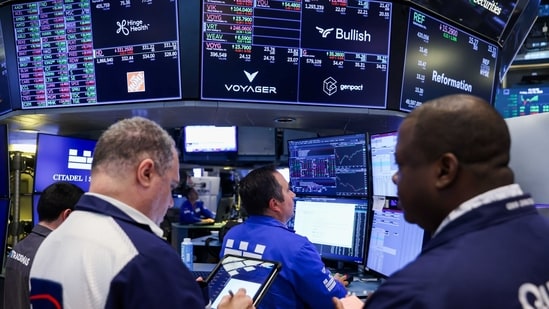
The S&P 500 was up about 0.1%, while the Nasdaq Composite fell 0.1%. The Dow Jones Industrial Average dropped 110 points, or 0.2%, during the session. The three major US stock indexes were coming off their best weekly performance since April. The S&P 500 also ended last week at a record closing high.
Strait of Hormuz worries
The biggest issue for markets on Monday was the uncertainty around the Strait of Hormuz, a key route for global oil shipments.
Iran has said it is getting closer to a deal with Oman that could allow more ships to move through the Strait of Hormuz. However, Tehran has not agreed to restart direct talks with Washington.
Iranian Foreign Minister Abbas Araghchi said on Sunday that there was no possibility of restarting negotiations while the US continued to violate a June memorandum of understanding and had not compensated Iran for those violations. Tasnim News Agency, a semi-official Iranian outlet linked to the Islamic Revolutionary Guard Corps, reported his comments.
{{/usCountry}}Iranian Foreign Minister Abbas Araghchi said on Sunday that there was no possibility of restarting negotiations while the US continued to violate a June memorandum of understanding and had not compensated Iran for those violations. Tasnim News Agency, a semi-official Iranian outlet linked to the Islamic Revolutionary Guard Corps, reported his comments.
{{/usCountry}}The mixed signals from the US and Iran made investors less confident that a deal to reopen the important shipping route would happen soon.
Oil prices rise
Oil prices jumped as investors worried that the Strait of Hormuz could remain under pressure. US West Texas Intermediate crude futures rose about 2% to above $80 a barrel, while Brent crude futures gained about 2% to above $85 a barrel. Later in morning trading, WTI crude was up 2.4% at $80.03 a barrel, while Brent crude was also up 2.4% at $85.53 a barrel, according to CNBC.
Oil had already been moving higher earlier in the morning. Brent futures were up 1.5% at $84.76 a barrel, while WTI futures gained 1.6% to $79.41 a barrel. The oil market has been reacting to conflicting signals from Washington and Tehran about whether a deal can be reached to increase ship traffic through the Strait of Hormuz.
Trump keeps Iran pressure
Last week, Treasury Secretary Scott Bessent gave investors hope that a deal could come as early as Tuesday or Wednesday and allow the Strait of Hormuz to reopen more freely. But President Donald Trump gave a more cautious message on Sunday.
Trump told Axios that the US was “only semi-negotiating” with Iran and wanted the country to continue feeling economic pressure. That change in tone added to uncertainty in financial markets because investors had earlier expected a possible deal to come soon.
Intel stock falls
Intel was one of the biggest losers among major stocks. Its shares fell about 4% after the chipmaker announced plans for a $15 billion common stock offering. Intel said it plans to use the money for general corporate purposes, including possible capital spending and working capital.
Intel also said its customers continue to show strong and sustainable demand because of the artificial intelligence boom. The company said the stock offering would give it more support as it looks for future growth opportunities. The stock offering put pressure on Intel shares because issuing a large amount of new stock can increase the number of shares in the market and dilute existing shareholders.
HPE shares jump
Hewlett Packard Enterprise was one of the stocks moving higher before the opening bell. Its shares gained more than 5% after Morgan Stanley upgraded the stock to overweight from equal-weight, according to CNBC.
Morgan Stanley said HPE currently has an attractive risk-reward profile. The bank also said investors may be underestimating the difference between HPE's earnings potential and its current valuation.
Verisk deal hits stock
Verisk Analytics moved sharply lower. Its shares fell more than 6.5% after a Delaware judge ruled that the company must go ahead with its $2.35 billion acquisition of AccuLynx.
Verisk had previously ended the deal in December because a Federal Trade Commission review of the transaction had not been completed before the deal's termination date. The Delaware court ruling now puts the company back on track to proceed with the acquisition.
Apple faces downgrade
Apple shares fell about 1% after Jefferies downgraded the stock to underperform from hold. Jefferies said its supply-chain checks suggest that an all-glass iPhone that Apple has never publicly announced may have been canceled.
The possible cancellation is important because Apple is trying to develop more expensive devices as rising memory costs put pressure on its business. Apple has not publicly announced the all-glass iPhone mentioned in the Jefferies report, so the report is based on the investment bank's supply-chain checks rather than an official Apple announcement.
Also read: Why TSMC sales surged 45% as AI boom drives demand for advanced chips
Fed rate hike bets fall
US stock futures were slightly higher before the market opened. S&P 500 futures gained about 0.13%, while Nasdaq-100 futures rose 0.38%. Dow futures were just below the flatline.
Investors were also watching the bond market as they prepared for a busy week of economic data, especially new inflation figures. US Treasury yields moved slightly lower early Monday. The 10-year Treasury yield fell by just over 1 basis point, while the 30-year yield also dropped about 1 basis point. The 2-year Treasury yield was almost unchanged.
The bond market was still reacting to last week's weaker-than-expected July jobs report. The July nonfarm payrolls report showed an unexpected contraction in employment, which changed investor expectations about the Federal Reserve's next interest-rate moves. The weaker jobs data gave investors hope that the Federal Reserve may avoid raising interest rates soon.
Fed funds futures now show about a 46% chance of a rate hike at the Fed's September meeting, down from about 67% a week earlier, according to CME's FedWatch tool.
Deutsche Bank analysts said the weaker jobs data had reduced the urgency for the Federal Reserve to tighten policy further in the near term. This means investors are now paying close attention to upcoming inflation data because it could give the Fed another important signal about where interest rates should go next.
Gold stays near high
Gold prices were mostly flat on Monday after hitting a seven-week high on Friday. Spot gold was around $4,342.86 an ounce, while Comex gold futures were near $4,399.90 an ounce, with both prices little changed in early trading, according to CNBC.
Critical minerals move
Investors were also watching developments in the critical minerals sector as the Trump administration backed plans for an Australian scandium mine. The plan is part of a broader US effort to reduce China's dominance in critical minerals, which are important for industries such as technology, defense and advanced manufacturing. Sunrise Energy Metals shares jumped as much as 29% after the company received a $400 million US investment connected to the project.
Overall, Wall Street started the week cautiously. Strong gains from last week and expectations of less aggressive Federal Reserve policy were supporting stocks, but rising oil prices and uncertainty over the US-Iran situation were keeping investors on edge.
The key market question now is whether the US and Iran can reach an agreement over the Strait of Hormuz. A deal could ease pressure on oil prices, while continued uncertainty could keep crude prices elevated. At the same time, investors will be watching US inflation data, Federal Reserve rate expectations, oil prices and major company-specific moves for the next direction of the market.