When Anupam Kumar, co-founder and CEO of clean tech company MiniMines, talks about sustainable and efficient battery recycling to extract lithium, cobalt, manganese, and nickel for re-entry into the supply chain required for Li-ion cell manufacturing, he means it. Kumar is a chemical engineer and has worked at the Bhabha Atomic Research Centre where he used to recover uranium, cobalt, technetium and nickel from deactivated waste. “I was working onto something similar to what we do right now in terms of heavy metal recovery,” he says.
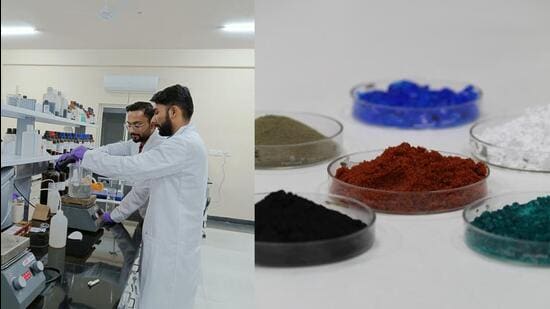
At the core of this discussion is MiniMines patented Hybrid-Hydrometallurgy (HHM) process that works across battery chemistries, as Kumar and chief technology officer (CTO) Arvind Bhardwaj emphasise time and again. Batteries that are at their end of life are processed in multiple steps, to recover Lithium, Cobalt, Nickel, and Copper at a very high purity levels. This is a closed loop system, with no solid, liquid or gaseous waste. In a conversation with HT, Kumar and Bhardwaj talk about localisation of the battery chain that’ll be critical for electric vehicles as well as local tech manufacturing, the journey that takes MiniMines to what they call Mega-mines and Giga-mines, and next for critical mineral recovery. Edited excerpts.
Q. What exactly is the Hybrid-Hydrometallurgy (HHM) process all about? Does this include processing of all types of batteries, such as those in smartphones, laptops, tablets and EVs, for instance?
Anupam Kumar: This is a patented process and is a combination of 3 different tech — extraction, separation and benefication, which when combined together, generate a 96% recovery rate. And the recovered mineral is as good as virgin material, which is more than 99% purity. This can be done with any battery.
{{/usCountry}}Anupam Kumar: This is a patented process and is a combination of 3 different tech — extraction, separation and benefication, which when combined together, generate a 96% recovery rate. And the recovered mineral is as good as virgin material, which is more than 99% purity. This can be done with any battery.
{{/usCountry}}The key is uniqueness of this propriety process is, and we knew from the day we started that there’s aren’t only two or three types of chemistries, we built this technology in such a way that any chemistry starting from NMC, LFP, LCO, NMC, LTOs, LMFPs are compatible.We recycle everything from battery from a wristwatch to electric buses, drone batteries or mobile phones, laptops and so on. We recover Lithium, Cobalt, Nickel, and Copper, in what is one of the most unique features in industry in India.
Q. India wants to become an EV manufacturing as well as usage powerhouse, but much of the battery value chain still runs through China. Are we overestimating how quickly localisation can happen, particularly as far as critical mineral recovery is concerned?
Anupam Kumar: This can be addressed in two ways. In India, cell manufacturing has started with players such as Exide Ola, Nash Energy and Ather Energy. There are other cell companies that have started manufacturing lithium cells in the country itself. We are getting their manufacturing waste as well. That is the extent they’re operating at. India is moving fast in terms of scaling cell manufacturing. All the tech in terms of battery pack development and BMS (or battery management software) development, India already has that expertise.
What is missing is the ‘Pre-CAM’ (Precursor Cathode Active Material (pCAM), the critical upstream chemical compound; typically a transition metal hydroxide or carbonate of nickel, cobalt, and manganese) used as the fundamental building block to manufacture CAM for lithium-ion battery cells) in cell manufacturing, but that will happen in the next couple of years.
Q. What targets have you set for the next few years in terms of the volume of end-of-life batteries that need to be processed and is the broader infrastructure in place?
Anupam Kumar: I’ll say that by the end of 2028, we foresee roughly 45,000 MT per annum processing capacities. We have been blessed by the Karnataka government and they have awarded us 40 acres of subsidised land where we have been putting up a giga critical mineral refining complex where we’ll be operating from all kinds of waste, which is bearing cobalt nickel lithium into the system. We will be refining this element and scaling our plant to 45,000 metric tonnes per annum.
Q. MiniMines highlights that the HHM process generates negligible solid, liquid, or gaseous discharge. How challenging is it to maintain this carbon-negative, closed-loop efficiency as you scale up to thousands of tonnes per year?
Anupam Kumar: The plants are designed in such a way that any kind of pilferage or any kind of processing loss is connected to a first reactor. So nothing goes waste. Our process is zero solid, liquid or gas discharge throughout. Even any by-product that may be generated is a raw material for some or the other industry. We have designed the complete plant.
Q. There’s a lot of discussion around discovering lithium reserves in India. Is the bigger opportunity actually above ground — in used batteries — rather than underground?
Anupam Kumar: Concentrates in India are very rare for lithium, cobalt and nickel. It’s not all there. Lithium can be there, but the quality of ore is not very low concentration, which is more expensive to process rather than the waste that is above ground.
Arvind Bhardwaj: Claims have been made by various agencies about lithium presence inside India. However, further studies are required by the government. This is all still in the initial stage. There are G3 studies, and G4 studies are required (In mineral exploration and geological surveys such as those regulated by the Ministry of Mines and Geological Survey of India, G3 and G4 studies refer to distinct, sequential stages of mineral resource exploration). Extensive studies are required until there is feasibility report for the extraction of these minerals.
Q. The ₹10 crore TDB grant, alongside recent backing from organisations like Oil India and UNIDO, is a major validation of your model. Scaling from pilot to full commercial operation often reveals hidden friction points. Where exactly is this capital being deployed?
Anupam Kumar: We got an opportunity to showcase this particular process to the United Nations industrial Development Organisation (UNIDO), and they with the help of the Bureau of Energy Efficiency evaluated our process and awarded us the lowest carbon emitting technology across the globe for recycling lithium batteries.
Q. What are the hardest engineering or supply chain hurdles you need to clear in the next 12-24 months?
Arvind Bhardwaj: Whenever we are scaling up a process, there are multiple stages of optimisation required in terms of unit operations or equipment. We have been doing that, and we know what is going to change at what processing capacity. But given the scenario that the lithium-ion battery is a very fast evolving chemistry and specifically the elemental composition of these is evolving very fast — every six months, we see a new chemistry. To be able to cope and to be aligned with these chemistries is on our process.
We deliver the same kind of process efficiency and purity of materials, because the process was developed in such a way that no matter the composition or changes inside the battery, we will be able to achieve similar efficiencies and purities for all chemistries without changing the capital expenditure or operating expenditure.
For example in electric vehicles, there will be a transition to cheaper alternatives to lithium-ion batteries. I believe LFP (lithium iron phosphate batteries) is a dominant chemistry, because OEMs are more included towards this chemistry in bigger applications such as electric vehicles. In the supply chain, the composition of LFP is going to increase drastically, and we as recyclers need to remain vigilant to stay ahead of the curve.
Q. As battery chemistries evolve towards Lithium Iron Phosphate (LFP) and sodium-ion, does recycling become a moving target? How are you preparing for shifts in the coming years?
Anupam Kumar: As an extended producer responsibility (EPR), we are helping companies and people in reverse collecting dead batteries and products from OEM sites. If you observe the ratio of batteries changing which we foresee, the next plant that we are building is the giga critical mineral refining complex which will operate from all kinds of feed such as the spent catalyst which is nickel. Irrespective of the feed, we are proud to demonstrate that our current facility as well as the new one simply work.
Q. While EV batteries are a primary focus, decommissioned solar panels and permanent magnets represent the next massive wave of complex waste. How transferable is your current extraction chemistry to these new waste streams?
Anupam Kumar: We have modified this technology for rare earth as well as spent magnets and we are already working on the research for solar panels. In the next decade, there will be a huge volume of solar panel scrap that’ll come into the picture. We have a clear target to not just cater to as many critical minerals as possible, but also rare earths. There are two ways of doing this — either we increase the capacity of battery recycling or increase the number of element into our portfolio.
We are putting up new plants. We are adding new lines for the battery crushing as well as downstream processing. Simultaneously we are also working to add rare earth metals and other critical minerals like copper, rare earth metals like NdPr (neodymium-praseodymium alloy), samarium, and selenium, and critical minerals from catalyst-use such as tungsten, magnesium to our portfolio.