E-Paper



Tata Harrier EV caught your attention? Here's what it gets over Mahindra XEV 9e
Available across three trim levels, Adventure, Fearless and Empowered, the prices of the Harrier EV go up to ₹21.49 lakh, ex-showroom.

 Prefer HTon Google


Tata Motors has launched its newest most sophisticated electric SUV to date—the Tata Harrier EV at an introductory price of ₹21.49 lakh (ex-showroom). Designed on the company's acti.ev plus EV architecture, this new flagship not only offers a future-age design and robust performance credentials but also claims to be a segment leader in terms of innovation.
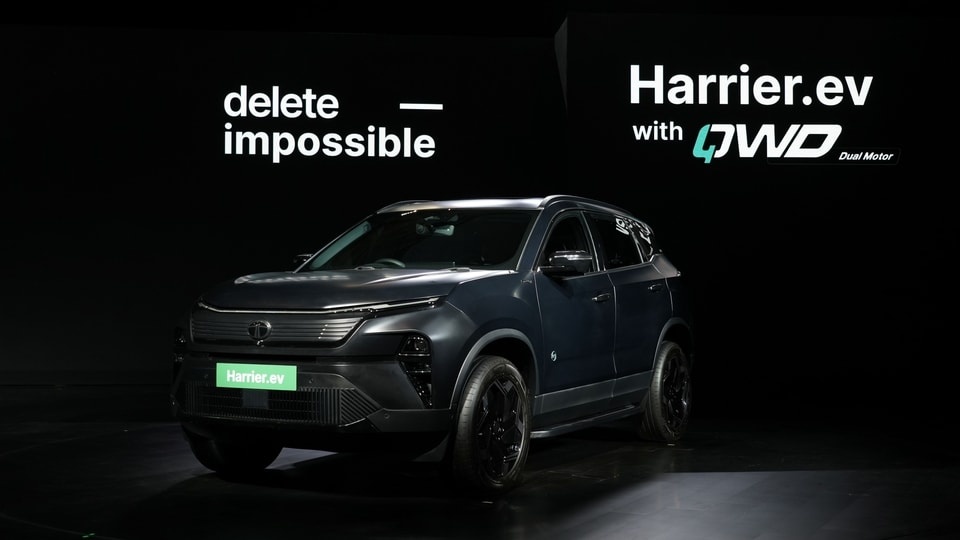
Positioned directly against Mahindra’s upcoming electric SUV coupe, the XEV 9e, the Harrier EV manages to pack in several key advantages that could tip the scales in its favor.
Dual-Motor All-Wheel Drive System
For the very first time in Tata's EV portfolio, Harrier EV arrives with a dual motor arrangement bringing all-wheel-drive capabilities on board. The former outputs a cumulative figure of 396 PS with the front motor churning out 158 PS with the rear motor putting out 238 PS. This results in a maximum torque figure of 504 Nm, which does not only increase the performance number but also gives surefootedness on variegated road surfaces.
(Also read: Tata Harrier EV launched at ₹21.49 lakh, brings AWD capabilities. Check details)
By contrast, the Mahindra XEV 9e is available at present only with rear-wheel drive, potentially restricting traction and off-road capability.
Remote-Controlled Summon Mode
Parking in small parking spaces is easier with the Harrier EV's Summon Mode, which allows one to drive the car forward or in reverse at slow speeds with the key fob. The feature is ideal for small garages or packed parking lots.
While both the Harrier EV and XEV 9e have auto park assist, only Tata's electric SUV carries this simple-to-use manual remote maneuvering feature.
Six Terrain Modes for Enhanced Adaptability
The Harrier EV provides its users six terrain modes: Normal, Rock Crawl, Mud Ruts, Snow/Grass, Sand, and the ability to make one's own setting. That puts the SUV in a position to take on a wide range of road types, from urban roads to light trails.
(Also read: Tata Harrier EV base variant features revealed. Check them out)
On the other hand, the Mahindra XEV 9e has its package to only three driving modes—Range, Everyday, and Race—tuned more towards performance and economy with no presetting for particular terrain.
Larger 14.5-inch QLED Infotainment Screen
The Harrier EV's interior boasts a centrally located, 14.5-inch QLED touchscreen, co-designed with Samsung. The screen is aesthetically sharp, large, and well mounted on the dashboard, adding to both form and function.
The Mahindra XEV 9e does boast a more futuristic triple-screen arrangement, including a co-passenger display, but with a smaller middle screen at 12.3 inches.
Digital IRVM with Integrated Dashcam
A standout feature of the Harrier EV is the digital inside rearview mirror (IRVM) that takes a live feed from a rear-mounted camera mounted on the sharkfin antenna. The result is an improved, obstructed-free view of the back. Better still, the IRVM has a dashcam built into it, and provides real-time video recording for added security.
The XEV 9e features just a standard auto-dimming IRVM, not this dual-purpose feature.