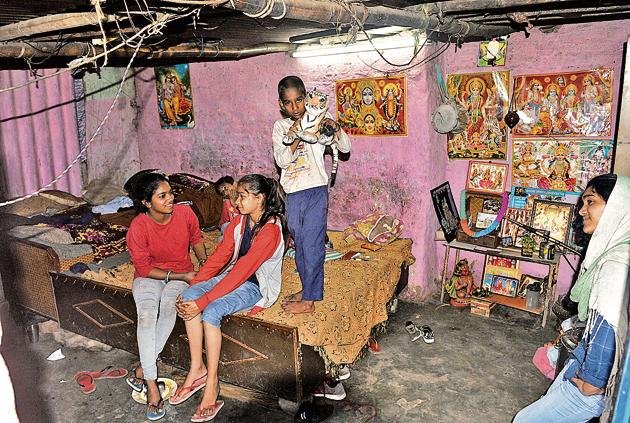
Harpali is an 18-year-old girl living in a 10x6 square feet ‘jhuggi’ with her mother, father, three sisters and a brother in the middle of the shanties in Sector 25. Her family says they are aware of the coronavirus and the threat it poses, yet social distancing is a distant dream for them and over a lakh others living in these colonies.
Spread over around 60 acres across the city, the Colony No 4, Janta Colony, Guru Sagar Colony in Maloya, Sanjay Colony, and Rajiv Colony in Sector 38 and other such slums are home to over one two lakh people, mainly migrant labourers, household maids and garbage collectors, out of Chandigarh’s total population of 14 lakh (an estimate).
According to the World Health Organisation (WHO), to avoid the spread of Covid-19 pandemic, one has to self-isolate and keep at least one-metre distance from anyone who is coughing or sneezing. “But is it possible here?” asks Harpali.
Priya Chauhan, a student of Class 8, said around five people share a bed in her ‘jhuggi’ in Sector 25, while three families share a bathroom.
So far, Chandigarh has reported five positive cases of the coronavirus with no evidence of community spreading. But many of these slum dwellers work as domestic helps, garbage collectors, auto drivers, delivery persons, vendors and waiters in several parts of the city, being extremely vulnerable to contact-based infection. On Saturday morning, a woman belonging to Kharak Mangoli village of Panchkula was also found positive for Covid-19 raising questions on the practices of social distancing, hand-washing and respiratory hygiene in such places.
{{/usCountry}}So far, Chandigarh has reported five positive cases of the coronavirus with no evidence of community spreading. But many of these slum dwellers work as domestic helps, garbage collectors, auto drivers, delivery persons, vendors and waiters in several parts of the city, being extremely vulnerable to contact-based infection. On Saturday morning, a woman belonging to Kharak Mangoli village of Panchkula was also found positive for Covid-19 raising questions on the practices of social distancing, hand-washing and respiratory hygiene in such places.
{{/usCountry}}Smita Kumari, 27, of Dadumajra Colony, which has been battling a mountain of garbage next door, said, “The people who I work for as a maid tell me to wash my hands, wear mask and gloves and maintain distance. At my house, I neither have ample water supply nor am I able to buy a mask or distance myself from residents of my colony.”
Till 2006, there were 18 colonies in the city. Later the UT administration razed eight, leaving the remaining 10 with around 8,000 shanties at the last count, though the number is said to be higher.
City-based architect Surender Bahga said, “In Chandigarh, the existing sectors were designed for 25 to 75 people per acre whereas the slums were planned for 250 people per acre. As of now, in Manimajra itself, the population per acre is around 340 people, so these slums will definitely have more than 400 people per acre.”
Dr Ravindra Khaiwal from the department of community medicine and public health said, “The administration has planned a contingency fund for a situation in case the infection spreads to such slums. There is no scarcity of funds.”
Khaiwal, however, advises maintaining basic hygiene, avoiding personal contact and covering the mouth while coughing and sneezing.
Reiterating that the administration had not shortage of funds, UT adviser Manoj Parida said, “We are prepared for any untoward situation. If space is required for quarantine and self-isolation, we will provide the infected persons rooms in panchayat bhavans and hotels.”