As the April 30-deadline set by the UT adviser for a revamp of Sector 17 is less than two weeks away, traders have started an awareness drive among them on removal of irregularities after meetings with top officials.
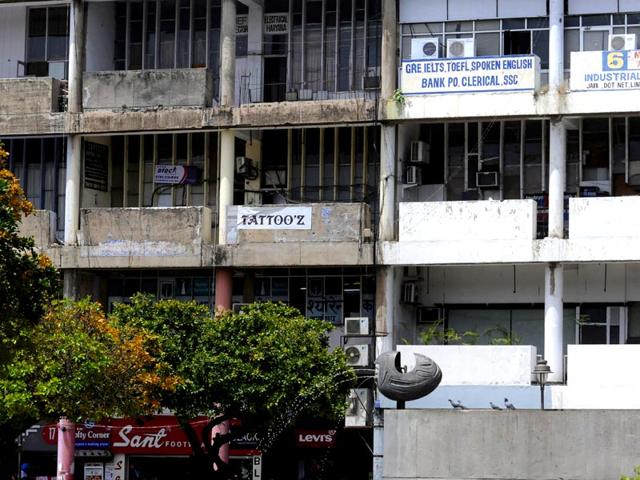
But traders have pointed out that government buildings, including the estate office, have violations such as use of non-permitted paint and signboards and the administration should set a benchmark.
Worth noting is the wall panelling on the façade of the deputy commissioner-cumestate officer’s office building, and blackening of the exposed concrete on most of the buildings owned or occupied by the governments of Punjab and Haryana, too.
The top issues flagged by the adviser in a visit just days after he joined in December — and even in a reminder to the estate office and the MC commissioner by the UT chief architect around a week ago — include withering of the iconic exposed concrete façade, an essential part of Chandigarh’s design; haphazard signboards; uneven flooring; and hanging wires and split-AC plants in the corridors.
A meeting of the traders was held by the DC on April 8 and a subsequent meeting of top officials was held on April 16 as well, after which the Traders’ Association, Sector 17, started an awareness drive on Friday among its members in the form of a letter.
{{/usCountry}}A meeting of the traders was held by the DC on April 8 and a subsequent meeting of top officials was held on April 16 as well, after which the Traders’ Association, Sector 17, started an awareness drive on Friday among its members in the form of a letter.
{{/usCountry}}This came as traders’ representatives were shown a presentation in which the rules for boards and other things were shown. “We did not know many of the rules and that made us realise that we had needed to make adjustments if only we were made aware earlier,” said president of the association Kamaljit Singh Panchhi.
At the meeting, traders pointed out that the government buildings needed to set the example, particularly in terms of removing the paint and using only the light gray façade paint as permitted.
“Our reach limited to traders and that, too, on the ground floor. For the coaching centres, tailors and others on the upper floors, government offices — which are on the upper floors mostly — should lead by example,” said another veteran trader and general secretary of the association JP Singh Kalra.
Panchhi cited the Bank Square as another example where the government-owned banks have violated the norms.
“As for the flooring, only the level has to be maintained as same and glazed or slippery tiles cannot be used — we are mostly fine on that count,” he added. “The rest will take awareness and possibly some more time, too.”
In its letter to the traders, the association has “suggested” for them to conform to the norms, especially in terms of symmetry in signboards by April 25. It has also enclosed the document that explains the norms.
While DC Mohammad Shayin was on leave, MC commissioner Vivek Pratap Singh, who chaired the most recent meeting with traders, did not take calls.
Another senior official present at the meeting, not authorised to speak to the media, said, “Traders may need more time for the kind and quantum of work required to be undertaken. We are planning to hire experts to start at least the removal of non-permitted paint from the government buildings.”