Jind superintendent of police (SP) Kuldeep Singh on Sunday suspended 10 policemen for negligence in preventing crop residue burning.
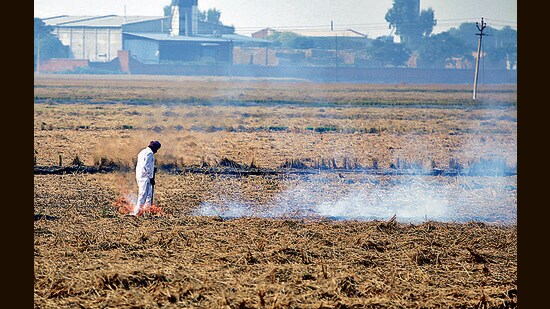
The SP said that the police teams have visited villages under Uchana, Garhi and other police stations to inform people about the hazards of stubble burning , despite that farm fire cases were reported from these areas.
“The policemen deployed there have failed to fulfil their duty. If similar incidents are repeated, strict action will be taken. We can’t take this issue lightly as the air quality index in the district has increased in the last week,” he added.
Paddy straw burning in Punjab and Haryana is one of the reasons behind the alarming spike in air pollution in the National Capital Region in October and November. As the window for rabi crop wheat is very short after the paddy harvest, farmers set their fields on fire to quickly get rid of crop residue for sowing of the next crop.
On Friday, Jind deputy commissioner Mohammad Imran Raza had announced closure of physical classes for students studying in classes 1-5 till further orders. Jind has witnessed a surge in AQI and on several occasions, the district’s AQI was reported highest in the country. Earlier this week, Fatehabad SP also placed four cops under suspension and issued notice to 23 others for negligence in preventing stubble burning.
According to the Central Pollution Control Board data released on Sunday, Haryana’s Bahadurgarh (in Jhajjar district) fared the worst on CPCB’s daily Air Quality Index value of 439 in the severe category. It was followed by neighbouring Sonepat with the index value at 369 (very poor), Bhiwani 317 (very poor), Fatehabad (309) and Gurugram’s AQI stood at 301. Palwal’s AQI is recorded best in the state with index value at 82 (satisfactory level). As per CPCB’s bulletin, the AQI in Jind stood at 273 (very poor category).
{{/usCountry}}According to the Central Pollution Control Board data released on Sunday, Haryana’s Bahadurgarh (in Jhajjar district) fared the worst on CPCB’s daily Air Quality Index value of 439 in the severe category. It was followed by neighbouring Sonepat with the index value at 369 (very poor), Bhiwani 317 (very poor), Fatehabad (309) and Gurugram’s AQI stood at 301. Palwal’s AQI is recorded best in the state with index value at 82 (satisfactory level). As per CPCB’s bulletin, the AQI in Jind stood at 273 (very poor category).
{{/usCountry}}Meanwhile, Delhi’s most toxic fortnight of the year — the November 1 to 15 stretch that has historically produced the Capital’s foulest air — has logged its lowest average air quality index (AQI) in three years. Yet the city has continued to breathe air that is overwhelmingly in the “very poor” to “severe” range. This year’s average of 349 is marginally lower than 367 in 2024 and 376 in 2023, and only a shade higher than 345 in 2022.
The CPCB data for this fortnight shows three “severe” days, 10 “very poor” days and two “poor” days. Last year, Delhi saw two severe days and 13 very poor days in the same period.
Dipankar Saha, former head of the Central Pollution Control Board’s air laboratory, said: “If winds pick up again, we can expect more very poor or even poor days instead of severe.”
.