Jalandhar/Bathinda: With a spike in stubble burning cases, the air quality in some Punjab districts has deteriorated to “poor” and “very poor” category.
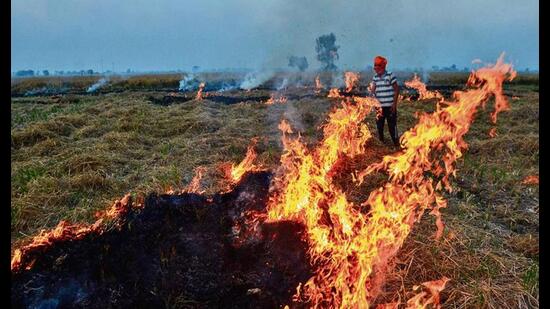
The state has recorded 9,594 stubble burning cases between September 15 and November 1. Residue burning data for November 2 was unavailable till the filing the report.
Patiala remained the most polluted with air quality index (AQI) at 307, followed by Bathinda at 303, which fall in “very poor” bracket.
Mandi Gobindgarh recorded AQI level of 299, followed by Khanna 255, Jalandhar 220, Rupnagar 215 and Ludhiana 214, all in “poor” bracket. Amritsar was placed better with AQI of 166, which is in “moderate” bracket.
Smog engulfed several parts of the state, particularly the southern districts, where the paddy harvesting is in full swing.
PPCB chairman Adarshpal Vig said that according to the Punjab Remote Sensing Centre (PRSC), the report on active fires in Punjab has been delayed. “Data has not been received from the National Remote Sensing Centre (NRSC), ISRO,” he said.
On November 1, Punjab reported 1,921 farm fires, the highest in a single day this season, taking the total incidents of stubble burning to 9,594.
According to the PPCB, overall cases of stubble burning were sown by 46% compared to corresponding period last year. The total cases reported in the state during the corresponding period till November in 2022 and 2021 were 17,846 and 14,920, respectively.
{{/usCountry}}According to the PPCB, overall cases of stubble burning were sown by 46% compared to corresponding period last year. The total cases reported in the state during the corresponding period till November in 2022 and 2021 were 17,846 and 14,920, respectively.
{{/usCountry}}Paddy straw burning in Punjab and Haryana is one of the reasons behind alarming spike in air pollution in the national capital in October and November. As the window for rabi crop wheat is very short after paddy harvest, farmers set their fields on fire to quickly clear off the crop residue for sowing of the next crop.
South Malwa dists account for 29% of total farm fires
The south Malwa region of Punjab is reeling under smog with seven districts of the belt accounting for 29% of farm fires in the state.
Visibility on the National Highway-7 (Bathinda-Patiala NH) and other state roads in the region remained poor for the fourth consecutive day on Thursday due to smoke from paddy fields.
Analysis of data generated by the Ludhiana-based Punjab Remote Sensing Centre (PRSC) and Central Pollution Control Board (CPCB) says air quality started deteriorating in Bathinda, the only monitoring station in southwest Punjab, since October 29 after spurt in paddy residue burning cases.
Satellite imageries of the PRSC captured 2,773 fire events in the seven Bathinda, Ferozepur, Moga and four other adjoining districts between September 15 and November 1.
Of these, 1,908 incidents or 69% of total cases were recorded since Sunday.
The CPCB data says in the last five days, Bathinda’s air quality index (AQI) plunged to the ‘very poor’ category thrice and remained ‘poor’ on two days since October 29.
Till November 1, Ferozepur has recorded 989 fire events, the highest from southwest Punjab, followed by Mansa (617), Moga (321), Faridkot (319), Bathinda (294), Muktsar (132) and Fazilka (101).
Agrometeorological data of the Punjab Agricultural (PAU) says that on Thursday, Bathinda had zero “bright sunshine hours”.
PAU agrometeorologist Raj K Pal said on Tuesday and Wednesday, the sunshine hours in Bathinda were only three hours against the average normal 8-9 hours.
“The region is engulfed under smog caused by rampant paddy residue burning. Partly cloudy sky is also to be blamed for hazy climatic conditions. Similarly, conditions are likely to stay for another two weeks,” added the expert.
Prof VK Garg of the department of environmental science and technology of Bathinda-based Central University of Punjab said the ongoing climatic condition has ample pollutants from different factors, including burning of crop residue, construction, industrial units and vehicular traffic.
“It is certainly smog as the visibility has turned low. The current climatic conditions are prone to respiratory problems among the elderly, children and asthmatic patients. The situation will subside after rains or strong winds,” he adds.