The Air Quality Index (AQI) crossed 400 and stayed in the severe range for about an hour before showing improvement at both continuous ambient air quality monitoring stations in Sectors 22 and 25, Chandigarh, on Diwali night.
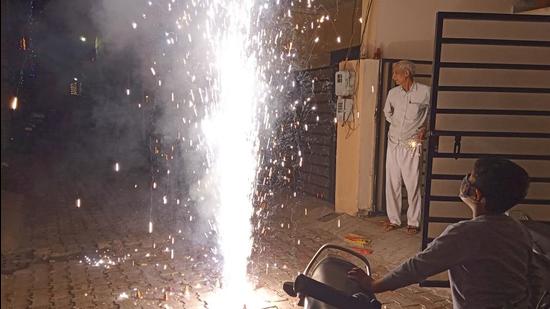
Meanwhile, the average AQI at all observatories across the city remained on the lower side on Thursday and it took just around four to five hours for the air quality to improve, according to data available with the Chandigarh Pollution Control Committee (CPCC).
The AQI was in the moderate range till 6pm on Thursday, after which it started rising. At Sector 25, it went up to 465 between 10pm and 11pm, the highest it has ever gone since this observatory was opened in 2019. After this, it remained in the very poor category and came down to satisfactory levels (below 100) around 2am on Friday.
At the other real-time data observatory in Sector 22, the AQI spiked to 409 between 9pm and 10pm. After this, it dropped to the very poor bracket for two hours and came down to satisfactory levels around 2am.
“This is the first time that the AQI went up to 400 on Diwali. However, weather-wise we were lucky as the pollutants cleared within a few hours,” said CPCC member secretary Debendra Dalai, adding that it was unfortunate that people had ignored the administration’s blanket ban on crackers.
{{/usCountry}}“This is the first time that the AQI went up to 400 on Diwali. However, weather-wise we were lucky as the pollutants cleared within a few hours,” said CPCC member secretary Debendra Dalai, adding that it was unfortunate that people had ignored the administration’s blanket ban on crackers.
{{/usCountry}}Due to the air getting cleared in a few hours, the average AQI also remained on the lower side as compared to previous years. At 115, it was lowest at Sector 25. It was highest at the observatories in Sector 39 (IMTECH) and Sector 12 (PEC), touching 207, though lower than that recorded last year.
“This doesn’t mean that less crackers were used this year. Last year, Diwali was celebrated on November 15, which was colder weather. Temperature inversion causes AQI to increase. Further, weather conditions helped clear the pollutants and the air quality was back to normal within a few hours this year,” said Dalai.
The department had also calculated the average AQI at all observatories on October 29 to get the AQI values for a normal day, and it was found that the index had dramatically increased between an average day and Diwali across all centres. The noise pollution also went up this year. The highest noise level was recorded at Sector 39 (78.2 dB). Last year, the highest noise level stood at 66.6 dB, at the observatory in Sector 22.