E-Paper



Battle of Panipat’s legacy: 500-year-old Kabuli Bagh Masjid stands tall
Built in 1526 AD, the mosque was built by Mughal ruler Babur to commemorate his victory over Sultan Ibrahim Lodhi of the Lodhi dynasty in the First Battle of Panipat in 1526


Surrounded by a large number of handloom-making units, narrow alleys and bustling houses, the 500-year-old Mughal-era Kabuli Bagh Masjid still stands tall in Panipat.
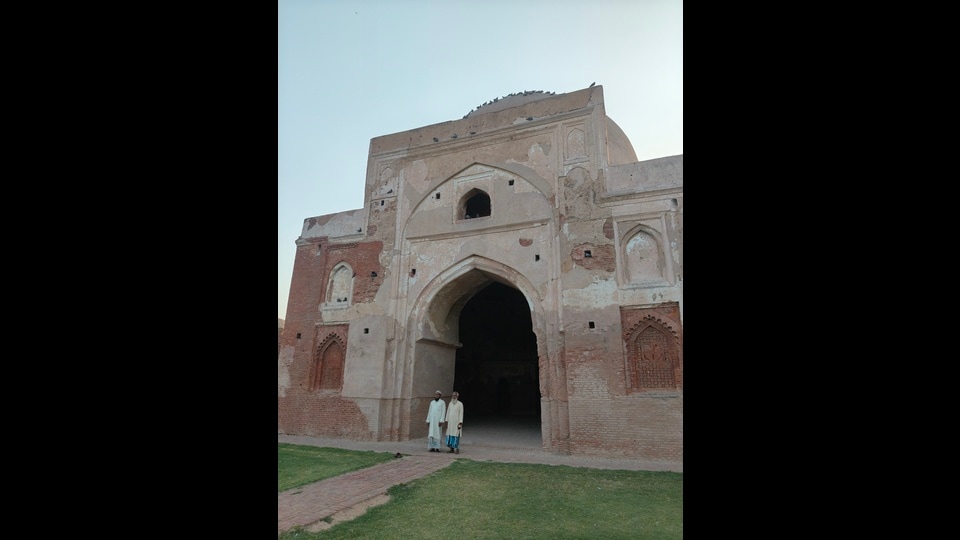
Built in 1526 AD, the mosque was built by Mughal ruler Babur to commemorate his victory over Sultan Ibrahim Lodhi of the Lodhi dynasty in the First Battle of Panipat in 1526. “Though the prayers at the monument remain shut for decades, the mosque is still preserving the memory of the battle which changed the course of India for years to come,” Ram Mohan Rai, an advocate and public historian, said.
It is said that Babur named the mosque after his wife Mussamat Kabuli Begum. According to the Archaeological Survey of India (ASI), the central prayer hall has its cells on either side of the mehrab, which is engraved with verses from the holy Quran.
Faizan Khan, an 18-year-old boy who just finished his schooling, frequently visits the mosque with his friends or relatives. “I come here and explain the history of the mosque to them. It is so inspiring to witness such a huge structure standing erect even after 500 years. For the last three-four years, the security has been strict here, otherwise, we could easily climb the wall to walk till the tomb and fly kites,” Khan said, while trying to translate Arabic verses inscribed in the main hall.
Hazi Kalimudin, an 82-year-old from Bihar’s Araria was visiting the mosque on Monday with his nephew Afzan Khan, who works at a local factory. “We’ve heard about Babur and his battle and were so amazed to see its memorial. Afzan told us that prayers are not allowed here, which is unfortunate,” the octogenarian said.
Standing next to him was Sameer Khan from Saharanpur, who nodded in agreement. “Rab ka ghar band karna galat hai, vo chahe kisi ka bhi rab ho (It is wrong to close the house of God, no matter whose God it is),” Sameer Khan said, who also works at a local handloom unit.
While pointing out some partially damaged structures and filthy sewer canals next to the mosque, Sameer Khan said,”I can see CCTVs, barbed wires and security guards, but there should have been more maintenance and cleanliness to preserve this heritage structure.”
However, 68-year-old Suraj Mal Dhiman, who lives in the next lane and comes to the mosque’s lawn for evening walk daily, disagrees with Sameer Khan. “I’ve been coming here for 15 years and have seen the mosque in its worst state. The place used to be a den of drug addicts, who would damage the structure from inside. Now, there are barbed wires on the newly built boundary wall and CCTVs. A security guard is on 24x7 vigil, without whose permission no one could enter the mosque. There have been maintenance works a few years ago, when a few unused areas were also closed to keep transpassers in check, but there is always scope for more,” he said.
Advocate Rai said that the victory over Lodhi was beyond belief for Babur, who asked his soldiers to bring his body for him. “As a mark of respect, he then built two graves for Lodhi and his loyal elephant, just two kilometers from this mosque. The place is called the Ibrahim Lodhi Tomb. These two places carry the memory of the First Battle of Panipat. During the 12th and 13th centuries, the town was the center of Islamic education. During that period, Bu Ali Shah Kalandar, a saint of Chishti order, also arrived. A 700-year-old tomb and a dargah in his name also exist,” he said.
Vijay Singh, head of history department at Arya PG College here, said, “The battle was decisive for Babur as victory here would mean, march forward to Delhi. Panipat was chosen as a suitable place for battle with Lodhi as there was a huge open area and availability of water source in the form of Yamuna River. The monument built in its memory carries huge relevance, but there has not been much documented history about it.”