
 E-Paper



Blessed hand feeds the snake
Anmol Arora is a young wildlife rescue and conservation activist, who goes to Perch dam every alternate day from his residence in Aerocity, Mohali; he helps and guides local youths from Perch village who are supplying tanker water to replenish waterholes for wildlife


The tragic devastation wrought by recurring droughts at Perch dam situated in the Shivalik foothills, behind the PGIMER, can best be symbolised through the fate of a water snake, the non-venomous checkered keelback. As highlighted in these columns of June 2 last, the dam has silted up so badly that its storage capacity cannot sustain water till the following monsoon. The cracked, silted surface of the dam is littered with the bones and skeletons of thirsty wild creatures. However, amid this gloom and doom, there was one of the keelbacks which managed to survive the drought for weeks by a display of sheer doggedness. When death was about to overwhelm the snake’s fierce will to survive, a helping hand reached out of the blue.
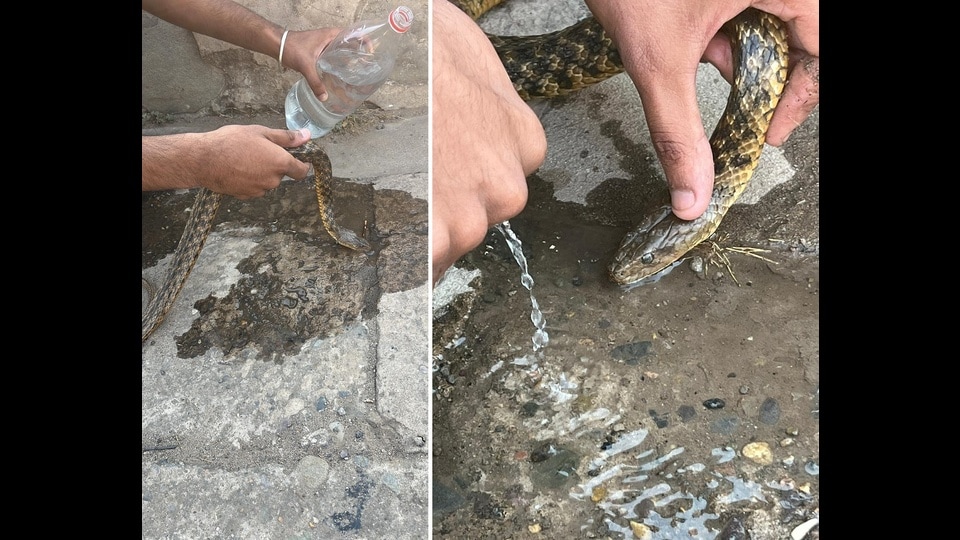
Anmol Arora is a young wildlife rescue and conservation activist, who goes to Perch dam every alternate day from his residence in Aerocity, Mohali, He helps and guides local youths from Perch village who are supplying tanker water to replenish waterholes for wildlife. “This emaciated snake had somehow managed to climb the steep Perch dam and reach its top. It was desperately looking for another natural water pool but there was none. From a distance, it looked like a piece of still, shrivelled wood. Its fat reserves were depleted and it was very thin across its four feet of length,” Arora told this writer.
Arora grasped the dying keelback and provided it with water from a bottle. “The snake drank for 10-15 minutes, its body filled up and its sagging skin turned elastic. Before drinking, the keelback was so low on energy that it did not typically flare its hood, hiss or bite my hand. But after it had its fill, it poked its tongue out to sense the environment and tried to bite me twice!” quipped Arora.
Arora procured two small fish from the market. The famished keelback relished the fish and gobbled both in 15 minutes. Arora then rehabilitated the keelback in the adjacent Jainti Mata dam, which retains plenty of water despite the harsh summer.
War memories & Kargil trees
The 25th anniversary of the Kargil War has opened a treasure trove of memories and recalls of the valiant officers and soldiers who fought on the towers of a barren, cold desert. Memories not just of blood, bullets and bravery but of sparse flora and fauna. The wild creatures on the heights fled due to relentless artillery shelling but the few trees had to stay put. Splinters felled animals and poisoned the snowy peaks with cordite but the trees were miraculously untouched.
Col Lalit Rai, Vir Chakra, was commanding the 1/11 Gurkha Rifles in the Batalik battles and saw an ibex tumbling from the Yaldor heights felled by shelling. He swears by the heroic though unsung effort of Ladakhi porters to ferry war loads from faraway road heads. “While moving from Yaldor to the Khalubar ridge for attack, I came across a porter lying under a tree. He smiled weakly at me and lifted his jacket. There was a bullet hole through his stomach. He assured me that the war effort would never be halted because of wounds to porters because many more of his comrades were waiting to shoulder the heavy loads of ammo/food. His face never leaves my memory, it haunts me. I always wonder, did he survive? I wish I could have done something for that brave porter under the tree,” Rai told this writer.
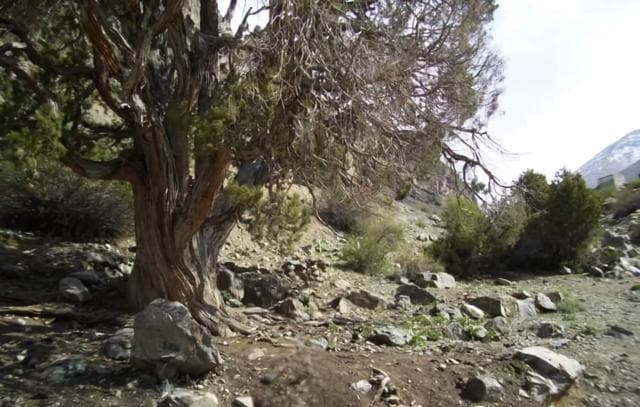
The 1 Bihar was in action on Jubar ridge and its second-in-command, Lt Col Bijoy Mukherjee, was a keen observer of flora and fauna. He had one of the very few cameras in possession of army officers deployed on the frontline. Mukherjee recalls an evergreen Juniper tree or ‘Shupka’ (declared the state tree of Ladakh in 2023) dominating the Ganasok landscape, its gnarled trunk reflecting its battle with the harshest of nature’s vagaries. The forward TAC HQs of 70 Infantry Brigade was located at Ganasok. “The Juniper is medicinal as well as a sacred one for the Brokpa tribes of Dah, Garkun and Darchiks villages. They used the leaves as medicine as well as to burn them and smear the ashes on their bodies for protection from bites and as an antiseptic,” Mukherjee told this writer.
An aromatic tree, the Juniper or Himalayan pencil cedar hosts insects, birds and rodents but is over-exploited for cultural, religious and commercial purposes.


