The UT estate office demolished Adarsh Colony, an illegal settlement spread across Sectors 53 and 54, under its ongoing slum-free campaign on Thursday. It was the second last remaining slum in the city. The colony, which came up nearly two decades ago on approximately 12 acres of government land, housed around 1,000 shanties. The estimated value of the reclaimed land is ₹480 crore.
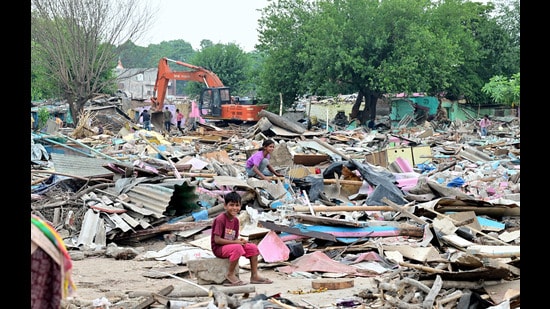
The land, acquired by the Chandigarh Administration in 2002, is part of the city’s master plan and will now be integrated into Sector 54 where residential plots are proposed to be developed.
The demolition drive began at 6.30 am and continued until 10.30 pm. However, the operation was halted for nearly four hours after some occupants filed a writ petition in the Punjab and Haryana high court (HC) on Wednesday. The hearing was scheduled for Thursday morning and after the court dismissed the petition, the drive resumed at 2.30 pm and concluded by 5.30 pm.
To maintain law and order, around 1,000 police personnel were deployed at the site. Additionally, six ambulances, along with doctors and paramedical staff, were stationed to provide emergency medical support, if needed.
Established in 2002, Adarsh Colony was home to labourers, hawkers, industrial workers, daily wagers, sanitation workers and domestic helpers, many of whom worked in the nearby furniture market.
{{/usCountry}}Established in 2002, Adarsh Colony was home to labourers, hawkers, industrial workers, daily wagers, sanitation workers and domestic helpers, many of whom worked in the nearby furniture market.
{{/usCountry}}Now, only one slum area — Shahpur Colony in Sector 38 — is left in the UT. Spread over four acres, Shahpur Colony comprises about 300 shanties on encroached government land valued at ₹150 crore.
Deputy commissioner Nishant Kumar Yadav said, “This drive is not just about reclaiming land, but about sending a clear message that encroachments will not be tolerated. The reclaimed land will now be used in line with planned urban development goals.”
To curb future encroachments, the administration has assigned three to four sectors to each junior engineer, who is required to submit a weekly report on any encroachment activity in their respective areas.
The administration has been working to make Chandigarh slum-free since the early 2000s. In 2006, it launched an ambitious rehabilitation initiative under the Chandigarh Small Flats Scheme, earmarking 356 acres — nearly 20% of the city’s 2,811 acres of net vacant land — for the construction of 25,728 flats intended to house 23,841 families from 18 unauthorised colonies.
The identified families, comprising over one lakh residents, were required to pay a nominal monthly rent after relocation. However, delays and non-payment have resulted in significant outstanding dues.
In two months, the UT has reclaimed 28 acres as it razed Janta Colony in Sector 25 on May 6, reclaiming around 10 acres worth ₹350 crore. The site is now being earmarked for a dispensary, primary school, community centre and shopping area.
On April 24, over 1,000 makeshift structures were razed in Sanjay Colony, Industrial Area, Phase 1. The colony had been encroaching on nearly six acres of prime government land worth ₹300 crore.
In 2013, it razed Colony Number 5, followed by Colony Number 4 in 2022. Together, these two slums had occupied over 165 acres. Other demolished slums include Mazdoor Colony, Kuldeep Colony, Pandit Colony, Nehru Colony, Ambedkar Colony, Kajheri Colony and Madrasi Colony.