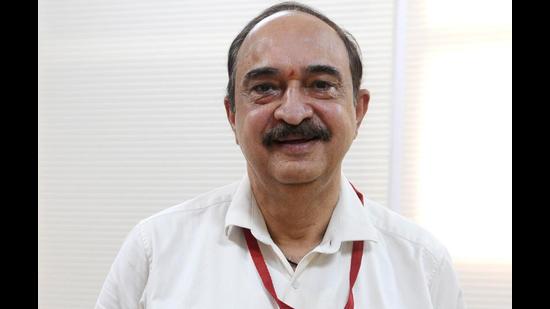
As the city braces for a third Covid wave, Hindustan Times talks to Dr G Dewan, the former director, health and family welfare, Chandigarh, who was at the forefront in fighting the first wave and helped administration during the second. Having spent 35 years in UT’s health department before his retirement in October 2020, Dr Dewan talks about his experience and challenges that lie ahead for the city’s health infrastructure.
Covid testing has always remained a concern. What should be done to increase testing before the third wave hits the city?
Testing of super-spreaders and asymptomatic people still remains a challenge, especially when new variants are spreading. The grassroots level health staff should reach every home in UT to test people.
What are the lessons for UT administration from first and second wave management?
Earlier, we were short on beds and ventilators, but Chandigarh is now self-sufficient in handling the third wave. However, there is always scope for improvement in any system. Efforts should be made to spread awareness among children about containing the spread.
How tiring Covid-19 has been for doctors? What should be done to boost their morale?
Not only the doctors, but the paramedics are also Covid warriors. Even though fresh manpower was added in hospitals, healthcare workers are now getting tired and fatigued. The staff should work in batches so that they have ample time to replenish their energy before getting into the third wave. This will avoid over-utilisation of manpower and they should also be given short rest to boost their energy levels.
{{/usCountry}}Not only the doctors, but the paramedics are also Covid warriors. Even though fresh manpower was added in hospitals, healthcare workers are now getting tired and fatigued. The staff should work in batches so that they have ample time to replenish their energy before getting into the third wave. This will avoid over-utilisation of manpower and they should also be given short rest to boost their energy levels.
{{/usCountry}}What are the challenges before frontline workers, especially doctors, as we gear up for the third wave?
We have to be over-alert now in view of the mutation of the virus. The quality and availability of protective tools should be assured by the institutes and be readily available in the market. Patients with mild to moderate symptoms should be sent to mini Covid-care centres so that beds are available for severe patients. Doctors and staff should be trained to use ventilators. Gaps need to be bridged proactively, which have been observed in the past.
Chandigarh recorded shortage of medical oxygen, ventilators and crucial drugs during the second wave. What steps need to be taken before the third wave strikes?
Chandigarh is well-equipped with oxygen, which is available through multiple modes. It is time to strengthen manpower. The city can be divided into zones where state-of-the-art 24x7 vaccination centres can be set up. Mobile vans can be sent to urban slums and colonies in the evenings and nights to cater to the daily wagers who are not available in day-time. Special education should be imparted to beggars and rag-pickers as they may be asymptotic super-spreaders. People should also cooperate with the administration and follow every guideline.