Tourism is one of the fastest-growing industries today. While it brings economic development and prosperity, it also poses a threat to the ecology and environment as has been witnessed recently in tourist centres of the Himalayas.
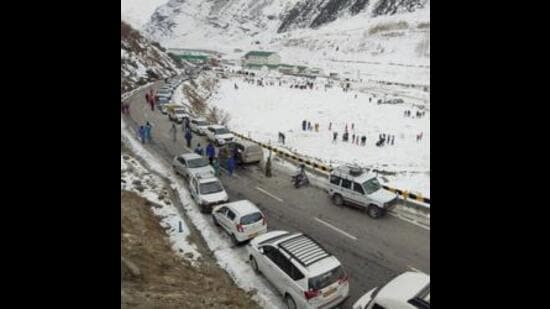
Among the destinations, Lahaul has recently emerged as the new hotspot. Tucked away in the mountains, Lahaul valley in Himachal Pradesh is a treasure trove of natural beauty, rich cultural heritage, and adventure opportunities, making it a paradise for travellers and thrill-seekers alike.
For centuries, Rohtang Pass at 13,000ft deterred travellers from venturing into Lahaul. However, that changed in October 2020 when the Atal Tunnel, the new gateway to Lahaul and Spiti, was thrown open, leading to a sudden, unprecedented influx of tourists. According to the October 2023 report of the statistics research department, the influx of tourists post-inauguration surged manifold, from 1.3 lakh visitors in 2019 to 7.4 lakh in 2022.
Rationalising tourist flow
In view of this rapid development, there is an urgent need to ensure that Lahaul with a population of only 19,083 is developed as a sustainable and responsible tourism destination, ensuring no harm to its pristine and fragile ecology and environment. It could become a model for eco-friendly and community-based tourism in the Himalayas.
To do so, there is a need to develop a master plan by bringing all stakeholders together to address concerns raised by local people. These include the need for carrying out a capacity assessment which can determine the maximum population size that an ecosystem can sustain without getting degraded. The evidence obtained can help rationalise the flow of tourists thereby ensuring traffic management and sustainable development.
{{/usCountry}}To do so, there is a need to develop a master plan by bringing all stakeholders together to address concerns raised by local people. These include the need for carrying out a capacity assessment which can determine the maximum population size that an ecosystem can sustain without getting degraded. The evidence obtained can help rationalise the flow of tourists thereby ensuring traffic management and sustainable development.
{{/usCountry}}Already, the local population is faced with nightmarish situations, particularly during the peak tourist season from April to early July, due to traffic jams and resultant vehicular pollution detrimental to the environment.
Rationalising the flow of tourists through a system of online passes as is done for vehicles heading to Rohtang Pass can be considered. Upgrading the condition of roads and construction of public parking places in a public-private partnership mode, are among the priorities.
Ensuring cleanliness
It is disappointing that even after three years since the Atal Tunnel was opened, one does not find signages along National Highway 3 in Lahaul to guide tourists coming to the valley for the first time regarding the distance to facilities, such as toilets, restaurants, petrol stations, etc, or to the next village or town. These are basic services routinely expected and provided elsewhere.
The plan must address cleanliness. Lack of toilet facilities along the highway is a shame. Tourists are often forced to relieve themselves in the open – an alien concept for Lahaulis as every house in the valley has been having a toilet for decades. Building toilets along the highway and maintaining them is the need of the hour. Collaboration with private players can be explored. All restaurants and dhabas ought to have toilet facility.
Littering plastic wrappers, empty tins and glass bottles besides cardboard packaging material has become a nuisance. Panchayats must impose hefty fines for such irresponsible behaviour.
As required by the Himachal Pradesh high court ruling, all tourist vehicles must carry plastic bags and dispose them of properly. Garbage bins installed along the highway must be cleared regularly. The tourism department and traffic police must collaborate in distributing pamphlets, listing dos and don’ts for visitors to Lahaul.
Installing solid waste management plants at a few places along with a mechanism for collection, segregation and disposal of waste generated both by tourists and the local population can help ensure the valley is not reduced to a garbage dump.
Engaging stakeholders
The local community has a vital role to play in welcoming tourists in the spirit of ‘Atithi devo bhava’, besides shaping experiences and perceptions of the place, thereby contributing to sustainable tourism. It should be at the heart of the tourism decision-making process. For this, the capacity of local residents can be built in hospitality-related skills, tourist management, and entrepreneurship. For encouraging rural tourism, homestays rather than hotels and resorts should be encouraged.
At the same time, tourists must be made aware of customary rights of the local community related to the area and its natural resources. They are expected to not only understand but also respect local values, traditions and cultural sensitivities.
For an enhanced tourist experience, the local administration must establish a tourism cell or department as a focal point in Lahaul. While the government alone cannot carry out all activities outlined above, participation and engagement of stakeholders is essential to make it a success. To ensure collaboration, a tourism development coordination committee with members representing each of the sectors should be set up. The local MLA could chair the committee with the deputy commissioner as its member secretary.
By implementing this plan, it is hoped that Lahaul will become a model of people-centric and eco-friendly tourism development in the Himalayas, benefiting both the local community and tourists alike.
narainjp88@gmail.com (Dr Narain is a former WHO director. Katoch is a tourism research scholar. Views expressed are personal.)