E-Paper



Punjab: Farmers on edge as rain, winds flatten wheat crop
Lodging reported across Punjab, Haryana as Met forecasts more rain. According to the IMD’s evening weather bulletin on Friday, light to moderate rain occurred at several places in Punjab and Haryana during the past 24 hours.


Persistent rain and gusty winds over the past 48 hours have flattened the wheat crop in several districts of Punjab and Haryana, leaving farmers concerned about their harvest.
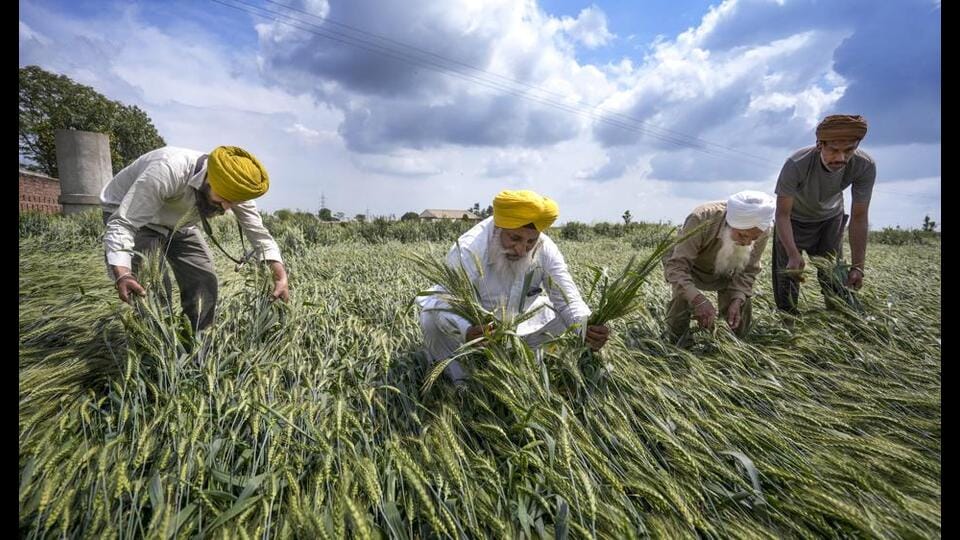
While the dip in mercury initially benefited the grain, the continuous downpour and gusty winds have become a cause for concern. The India Meteorological Department has predicted more rainfall in the coming days. The widespread rains attributed to the Western Disturbance come after a long dry spell. Over the past 50 days, from February 1 to March 15, there was a sudden rise in the temperature, leading to fears of the shrivelling of grain. The temperatures touched 33 degrees Celsius, 4 degrees above normal. Following a difficult paddy season, farmers fear a repeat of low yields as the grain begins to deteriorate and discolour due to the constant wet weather.
Field reports from villages in Sangrur, Patiala and Karnal in Haryana indicate widespread lodging, which experts believe can delay crop maturing and harvesting.
Five districts - Amritsar, Pathankot, Tarn Taran, Hoshiarpur and Ropar received an average of 9 mm rainfall on Thursday and on Friday. According to the IMD, Rohtak received 22 mm of rain in 24 hours until 8:30 am on Friday. Sonepat also received 19 mm of rain, and light showers were reported in Panipat (13.5 mm), Charkhi Dadri (12.5 mm) and Mahendergarh (12 mm). Yamunanagar received the most rain during the day (8:30 am to 5:30 pm), recording 14.5 mm on Friday.
In Punjab, the procurement annually opens in 1,872 mandis from April 1. This season, wheat was sown over 35 lakh hectares and 25 lakh hectares in Punjab and Haryana, respectively.
In Sangrur’s Laddi village, farmer Rajveer Singh, reported that nearly 20% of his 60-acre crop is already damaged, while Satnam Singh from Nagla village in Karnal rued the fact that the crop is yet to recover from the last rain spell and more water will spell trouble for the crop which is in maturing stage, in case of early varieties or at the grain filling stage.
Farmers in Patiala, Sangrur, Ludhiana and Bathinda said strong winds had already affected parts of their fields. “The crop will be ready in the coming weeks. If it lodges now, harvesting will become difficult, and grain quality may deteriorate,” said Pragat Singh, a farmer from Patiala.
Met issues fresh Western Disturbance alert
According to the IMD’s evening weather bulletin on Friday, light to moderate rain occurred at several places in Punjab and Haryana during the past 24 hours, accompanied by thunderstorms and gusty winds.
MeT data shows that the average maximum temperature in Punjab dropped by 1.3°C compared to the previous day and remained markedly below normal by 6.6°C. The highest maximum temperature recorded in the state was 24.1°C in Ferozepur, significantly lower than typical March conditions. In Haryana, the average maximum temperature dropped by 5.7°C on Thursday.
Adding to farmers’ concerns, the MeT department has released a fresh Western Disturbance alert likely to affect northwest India from March 22 onwards. Under its influence, light to moderate rain is likely at isolated locations on March 22, 23, 25 and 26, while weather is expected to remain dry on March 21 and 24.
The forecast also indicates no significant change in maximum temperatures over the next 24 hours, followed by a gradual rise thereafter—offering some hope of recovery if dry conditions prevail.
Cold condition beneficial for crop: Experts
Officials, however, maintained that no major crop damage has been reported so far. Punjab agriculture department director GS Brar said field staff are monitoring the situation closely.
“Our officers have been in the fields over the past two days. There has been no major damage to the wheat crop in the state so far. In fact, cool temperatures will not have an impact, but prolonged rains accompanied by strong winds can lead to lodging of the wheat crop,” he said.
Punjab Agricultural University (PAU), Ludhiana, vice-chancellor SS Gosal said the wheat crop is currently in the grain-filling stage, and lower temperatures could be beneficial; however, strong winds lead to lodging.
“Prolonged low temperatures may delay the ripening of the wheat crop and can improve yield. At this stage, moisture also plays a crucial role,” Gosal added.
Sangrur chief agriculture officer Dharminderjit Singh and Jalandhar chief agriculture officer Jaswinder Singh said light to moderate rainfall will have a negligible impact on the crop. “No loss has been reported so far,” they added.
Ratan Tiwari, director of the Karnal-based ICAR-Indian Institute of Wheat and Barley Research (IIWBR), said the institute has issued an advisory asking farmers to ensure proper drainage in fields.
“Rain is beneficial for both the early sown variety, which is in the maturity stage and the late sown variety, which is in the grain filling stage. We have issued an advisory asking farmers to ensure proper drainage to avoid waterlogging and possible damage to the crop,” he added.
Punjab seeks ₹27k-crore for procurement
The Punjab government has sought ₹27,000 crore for the procurement of the wheat crop, which, as per the state’s food and civil supplies department, has been scheduled to start from April 1. Haryana also starts procurement around this time.
The department is anticipating the arrival of 122 lakh tonne of wheat in the mandis, and the commission for agricultural costs and prices (CACP) has fixed the minimum support price at ₹2,585 per quintal.
Last year, 129 lakh tonne wheat arrived in the mandis, and 118 lakh tonne was procured by the state agencies and nearly 11 lakh tonne by the private traders.