A tinge of surprise, and welcome relief in its wake, was discernible in the overall exultant mood that greeted the first kills by Namibian cheetahs released in India. The imported Cheetahs were hungry and killed cheetals, which are not found in Namibia. The imported Cheetahs had received no training or familiarisation with Indian conditions prior to their release in large enclosures at Kuno (MP). However, surprise would have been less pronounced had the media acquainted itself with the history of African cheetahs in India.
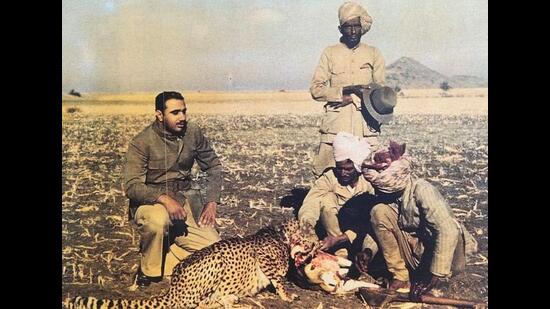
From 1918 to 1945, an estimated 200 cheetahs were imported by princes for the blood sport of coursing lack bucks and other game.Cheetahs were shipped from Africa on a 15-day journey without tranquilisers or antibiotics. They underwent training without putting up much of a cantankerous reluctance and were not in any manner substantially different from Indian cheetahs trained by princes. Upon contracting feline maladies, the imports were treated not with Western medicines but with indigenous medicines / remedies (just as ailing Indian cheetahs were). The imports adapted remarkably and brought down non-African game in sub-continental habitats.
Their kindred nature lies in the fact that African cheetah DNA is not markedly different from Asiatic cheetahs. In his scholarly, historical work, The End of a Trail: The Cheetah in India, Divyabhanusinh lends us a comparative framework and thus a positive augury for the contemporary introduction of Namibian Cheetahs. He challenges those claiming the Kuno project (inaugurated by PM Narendra Modi) is doomed. Citing Gwalior State’s records of 1920, Divyabhanusinh points out that the same wilderness area then held 50 Indian Cheetahs. So, Namibian cheetahs have a fighting chance of striking roots.
On royal patronage, his book is rich in detail. Bhavnagar State (Gujarat) imported a Cheetah from Africa at a landed cost, Bombay, of Rs.1,000 in 1945, leading its ‘Cheetah Prince’, the late Nirmalkumarsinh, to remark that hunting with trained Cheetahs was solely a prerogative of kings. Its expenditures exceeded the prohibitive costs footed by the nobilities since ancient times to indulge in falconry, reckoned also as a ‘sport of kings’.
{{/usCountry}}On royal patronage, his book is rich in detail. Bhavnagar State (Gujarat) imported a Cheetah from Africa at a landed cost, Bombay, of Rs.1,000 in 1945, leading its ‘Cheetah Prince’, the late Nirmalkumarsinh, to remark that hunting with trained Cheetahs was solely a prerogative of kings. Its expenditures exceeded the prohibitive costs footed by the nobilities since ancient times to indulge in falconry, reckoned also as a ‘sport of kings’.
{{/usCountry}}It took 6-12 men to train a Cheetah. Baroda State records reveal four Cheetahs maintained in 1924 entailed annual maintenance of Rs.10,176. Kolhapur State’s 11 Cheetahs cost Rs. 28,000 in 1921. The diet was mutton of impeccable quality and included ‘pedas’ and butter as inducements to calm the big cat while hunkered down in a jungle ambush on a moonlit night! Bhavnagar and Wankaner princes clocked bucks running at 88-90 kmph and assessed their Cheetahs attained comparable or more speed. On occasion, a fierce, die-hard buck would turn on its African tormentor, launching a counter-attack with long, pointed horns.
Sarfrazuddin Malik, who hunted and trained on raptors with Pathan shikaris in service of Bhavnagar’s royalty, recalled a hunt. An unwitting Parsi gentleman had joined in as Nirmalkumarsinh’s guest. “The royal Cheetah brought down a Black buck and the shikari rushed forward to ‘halal’ the throat of the buck. The Cheetah was rewarded with a feed of fresh, surging buck blood. The buck’s hind leg was sawn off and fed to the Cheetah. Buck blood flew in fountains. The Parsi gent, unable to digest the blood sport’s denouement, fainted leaving the princely pursuit with an unusual victim!” recalled Malik.
vjswild1@gmail.com