Navratri heralds the onset of the festival season with celebrations held across the length and breadth of India. Over the nine days of Navratri, the devi (goddess) is celebrated in all her nine forms. However, how many of us pause to ponder upon the significance of these nine days of prayer and celebration?
It is said that Goddess Durga finally annihilated the demon Mahishasura on Dussehra after he stalked her for nine days. Lord Rama also vanquished the demon king Ravana on Dussehra, so the day signifies the victory of good over evil.
I have always marvelled at the scientific timing of the biannual Navratri festival as the Shardiya Navratri comes during the transition of summer into winter, and Chaitra Navratri is just the opposite. As we live in the modern world, let us think of it this way, one goes to hill stations or the beach for a holiday to get a break from the mundane chores of daily life so that one may rejuvenate oneself physically and mentally. Similarly, the Navratri festival is placed in the lunar calendar in such a way that it gives one an opportunity to rejuvenate oneself on a different plane.
Navratri gives us the opportunity to connect with the Divinity within us and cleanse and detoxify our bodies. Just as we need to get our cars serviced from time-to-time so that they may function smoothly, we also need to revitalise our body and mind. As the Earth turns on its axis and the seasons change, the body needs to detoxify to prepare for the next season. These days visiting a dietician to lose weight and detoxify the body is in vogue. Most professionals prescribe a gluten-free diet, lots of fruits, juices, grains and millets. Navratri food is just that! It includes fruits, milk, curd, kuttu ke aate ki roti (buckwheat flour), singhare ke atte ki roti (water chestnut flour), swank ke chawal (barnyard millet), chulai (Amaranth), and sabudana (tapioca pearls) , all of which are gluten-free, alternate grains. And, the cherry on top is that all food must be cooked with sendha namak (rock salt), a known detoxifying agent! This has been a biannual practice from times immemorial.
{{/usCountry}}Navratri gives us the opportunity to connect with the Divinity within us and cleanse and detoxify our bodies. Just as we need to get our cars serviced from time-to-time so that they may function smoothly, we also need to revitalise our body and mind. As the Earth turns on its axis and the seasons change, the body needs to detoxify to prepare for the next season. These days visiting a dietician to lose weight and detoxify the body is in vogue. Most professionals prescribe a gluten-free diet, lots of fruits, juices, grains and millets. Navratri food is just that! It includes fruits, milk, curd, kuttu ke aate ki roti (buckwheat flour), singhare ke atte ki roti (water chestnut flour), swank ke chawal (barnyard millet), chulai (Amaranth), and sabudana (tapioca pearls) , all of which are gluten-free, alternate grains. And, the cherry on top is that all food must be cooked with sendha namak (rock salt), a known detoxifying agent! This has been a biannual practice from times immemorial.
{{/usCountry}}If you sow barley seeds as khetri in your house in Navratri, it ensures that you stay in town and do not travel.If you fast (not feast), you are able to detox. If you follow a prayer routine, you end up filling your day with positivity.
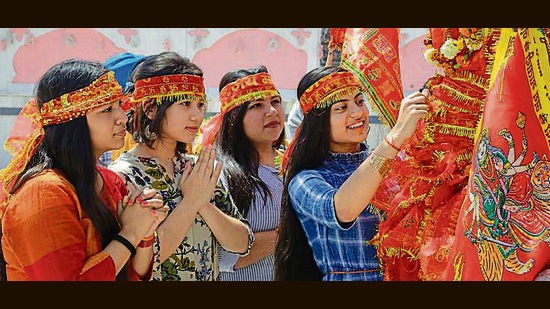
The kanya poojan on ashtami or navami is a reminder to value the girl child. Perhaps our ancestors foresaw that the girl child would be endangered in our society at some stage, so they introduced a ritual, which involves worshipping girls as miniature goddesses twice a year during Navratri. Each year, we invite kanyas/kanjaks to our home, wash their feet with water, apply tilak on their forehead, tie a roli on their wrists, and serve them a feast of halwa-poori-chanaand.
This time during Kanyapoojan, do remember that the girl child is as precious as the boy. God made everything in pairs for a purpose. He made day and night, summer and winter, hot and cold and he made boys and girls! The devi is the better half of ardhnarishwar. Let’s play our roles with acceptance and grace.
priyatandon65@gmail.com
(The writer is a Chandigarh-based freelance contributor)