
 E-Paper



Gujjar youth brave chill to protest scheduled tribe status to Paharis
The march started in Kupwara and will be culminating in Kathua, the J&K border district with a good concentration of Gujjars


Srinagar: For the past 15 days, a group of Gujjar youth have braved chilly conditions and rains to continue their march on foot to oppose the government’s decision to provide scheduled tribe (ST) status to the Pahari community.
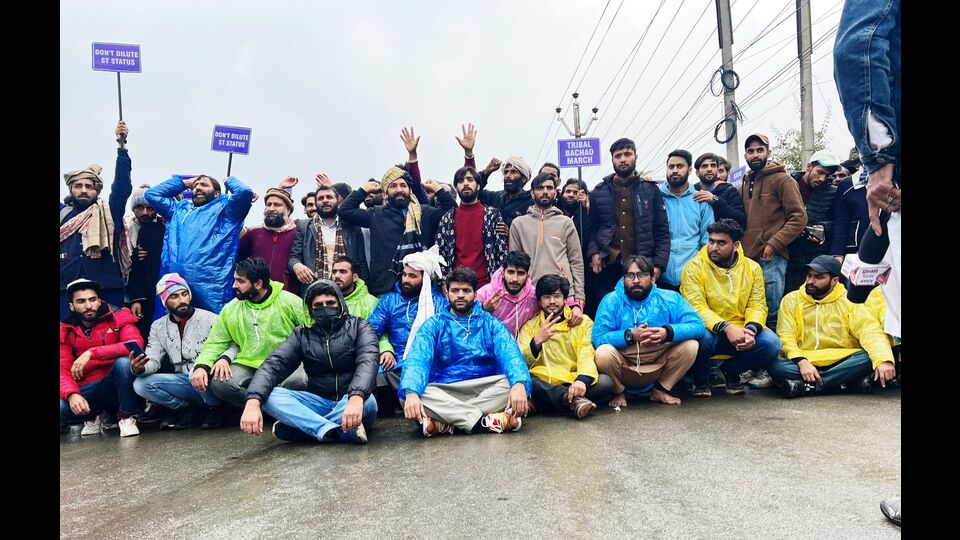
The march started in Kupwara and will be culminating in Kathua, the J&K border district with a good concentration of Gujjars.
“We are fighting for the rights of the marginalised community whose members are the most backward people in the entire UT. We don’t want our status to get diluted by giving the same status to the Paharis who are well off,” said Zahid Parwaiz, the vice president of the joint action committee for Gujjars and Bakarwals.
“Our march has reached Surankote, and from Tuesday, we will start our foot march,” he said adding that it will take them 15 days to cover all the ten districts of Kashmir.
The announcement to grant tribal status to Paharis was made by Union home minister Amit Shah during his public rallies at Baramulla and Rajouri last month. Thousands of members of the Pahari community attended those rallies with the hope that the community will get the coveted ST status.
Since then, Gujjars, who got this status in 1991, are feeling disheartened. Though, BJP leaders have tried to clarify that giving ST status to Paharis won’t affect the prospects of Gujjars living in J&K.
The census of 2011 put the number of Gujjars around 15 lakh (12%). The community members, however, said the census was done in summers when half of the community is in meadows and pastures on the mountains. “We are more than 25 lakh of the population in J&K, and if political parties neglect us, our community can show them the results. We are hopeful our march will be successful and the government won’t extend ST status to Paharis, who don’t deserve this and belong to upper castes,” said Guftar Chowdhary, a social activist and head of the publicity wing.
Both Paharis and Gujjars live in different parts of J&K, especially in remote areas. However, Gujjars, a majority of whom still earn their livelihood from rearing cattle and sheep, are considered among the marginalized community in J&K for decades. The granting of ST status to the community has helped the community to improve their lives. “Our protest will go on till government clarifies about ST status. Ours is a strong voice and the community can even show this in elections if our concerns are not addressed,” Chowdhary said.
Though the march is led by young volunteers of the community, however, more and more people from the community are getting attracted towards the march, especially in the areas where the community has a good presence.
“Many of our volunteers have fallen ill while taking part in the march due to extreme weather conditions. We will continue to lead our march, protest until we will get justice,” said another volunteer.
Javaid Rahi, a tribal researcher, said that initially, they thought that the march won’t be successful as only youth were involved in this but it is generating a massive response. “The Gujjar community is based on one ethnic group while Paharis are based on 56 ethnic groups. The Gujjars fear if Paharis get the ST status, this in a way means the entire J&K will get it. So they are protesting against that.”
Political analyst, Javeed Ahmad said this march could be an awakening for the Gujjar community. “If the protests continue and the entire community gets mobilised the community could impact results on 12 to 15 assembly constituencies.”


