It took around 35 days to residents of Rajthal village of Hansi district to put 99% check over the drug peddlers in their village, where a group of elderly men unite to guard the village’s main road with round the clock ‘thikri-pehra’ to ensure that no-drug supplier could enter the village.
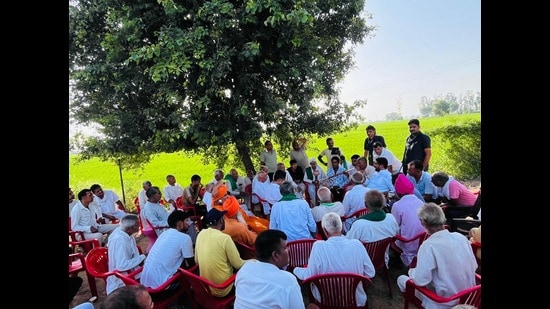
Wearing white kurtas and turbans and sitting on chairs, the villagers have been keeping a round the clock vigil for the past 44 days so they could wash away the tag “druggie Rajthal” from the village name, which was earlier known for the trade of milk and milk products.
The villagers use a police barricade with a banner on it carrying a stern warning: any person found carrying or selling drugs will be penalised with ₹1 lakh fine and a police case; those found helping the peddler will also get the same treatment.
The 24-hour community vigil has now become the village’s first line of defence against drugs. While the elders mark their attendance in the day, young boys keep the watch at the night as their number keep fluctuating to around 20 to 30.
Renu Bala, sarpanch of Rajthal village, told HT that the decision to set up checkpoints on both sides of the Jind-Hansi Road passing through the village was taken at a gram panchayat meeting on August 23. “The decision to set up ‘thikri-pehra’ was taken after repeated appeals to the local authorities did not yield required results. The checkpoints were put in place on August 26,” she said.
{{/usCountry}}Renu Bala, sarpanch of Rajthal village, told HT that the decision to set up checkpoints on both sides of the Jind-Hansi Road passing through the village was taken at a gram panchayat meeting on August 23. “The decision to set up ‘thikri-pehra’ was taken after repeated appeals to the local authorities did not yield required results. The checkpoints were put in place on August 26,” she said.
{{/usCountry}}“The villagers wanted to get rid of the tag of a ‘drug hub’ attached to Rajthal. We had been suffering because of the increasing supply of drugs and the growing number of addicts in the village. Many of them also became involved in thefts. Around 300 tubewell wires were stolen in the area,” Bala said.
Anil Godhra, a resident, said the initiative had produced a visible impact within weeks. “In the first week, we stopped and checked around 400 people. The number fell to around 100 in the second week, 20 to 30 in the third week and five in the fourth week. This week, we have not found a single person coming into the village to buy drugs,” he said.
Another villager, Satbir Singh Yadav, said residents were now planning to set up a third checkpoint on another link road leading into the village. “There are reports that some people may try to enter through the link road after seeing the strict checking on the main roads,” he said.
Joginder Singh Maan, another elderly resident, said the villagers had also installed CCTV cameras at crucial points with the support of the gram panchayat. The villagers also met Hansi superintendent of police (SP) Vinod Kumar and sought strict action against those allegedly involved in drug peddling in the area.
Following the villagers’ concerns, Hansi police launched a special anti-drug drive in Rajthal village on September 23 and a team of around 150 police personnel conducted a door-to-door search operation, carrying out nearly 21 raids across the village.
The operation resulted in the arrest of 10 people allegedly involved in drug supply, while four FIRs were registered under the Narcotic Drugs and Psychotropic Substances (NDPS) Act.
During the operation, police recovered seven litres of illicit liquor, 2.5kg of ganja and 133mg of heroin, SP Vinod Kumar said. “Around 58 people were questioned during the drive. Police also booked locals Shamsher and Ramkumar under the NDPS Act and action was subsequently taken against their properties including demolition of allegedly illegal structures,” the SP said.
“As part of efforts to maintain a sustained police presence and prevent drug-related activities, two police check-posts have also been established in Rajthal village,” he added.