The Haryana government’s ambitious free tablet scheme, under which nearly five lakh devices worth ₹620 crore were distributed to Class 10 and 12 students in 2022, appears to have failed to deliver its intended impact on digital learning.
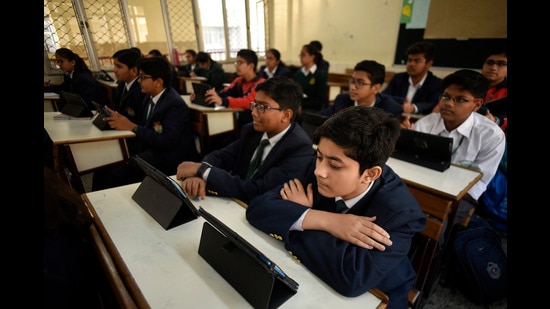
The 8.7-inch tablets, each costing around ₹12,500, were distributed with much fanfare by then chief minister Manohar Lal Khattar under the e-Adhigam (Advance Digital Haryana Initiative of Government with Adaptive Modules) programme. Over 30,000 teachers from more than 3,300 government schools were also provided with the devices.
Four years later, a large number of tablets loaded with Personalised Adaptive Learning (PAL) software are lying unused in cupboards due to lack of internet connectivity, technical glitches, poor battery performance, physical damage and the absence of a reset mechanism.
Initially, students were given free tablets along with 2 GB daily internet data through Airtel or Reliance Jio SIM cards. The state government spent around ₹57 crore on internet services to enable students from economically weaker sections to access video lectures, digital textbooks and online assignments. However, the internet facility ended last year, forcing students to depend on school WiFi—where available—or their own mobile data at home.
A government school teacher from Ambala said several applications on the tablets had stopped functioning. “Apps for homework are not working and show errors. Earlier, SIM cards with internet were provided, but now students have to rely on WiFi at schools or data services at home,” she said.
{{/usCountry}}A government school teacher from Ambala said several applications on the tablets had stopped functioning. “Apps for homework are not working and show errors. Earlier, SIM cards with internet were provided, but now students have to rely on WiFi at schools or data services at home,” she said.
{{/usCountry}}A teacher from a senior secondary school in Karnal said that the tablets were earlier linked to the AVSAR portal for monitoring, but frequent glitches have forced schools to update records manually. “During the non-functioning of the portal, there is no effective monitoring. In some cases, previous students had applied screen locks which the new batch cannot undo as there is no mechanism to reset the devices,” he said.
The tablets were preloaded with textbooks, PDFs, video and audio material, along with assessment and testing tools introduced to promote e-learning in the aftermath of the Covid-19 pandemic. Educational apps such as e-Pathshala, NORER, NCERT solutions and free learning resources for competitive exam preparation were also included.
However, several teachers told HT that many students began using the tablets for social media and accessing objectionable websites.
PM Shri Government Senior Secondary School, Karnal, principal Anita Rani said complaints from parents led to the collection of devices. “We received several complaints that children breached security codes and misused the tablets, spending most of their time on YouTube or social media. This defeated the purpose of the scheme, and as per orders, all devices were collected,” she said.
Karnal district education officer (DEO) Rohtash Verma confirmed receiving reports of damaged tablets and misuse. He said that, following government directions issued in December, data is being compiled on the number of tablets in the district and their current condition.
Sumit Mann, nodal officer of the e-Adhigam programme in Karnal, said that of the 31,869 tablets distributed in the district, only 22,301 are currently functional. “The rest are either damaged, non-operational, lost or taken by students and not returned. The data has been uploaded on the MIS portal, and we are expecting revival of the damaged devices soon,” he said.
Sources in the education department said the internet service was provided for three years from 2022, and after a gap of nearly a year, the government is working on restoring free connectivity. In the 2025–26 budget, ₹25 crore was allocated for internet services, with a proposal to reduce daily data usage from 2 GB to 1 GB per student.
Officials also said the government is considering allocating funds for annual maintenance charges (AMC) for the devices, though neither proposal has been implemented so far.
Meanwhile, Congress state president Rao Narender Singh criticised the government, calling it an “uncalled waste of money”. “If a scheme is implemented for the betterment of students’ education, there should have been a proper system in place. The entire episode raises questions about the quality of the tablets and the intent of the government,” he said.
“What is the utility of these e-tablets when schools are functioning and students are regularly attending the classes? The scheme was started when the Covid had disrupted the functioning of the schools,” an education department functionary privy to discussions on this matter at political level said.
Sources say the education department is now mulling a proposal to give the gadgets to those preparing for competitive examinations.