E-Paper



Haryana’s NIPUN mission catches fancy of global educators again
Policymakers from 10 countries and reputed global institutions like University of Cambridge visit govt primary schools

 Prefer HTon Google


Haryana’s flagship primary school education reform programme has again attracted global attention as policymakers, curriculum experts and researchers from 10 countries spent a day with government school teachers, students and parents to study the impact of creatively introduced changes in foundational learning.
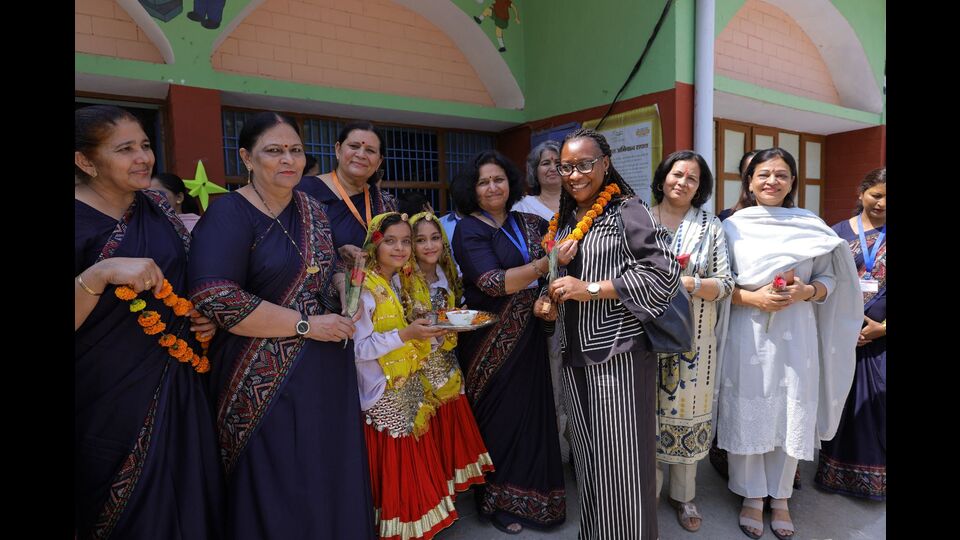
The visit took place on Wednesday under the School System Leadership (SSL) symposium and brought together representatives from Tanzania, Nigeria, Nepal, South Africa, Kenya, Rwanda, Ghana, the United Kingdom and Ireland. The delegates wanted to know how — NIPUN Haryana Mission — is improving foundational literacy and numeracy in government schools.
The participants also included officials from NCERT, education ministries, national curriculum bodies and institutions such as the University of Cambridge; Blavatnik School of Government at Oxford University; British Council and India’s national assessment body PARAKH (Performance Assessment, Review, and Analysis of Knowledge for Holistic Development).
The National Initiative for Proficiency in Reading with Understanding and Numeracy (NIPUN) is a nationwide mission aimed at ensuring all children achieve foundational literacy and numeracy (FLN) by the end of Class 3. Nipun Haryana Mission, launched in July 2021 under the National Education Policy (NEP) 2020, is designed to equip primary school students with essential foundational skills. NIPUN Bharat focuses on strengthening literacy in Hindi and English alongside numeracy skills.
According to Parmod Kumar, state programme officer of NIPUN, Haryana has set a benchmark in foundational learning through a strong educational foundation for future generations.
Jeetinder Joshi, joint director (administration), Haryana elementary education, said that delegates were divided into eight groups and sent to eight government primary schools in Jhajjar, Gurugram, Rohtak and Sonepat, where they observed classroom practices and programme implementation on the ground and interacted with teachers, students and the parents as well.
“The visitors were informed in detail about Haryana’s structured pedagogy model, which forms the backbone of the NIPUN Haryana Mission,” Joshi said, adding that teachers gave demonstrations using Activity-Based Learning (ABL), a child-centric method that encourages participation, interaction and hands-on learning in early grades.
Kumar said that the delegates, comprising 45 members, also took impromptu tests of the students and were impressed. He said the delegates expressed keen interest in understanding how education is funded in government schools, who writes the textbooks and how the curriculum is decided.
The visitors were informed how, unlike traditional teaching methods that depend heavily on individual teacher styles, structured pedagogy follows a carefully designed learning sequence supported by detailed teacher guides, student workbooks and standardised teaching-learning materials.
The visitors in a video message noted that teachers appeared confident and well-prepared with clear objectives.
Bridging learning gaps
The officials said that one of the key highlights of the visit was the Classroom Readiness Programme, which is implemented at the beginning of the academic session. The programme helps children reconnect with learning through structured activities designed to build engagement, strengthen basic skills and prepare students for grade-level instruction.
The Haryana education department officials accompanying the delegation said that the NIPUN Haryana Mission focuses on ensuring that every child achieves basic reading and numeracy skills at the primary level, which is considered the foundation for all future learning.
“The delegation also showed interest in Haryana’s continuous assessment system,” said Kumar, explaining that instead of relying only on annual examinations, teachers regularly assess students’ learning levels and immediately provide additional support to children who fall behind.
“This approach allows schools to identify learning gaps early and implement targeted remedial strategies.”
The state programme officer of NIPUN said that the delegates of Tanzania, Nigeria, South Africa, Kenya, Rwanda, and Ghana were particularly interested in taking along the English module, English textbooks, teacher guide and other modules which were given to the delegates along with other teaching material.
Data-backed reforms
The delegates were also taken through how the NIPUN Haryana Teacher App provides lesson plans, classroom guidance and assessment tools directly to teachers. The Parents App, which connects families with schools by sharing information about children’s learning progress, attendance and academic development, was also discussed. Officials said this App has strengthened home-school communication and increased parental involvement in education.
The visitors wanted to know about Haryana’s real-time monitoring dashboards. The officials quoted above said that delegates working in national education ministries and assessment bodies expressed interest in understanding how classroom data is collected, verified and translated into an action plan.
Joshi and Kumar, two senior state education officials, who also gave a presentation to the delegation, said that Haryana’s education reforms are driven by data-backed planning, continuous teacher capacity building and strong administrative oversight.
The latest visit adds to a growing list of international delegations that have travelled to Haryana in the past few years to study the programme. Education teams from more than 18 countries have already visited the state’s government schools.
Earlier, a coalition of eight African nations working to improve school education had sent a special mission to understand how Haryana redesigned foundational classrooms. Sri Lanka had also dispatched education experts to observe the structured pedagogy model Haryana has implemented.